
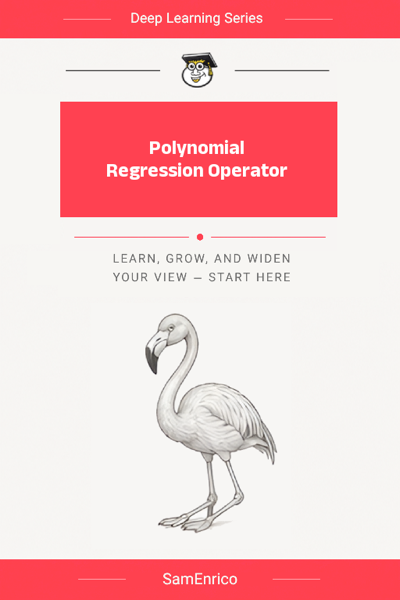
Non-FictionInformativeEducational
Polynomial Regression Operator
A Coursebook on Polynomial Regression Operator
A Coursebook on Polynomial Regression Operator
Formats
About this book
Free sample
Chapter 1: The Regression Riddle...--–- Every first-year statistics student learns to draw a line through a scatterplot. Few are told that they are already doing operator theory. This chapter dismantles the familiar least squares framework and rebuilds it as an inverse problem in Hilbert spaces—a shift in perspective that transforms polynomial regression from a bag of computational tricks into a unified mathematical language. By the final page, the design matrix will no longer be a passive table of numbers but a linear operator acting on coefficient vectors, and regression will reveal itself as the art of inverting that operator.1.1 The Conventional Narrative and Its Limits Imagine you are handed a dataset: one column of predictor values t1,t2,…,t Nt_1, t_2, \dots, t_Nt1,t2,…,t N and another column of responses y1,y2,…,y Ny_1, y_2, \dots, y_Ny1,y2,…,y N. Your task is to find a polynomial of degree ddd that fits these points reasonably well. The textbook solution is straightforward: form the Vandermonde matrix V\mathbf{V}V with entries Vij=tij V_{ij} = t_i^{j}Vij=tij, set up the normal equations VTVβ=VTy\mathbf{V}^T\mathbf{V}\boldsymbol{\beta} = \mathbf{V}^T\mathbf{y}VTVβ=VTy, and solve for the coefficient vector β\boldsymbol{\beta}β. This works—up to a point.But this conventional approach hides a deeper structure. The design matrix is treated as a collection of numbers, the coefficients as unknown parameters, and the solution emerges from a matrix inversion routine. The student learns to execute the mechanics without grasping the geometry. What does it mean to multiply a design matrix by a coefficient vector? Why do the normal equations produce the optimal fit? And why do high-degree polynomials become numerically unstable, even when the underlying function is perfectly polynomial?These questions are not merely pedagogical. They point toward a more profound understanding: regression is an inverse problem, and the design matrix is a linear operator. Once you see this, everything changes. The same mathematical language that describes quantum mechanics, signal processing, and infinite-dimensional function spaces also describes the humble polynomial fit. This chapter begins that transformation.1.2 What Is a Linear Operator?Before we can reframe regression, we need a precise definition of the central object: the linear operator.Definition 1.1 (Linear Operator). Let VVV and WWW be…
This is the end of the free sample. Get the eBook to keep going. Buy now
Contents
- Chapter 1
- Chapter 2
- Chapter 3
- Chapter 4
- Chapter 5
- Chapter 6
- Chapter 7
- Chapter 8
- Chapter 9
- Chapter 10
- Chapter 11
- Chapter 12
Details
- Author
- Siegel Delphine
- Publisher
- SamEnrico
- Language
- English
- Genre
- Non-Fiction, Informative, Educational
- Released
- 2026-06-02
- Pages (approx.)
- 159
- Available as
- eBook, Audiobook

Read better in the ZLOADR app
Your eBooks on your phone or tablet. Sign in with your SamEnrico account and start reading.
More by Siegel Delphine
 Freshman Congress Member SurvivalSiegel Delphine$11.99
 Ten Minute Body Scan MeditationSiegel Delphine$11.99
 Prostate Cancer Risk Factors CourseSiegel Delphine$11.99
 Kidnapping Negotiation Quick Reference GuideSiegel Delphine$11.99
 Reddit Upvote Validation AddictionSiegel Delphine$11.99
 Neon Noir: The Secret Life of Japan’s Underground Jazz ClubsSiegel Delphine$11.99
 The Alchemist of Ice and Blood: Paracelsus in AntarcticaSiegel Delphine$11.99
 How to Become a Caterer HelperSiegel Delphine$11.99
 China Plus One Strategy GuideSiegel Delphine$12.99
 China University Application FeesSiegel Delphine$12.99
 Understanding Congenital Hemidysplasia With Ichtyosiform Erythroderma and Limbs DefectsSiegel Delphine$17.99
You may also like
 Hong Kong Handover 1997Dunn Johnnie$11.99
 Zumba For Postnatal Recovery CourseNeal Christian$11.99
 Zumba for BeginnersLadner Nikia$11.99
 YouTube Comment Mining GuideHumes Pandora$12.99
 Worry Box MeditationCarlin Rudy$11.99
 Workplace Stress MeditationNguyen Lynn$11.99
 Workplace Stress and Sleep RepairHawley Ivory$11.99
 Workplace Perfectionism CureDelaney Jeffry$11.99
 Workplace Injustice Anger GuideWallen Isabelle$11.99
 Work Addiction and Burnout LinkGreenwood Ester$11.99
 Women in Yoga and WellnessBeattie Galina$11.99
 Women in Stand Up ComedyChun Evangeline$11.99