
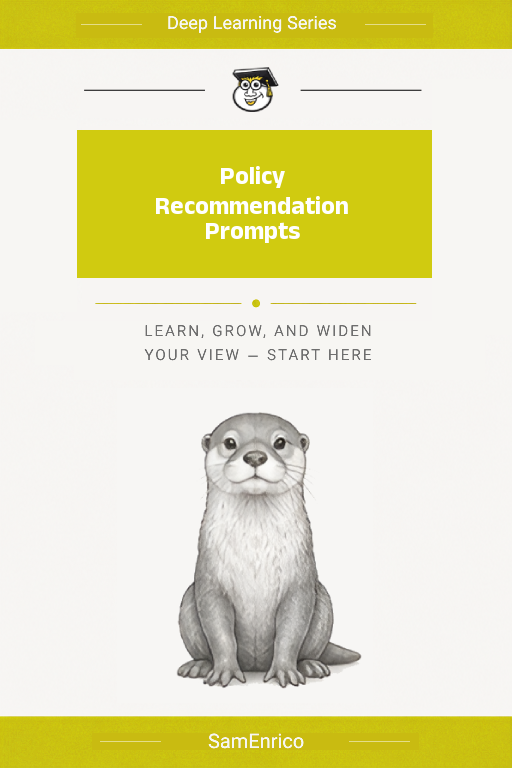
Non-FictionStudent's ShortcutPolicy Writing
Policy Recommendation Prompts eBook
Generate actionable policy proposals based on evid
by Barker Lee
Generate actionable policy proposals based on evidence using GPT prompts for solution oriented essays.
Formats
Free sample
Chapter 1: The 4:47pm Friday--–- The email arrived at 4:47 PM on a Friday. "Need policy options on the homelessness crisis by Monday. Please brief the Mayor at 9 AM. Thanks." Forty-seven hours. A problem that had defeated a generation of experts, and you had a weekend to solve it.
You opened a document. You stared at the blinking cursor. Then you did what anyone would do: you opened Chat GPT.The AI gave you something in thirty seconds. Four paragraphs. Three citations that looked real.
A recommendation that felt sensible. You felt a wave of relief. Then, because you are a professional, you checked one of the citations. It didn't exist. You checked another.
The study was real, but it concluded the opposite of what the AI claimed. The third citation had the right author, the wrong journal, and a publication date two years before the author graduated from college. The AI had hallucinated every single source.You closed the browser. You poured a cup of coffee. You accepted that you would not sleep this weekend.
And you wondered: why is this tool, which can write poetry and pass law exams, so catastrophically bad at policy analysis?This book answers that question. More importantly, it gives you a systematic method to fix it. Chapter 1 introduces the foundational architecture of effective policy prompting: the Policy-Analytic Loop, the SCQA framework, and the concept I call the Policy Burrito. You will learn why generic Chat GPT fails at policy work, how to force AI to become a reasoning partner rather than a confident liar, and the one prompt that eliminates ninety percent of hallucinations before they reach your memo. By the end of this chapter, you will never again trust an uncited AI output.
More importantly, you will never have to.The Two Failures That Ruin Policy Prompts Before we build a solution, we must understand the problem. Generic AI systems fail at policy work for two specific, predictable, and fixable reasons. Understanding these failures is the first step to engineering around them.Failure One: Hallucinations The word "hallucination" is a polite euphemism. What AI does is not a glitch. It is a design feature.
Large language models are trained to predict the next most probable word in a sequence. They do not know what is true. They do not know what is false. They know what is plausible. For most conversational purposes, plausibility is enough.
For policy analysis, plausibility is professional suicide.Consider what happens when you ask a generic AI for policy evidence. The model has seen thousands of academic citations in its training data. It knows the statistical patterns of how citations look: author names, publication years, journal titles, volume numbers, page ranges. It can generate strings that perfectly mimic these patterns. But it has no memory of whether a specific citation corresponds to a real study.
It is a forger who has never seen a genuine document, only descriptions of documents.The results are catastrophic. I have seen AI generate a citation to a "Harvard Study on Rental Assistance" that included a real Harvard professor's name, a real journal, a plausible publication year, and a completely fabricated finding. The study did not exist. The professor had never published on rental assistance. The journal had no record of the article.
But the citation looked perfect. A junior analyst, rushing to meet a deadline, might have included it. A senior official, scanning a briefing memo, would have seen the Harvard name and moved on. The lie would have entered the policy process.This is not theoretical. In 2023, a lawyer used Chat GPT to prepare a legal brief.
The AI cited several court cases that did not exist. The lawyer did not verify them. The opposing counsel discovered the fabrication. The judge imposed sanctions. The lawyer lost his job.
If this can happen in a profession where verification is mandatory and penalties are severe, it can happen in policy analysis, where deadlines are tighter and oversight is looser.Failure Two: Timeliness The second failure is less dramatic but more pervasive. Even the most advanced AI models are trained on data that is months or years old. The exact cutoff date varies by model, but the principle is constant: the AI does not know what happened yesterday, last week, or often last year.This is deadly for policy work. Consider a typical policy question: "What are the current best practices for overdose prevention centers in the United States?" An AI trained on data from eighteen months ago might describe a landscape where no federal action has occurred and only two cities have piloted programs. But in the intervening months, a major city might have released evaluation data, a state legislature might have passed enabling legislation, and a federal agency might have issued new guidance.
The AI would confidently describe a reality that no longer exists.Worse, the AI does not know that it does not know. It will answer as confidently about stale data as about fresh data. You cannot ask it, "When was your training data cut off?" because the answer varies by model and the AI itself may not have reliable access to that metadata. You are flying blind.Together, these two failures create a perfect storm. The AI hallucinates fake evidence while simultaneously lacking access to real recent evidence.
A naive user receives output that looks authoritative, cites plausible sources, and describes a recent-sounding policy landscape. Every instinct says: trust this. Every instinct is wrong.The Policy-Analytic Loop: From Search Engine to Reasoning Partner The solution begins with a mental shift. Most people use AI as a search engine. They type a question, receive an answer, and move on.
This is exactly wrong. AI is not a database. It is a reasoning engine. But it needs a structure.The Policy-Analytic Loop replaces the one-shot question-answer pattern with a structured dialogue. You do not ask the AI for answers.
You ask it to walk through a reasoning process. You demand that it show its work. You treat it as a junior analyst who needs supervision, not an oracle that deserves trust.The loop has four stages, drawn from the SCQA framework that management consultants have used for decades:Situation: Describe the current state of the world. What is happening right now? Who is involved?
What are the baseline conditions? This stage establishes facts that everyone can agree on before you introduce controversy.Complication: Identify what has changed or gone wrong. Why is the Situation no longer acceptable? What problem demands action? The Complication is the gap between how things are and how things should be.Question: Formulate the specific policy question that the Complication raises.
This is not "What should we do?" That is too broad. This is "Given the Situation and Complication, what specific decision or recommendation is required?" Good policy questions are narrow enough to answer and broad enough to matter.Answer: Generate the policy response. But crucially, the Answer comes last, after you have forced the AI to articulate the Situation, Complication, and Question. This prevents the AI from jumping to conclusions based on shallow pattern-matching.Here is how this plays out in practice. A naive prompt: "Give me policy options…
This is the end of the free sample. Get the eBook to keep going. Buy now
About this book
Details
- Author
- Barker Lee
- Publisher
- SamEnrico
- Language
- English
- Genre
- Non-Fiction, Student's Shortcut, Policy Writing
- Released
- 2026-05-30
- Pages (approx.)
- 155
- Available as
- eBook, Audiobook

Read better in the ZLOADR app
Your eBooks on your phone or tablet. Sign in with your SamEnrico account and start reading.
More by Barker Lee
 Swedish Green IncentivesBarker Lee$11.99
 Road Rage Triggers and SolutionsBarker Lee$11.99
 Postpartum Skin ChangesBarker Lee$11.99
 Legal Structure BlockBarker Lee$11.99
 Health Anxiety Meditation ReliefBarker Lee$11.99
 Constraints for ParentsBarker Lee$11.99
 Anticipatory Grief JournalingBarker Lee$11.99
 Assertiveness for SalespeopleBarker Lee$11.99
 The Prints of Deception: How Fingerprints Solved the Shanghai Bootlegging WarsBarker Lee$11.99
 Antigonus the One-Eyed: The Last Lion of the DiadochiBarker Lee$11.99
 A Beginners Guide to Subbuteo (Volume 1)Barker Lee$11.99
 Insurance Options for Rental Camera GearBarker Lee$12.99
You may also like
 Hong Kong Handover 1997Dunn Johnnie$11.99
 Zumba For Postnatal Recovery CourseNeal Christian$11.99
 Zumba for BeginnersLadner Nikia$11.99
 YouTube Comment Mining GuideHumes Pandora$12.99
 Worry Box MeditationCarlin Rudy$11.99
 Workplace Stress MeditationNguyen Lynn$11.99
 Workplace Stress and Sleep RepairHawley Ivory$11.99
 Workplace Perfectionism CureDelaney Jeffry$11.99
 Workplace Injustice Anger GuideWallen Isabelle$11.99
 Work Addiction and Burnout LinkGreenwood Ester$11.99
 Women in Yoga and WellnessBeattie Galina$11.99
 Women in Stand Up ComedyChun Evangeline$11.99