
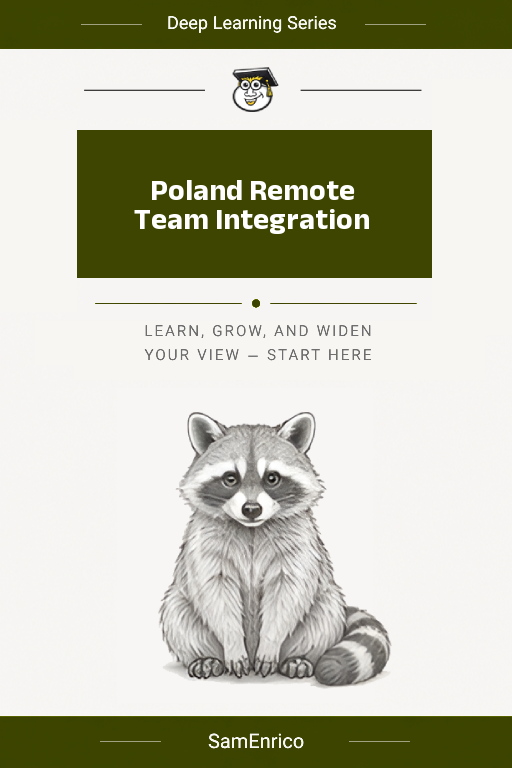
Non-FictionBusiness BriefCultural Integration
Poland Remote Team Integration eBook
Incorporate Polish remote employees into Western c
Incorporate Polish remote employees into Western company culture using virtual coffee breaks and shared goals.
Formats
Free sample
Chapter 1: The Accidental Disconnect--The email arrived on a Tuesday afternoon, and Mark, a product director at a mid-sized tech company in Austin, barely glanced at it before hitting "archive." His CEO had forwarded a quarterly engagement survey with a single line: "Polish team scores look different. Can you look into this?"Mark had hired seven engineers in Wrocław over the past eighteen months. They were brilliant—their code was clean, their tickets were closed on time, and their English was flawless. By every measurable metric, the Polish remote team was a success story. Mark had even mentioned them in his annual review as a model for future expansion.But something was wrong.
He couldn't name it. The Polish engineers never spoke in product meetings unless called on directly. They never volunteered ideas. They never flagged risks early. When Mark said "use your best judgment," they delivered exactly what he asked for—and nothing more.
The silence wasn't hostile. It wasn't even noticeable, really, unless you were looking for it. And Mark hadn't been looking.The engagement survey told him what he had been missing. On the question "I feel involved in decisions that affect my work," his Polish team scored 2.8 out of 5. His US team scored 4.3.
On "I understand how my work contributes to the company's mission," the gap was even wider: 2.9 versus 4.4. By every subjective measure of belonging and engagement, the Polish team was drifting away—even as their objective productivity remained excellent.Mark's story is not unusual. It is, in fact, the opening chapter of almost every failed cross-border remote integration. Good intentions, smart hiring, and solid execution on deliverables—none of it is enough. Culture does not transmit automatically across time zones, national borders, or the six thousand kilometers between Austin and Wrocław.
You cannot outsource belonging to Slack. You cannot hope your way to integration.This book exists because that hope is failing thousands of managers and tens of thousands of Polish employees. And because the fix—designed rituals, shared goals, and intentional connection—is simpler and more effective than most managers realize.The Problem with Hope The most common approach to integrating Polish remote employees is not really an approach at all. It is an assumption. Western managers assume that if they hire smart people, give them access to the same tools, and communicate in English, culture will take care of itself.
Polish employees, the thinking goes, will absorb Western norms through osmosis. They will watch how Americans behave in meetings and copy it. They will learn to speak up, to challenge ideas, to volunteer opinions without being asked.This assumption is wrong.Culture is not a gas that fills any container it is poured into. It is a set of deeply embedded habits, expectations, and communication patterns that are shaped by decades of upbringing, education, and professional socialization. A Polish engineer who spent four years in a university system that rewarded precise answers and punished guessing is not going to suddenly adopt American-style brainstorming just because her job title changed.
A Polish manager who learned that hierarchy means respect—that you do not interrupt, that you wait to be invited, that you address superiors formally—is not going to start calling the VP by his first name just because the VP said "my DMs are open."The problem with hope is that it is passive. It waits for change to happen instead of designing for it. And while you are waiting, your Polish team is quietly concluding that they are not really part of the core team, that their input is not valued, and that their job is to execute rather than to contribute.The costs of this passive approach are measurable. Companies with significant Polish remote teams report turnover rates 22 percent higher among Polish employees than among their Western counterparts. Onboarding for cross-team collaboration takes 40 percent longer—measured by time until a Polish engineer submits a pull request reviewed by a US colleague, or a US product manager incorporates Polish-sourced feedback into a roadmap.
And the "us versus them" dynamic, once established, becomes self-reinforcing: the less Polish teams speak, the less Western teams ask; the less Western teams ask, the more Polish teams feel invisible.This book proposes a different approach. Instead of hoping that culture will emerge accidentally, we will design it intentionally. Instead of assuming that Polish employees will adapt to Western norms, we will build a shared culture that works for both sides. Instead of treating integration as an afterthought, we will treat it as a core business process—measurable, improvable, and accountable.The Ambiguity-Structure Gap Every cross-cultural friction in this book traces back to a single underlying tension, which we will call the Ambiguity-Structure Gap. Understanding this gap is the single most important concept in the book.Western management culture—particularly in the United States and the United Kingdom—values flexibility, improvisation, and the ability to "figure it out." Managers pride themselves on giving vague direction and trusting employees to find their own path.
"Use your best judgment" is a compliment, a sign that the manager respects the employee's competence. "Run with it" is an invitation to creativity. "Let's brainstorm" is a call to collective problem-solving.This approach works well in highly individualistic, low-context cultures where employees are socialized from an early age to ask clarifying questions, to push back when something is unclear, and to volunteer ideas even when not explicitly invited. It works less well—sometimes not at all—in cultures that are more hierarchical, more formal, and more comfortable with explicit structure.Polish professional culture falls into the latter category. Shaped by decades of formal education that emphasized precise answers over creative speculation, by a business environment that emerged from the post-communist transition with clear rules and hierarchies, and by a historical context where ambiguity was often a precursor to risk, Polish employees value clear expectations, documented processes, and explicit authority.When a Western manager says "use your best judgment," a Polish employee does not hear a compliment.
They hear "we haven't thought this through." They hear "we don't respect your need for clarity." They hear "we are putting you at risk by not defining success."When a Western manager says "my DMs are open," a Polish employee does not hear an invitation. They hear a statement so vague as to be meaningless. Open when? For what purpose? With what expectation of response time?
In the absence of explicit answers, the Polish employee defaults to what their education and experience have taught them: wait to be invited. Do not initiate. Do not impose.The Ambiguity-Structure Gap is not a matter of right or wrong. It is not that Western managers are too loose or Polish employees are too rigid. Both approaches are rational responses to different environments.
The gap is a mismatch, not a deficiency. And mismatches can be bridged—but only if you first acknowledge that they exist.Throughout this book, we will refer back to the Ambiguity-Structure Gap. Every ritual, every tool, every framework is designed to bridge this gap: to give Polish employees the structure they need to feel safe, while preserving the flexibility that Western managers value.The "Open Door" That Was Never…
This is the end of the free sample. Get the eBook to keep going. Buy now
About this book
Details
- Author
- Hardesty Karie
- Publisher
- SamEnrico
- Language
- English
- Genre
- Non-Fiction, Business Brief, Cultural Integration
- Released
- 2026-05-30
- Pages (approx.)
- 140
- Available as
- eBook, Audiobook

Read better in the ZLOADR app
Your eBooks on your phone or tablet. Sign in with your SamEnrico account and start reading.
More by Hardesty Karie
 Sober Living Homes HandbookHardesty Karie$11.99
 Daily Review for StudentsHardesty Karie$11.99
 Deconstructing Pain SensationsHardesty Karie$11.99
 Meditation for Rheumatoid ArthritisHardesty Karie$11.99
 Self Talk For Exercise MotivationHardesty Karie$11.99
 Siri Voice RemindersHardesty Karie$11.99
 Gabon Jungle Elephant TrailHardesty Karie$11.99
 Work Self Esteem WorkbookHardesty Karie$11.99
 Whispers of the Great Assembly: The Forgotten Congress of 1884Hardesty Karie$11.99
 Marcel Marceau: The Silent Poet Who Spoke to the WorldHardesty Karie$11.99
 The Essential Guide to Adult ContemporaryHardesty Karie$11.99
 How to Start a Machinists Precision Tools Business (Beginners Guide)Hardesty Karie$11.99
You may also like
 Hong Kong Handover 1997Dunn Johnnie$11.99
 Zumba For Postnatal Recovery CourseNeal Christian$11.99
 Zumba for BeginnersLadner Nikia$11.99
 YouTube Comment Mining GuideHumes Pandora$12.99
 Worry Box MeditationCarlin Rudy$11.99
 Workplace Stress MeditationNguyen Lynn$11.99
 Workplace Stress and Sleep RepairHawley Ivory$11.99
 Workplace Perfectionism CureDelaney Jeffry$11.99
 Workplace Injustice Anger GuideWallen Isabelle$11.99
 Work Addiction and Burnout LinkGreenwood Ester$11.99
 Women in Yoga and WellnessBeattie Galina$11.99
 Women in Stand Up ComedyChun Evangeline$11.99