
Non-FictionHealth & WellnessEGMs
Poker Machine Problem Gambling eBook
Australian style poker machine specific addiction
Australian style poker machine specific addiction help.
Formats
Free sample
Chapter 1: The Twenty-Dollar Lie--–- The machine does not know your name. It does not care that you had a hard week, that your back hurts, that the kids were screaming, that you just want five minutes of peace. It is a box of lights and probability, programmed by people who will never meet you. And yet, when you slide that twenty-dollar note into the bill acceptor—when the screen flickers to life and the reels begin their hypnotic spin—something inside you believes. Not believes you will win, exactly.
Believes that this time might be different. Believes that you are in control. Believes that twenty dollars is nothing.That belief is the first lie. And this chapter is about understanding why you fell for it.Let us begin at the beginning. Not the beginning of your story—that comes later—but the beginning of every session.
The moment you walk into the venue. The moment your hand reaches for your wallet. The moment the machine takes your money and gives you nothing but spinning pictures in return.I want you to imagine the scene. It is a Tuesday evening. You have had a long day at work.
You are tired, but not sleepy—that wired kind of tired where your brain is foggy but your body is restless. You drive past the local pub on your way home. The lights are on. The carpark has a few cars. You think: just one.
Just twenty dollars. Just to unwind.You park. You walk inside. The air smells like beer and carpet cleaner and something faintly sweet from the kitchen. You nod at the bartender, who knows your face but not your name.
You walk to the back corner, where the poker machines hum in a row like sleeping animals. You choose your usual machine—the one with the dragon theme, the one that paid out two hundred dollars three months ago, the one you have been chasing ever since.You take out your wallet. You pull out a crisp twenty-dollar note. It feels like nothing, doesn't it? Twenty dollars.
That is a sandwich and a coffee. That is half a tank of petrol in a small car. That is less than you spend on groceries in a single trip. Twenty dollars is not even worth thinking about.The machine accepts your note. The screen shows 100 credits.
Each spin costs one credit. You have one hundred chances.You press the button. The reels spin. The machine plays a cheerful jingle. You lose.
You press again. You lose again. You press a third time. This time, the machine explodes with light and sound. Congratulations!
You have won five dollars. The machine celebrates as if you have just conquered an empire. The screen flashes. The music swells. For a moment, you feel something—a tiny spike of pleasure, a rush of warmth in your chest.But here is the truth: you just lost fifteen dollars.
You put in twenty. You won back five. You are down fifteen. And yet the machine treated that net loss as a victory.This is called a Loss Disguised as a Win, or LDW. And it is the single most deceptive piece of engineering in the history of gambling machines.Let me be explicit about what an LDW actually is.
When you stake two dollars and win back one dollar and twenty cents, you have lost eighty cents. That is a loss. But the machine does not treat it like a loss. The machine plays winning music. The machine flashes winning lights.
The machine adds your one dollar and twenty cents to your credit meter as if you have achieved something. Your brain, which evolved to respond to rewards, does not stop to do the math. Your brain hears the music, sees the lights, and releases dopamine. You feel like you won. You feel good.
You feel encouraged to spin again.This is not an accident. This is by design. The engineers who program these machines know exactly what they are doing. They have studied behavioral psychology. They have run thousands of trials to determine which sounds produce the strongest dopamine response.
They have calibrated the frequency of LDWs to keep you playing as long as possible without causing you to cash out in frustration.And it works. God, how it works.A study from the University of Melbourne found that LDWs increase the time a player spends on a machine by nearly forty percent. Another study, this one out of the University of British Columbia, used brain imaging to show that LDWs activate the same reward pathways as actual wins—even when the player consciously knows they have lost money. Your conscious brain might understand that you lost eighty cents. But your unconscious brain does not care.
The music has already done its work.Now let us talk about speed.The average poker machine in Australia completes a spin every 2.5 to 3 seconds. That is twenty to twenty-four spins per minute. Do the math: at one dollar per spin, you can lose twenty dollars in one minute. At five dollars per spin, you can lose one hundred dollars in one minute. At the maximum bet of ten dollars per spin—which is still legal in several Australian states—you can lose six hundred dollars in an hour.But here is the thing: you do not feel like you are losing.
The spins blur together. Each one is just another press of a button, just another flicker of the screen, just another chance. The speed creates a kind of sensory overload that bypasses your rational brain. You enter what psychologists call a state of cognitive absorption—or, as I will call it throughout this book, the dark flow state. (We will spend all of Chapter 2 on that phenomenon.
For now, just note that speed is the engine that drives you into that state.)The combination of LDWs and high spin speed creates a perfect trap. You lose money quickly, but you are constantly given small, noisy "wins" that trick your brain into thinking you are doing well. You leave the machine after an hour, having lost two hundred dollars, and you think: I almost broke even. I had some good runs. If I had just left ten minutes earlier, I would have been up.That thought is also a lie.
But we will get to the mathematics of randomness in Chapter 4.For now, I want to talk about near-misses.A near-miss is exactly what it sounds like: you come close to winning a large prize, but fall just short. Two jackpot symbols appear on the first two reels. The third reel stops on a blank—one position away from the jackpot. The screen shows you what you almost had. The machine plays a sympathetic little tune.
And you think: so close. I'll get it next time.Here is what the machine does not tell you: near-misses are not random. They are programmed.A truly random slot machine would produce near-misses at a rate determined purely by probability. But poker machines are not truly random in the way you might think. They use what is called a random number generator, yes, but…
This is the end of the free sample. Get the eBook to keep going. Buy now
About this book
Details
- Author
- Cordero Brittney
- Publisher
- SamEnrico
- Language
- English
- Genre
- Non-Fiction, Health & Wellness, EGMs
- Released
- 2026-06-09
- Pages (approx.)
- 124
- Available as
- eBook, Audiobook

Read better in the ZLOADR app
Your eBooks on your phone or tablet. Sign in with your SamEnrico account and start reading.
More by Cordero Brittney
 Feynman Path Integral MethodCordero Brittney$11.99
 Twelve Step for Incarcerated PersonsCordero Brittney$11.99
 Circadian Rhythm And Traumatic Brain InjuryCordero Brittney$11.99
 High School Stress SurvivalCordero Brittney$11.99
 Disengaged Parent RecoveryCordero Brittney$11.99
 Caregiving for VeteransCordero Brittney$11.99
 Intermittent Fasting Hormone BoostCordero Brittney$11.99
 Secret Eating Shame ReductionCordero Brittney$11.99
 The Frozen Cartographers: Uncharted Seas and the Birth of Marine ScienceCordero Brittney$11.99
 The Silent Spy: How a Double Agent Shaped the Cold WarCordero Brittney$11.99
 The Great Escape: The Untold Story of the 1974 Spaghetti Bowl HeistCordero Brittney$11.99
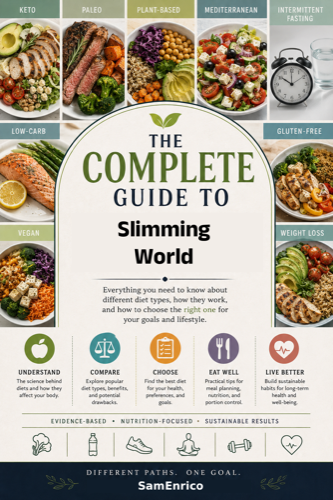 The Complete Guide to Slimming WorldCordero Brittney$11.99
You may also like
 Hong Kong Handover 1997Dunn Johnnie$11.99
 Zumba For Postnatal Recovery CourseNeal Christian$11.99
 Zumba for BeginnersLadner Nikia$11.99
 YouTube Comment Mining GuideHumes Pandora$12.99
 Worry Box MeditationCarlin Rudy$11.99
 Workplace Stress MeditationNguyen Lynn$11.99
 Workplace Stress and Sleep RepairHawley Ivory$11.99
 Workplace Perfectionism CureDelaney Jeffry$11.99
 Workplace Injustice Anger GuideWallen Isabelle$11.99
 Work Addiction and Burnout LinkGreenwood Ester$11.99
 Women in Yoga and WellnessBeattie Galina$11.99
 Women in Stand Up ComedyChun Evangeline$11.99