
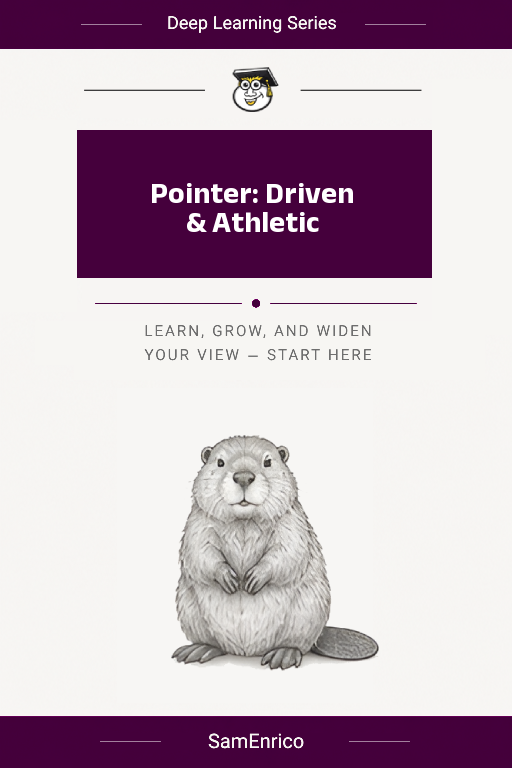
Pointer: Driven & Athletic eBook
This publication, published by SamEnrico, covers P
This publication, published by SamEnrico, covers Pointer: Driven & Athletic
Formats
Free sample
Chapter 1: The Independent Contractor...--–- The first mistake almost every new Pointer owner makes is treating the dog like a Labrador. They buy a long leash, stock up on tennis balls, and clear their schedule for two-hour fetch sessions at the local park. They believe, with absolute sincerity, that a tired dog is a good dog. What they discover, usually around the third month, is that their Pointer is not tired at all. The dog is faster, stronger, and more determined than the day it arrived.
The fetch sessions have not exhausted the dog; they have trained it for a marathon. The leash has become a point of friction, not control. And the owner, standing in the backyard with a sore throwing arm and a dog spinning in frantic circles, utters the phrase that defines the breed: "What have I gotten myself into?"This chapter is not about training. It is not about commands, diets, or gear. Those things will come in later chapters, and they will be covered in exhaustive detail.
This chapter is about something more fundamental. It is about unlearning everything you think you know about dogs and replacing it with a single, transformative insight: the English Pointer is not a pet. It is an independent contractor.If you come to this book expecting to teach your Pointer to sit for a cookie, you have bought the wrong book. If you believe that a dog's worth is measured by how closely it heels, you will be frustrated. If you think that love means constant physical affection and a warm spot on the sofa, you are in for a difficult adjustment.
The Pointer does not exist to please you. It exists to hunt. Its entire genetic heritage, its physical structure, its nervous system, and its emotional life are organized around one activity: finding birds at extreme distances with minimal human intervention. Everything else is negotiation.The Aristocrat of the Field To understand the Pointer, you must first understand where it came from. The English Pointer is not a recent invention.
It is not a designer breed cobbled together for Instagram appeal. The Pointer's ancestry traces back to the seventeenth century, when European hunters needed a dog that could cover vast, open country—the sprawling estates of England, the plains of Spain, the moorlands of Scotland—and locate game birds with enough precision that a human with a net or a gun could approach within range.Unlike the spaniels, which flushed birds into nets, or the retrievers, which brought downed game back to hand, the Pointer had a different job. Its job was to find and freeze. The dog was not supposed to catch the bird. It was not supposed to flush the bird.
It was supposed to stand perfectly still, one front foot cocked, tail straight up, nose extended toward the scent, and wait. The hunter would approach, flush the bird, and shoot. The Pointer's reward was the next opportunity to hunt.This arrangement created a unique psychological profile. The Pointer had to be independent enough to range far from the hunter. It had to be intelligent enough to read wind and terrain.
It had to be physically durable enough to run for hours on end. And it had to be patient enough to hold a point for minutes at a time while a human walked over. What it did not need was slavish obedience. A dog that constantly looked back to its handler for permission was useless in the field. A dog that needed a treat to perform was a liability.
The Pointer was bred for autonomy, and that autonomy is still baked into its DNA.Today, the English Pointer remains largely unchanged. While other breeds have been split into "show lines" and "field lines" with dramatically different temperaments, the Pointer has remained remarkably consistent. A Pointer from a champion show line can still hunt. A Pointer from a field trial champion can still lie on your couch. But the drive—that relentless, focused, almost obsessive need to find birds—is present in every well-bred individual.
It is not something you can train into a dog. It is something you can only channel or suppress. Suppress it, and you will have a neurotic, destructive mess. Channel it, and you will have a partner.The Great Misunderstanding: Energy vs. Drive The single most common mistake new Pointer owners make is confusing two very different things: nervous energy and genuine hunting drive.
They look at a dog that spins in circles, barks at shadows, chews the furniture, and cannot settle, and they say, "This dog has so much drive." No. That dog has anxiety. That dog has been mismanaged. That dog is screaming for structure, not exercise.True hunting drive looks different. Watch a Pointer that has locked onto the scent of a bird.
The dog stops. Its body tenses but does not tremble. Its tail goes up to twelve o'clock and holds there, motionless. Its nose extends toward the source of the scent. Its eyes, if you can see them, are fixed and intense.
The dog is not spinning. It is not barking. It is not looking to you for reassurance. It is completely absorbed in the task. This is drive.
This is what you want.Nervous energy, by contrast, is undirected. The dog with nervous energy moves constantly but without purpose. It checks the window, then the door, then the window again. It picks up a toy, drops it, picks up another. It whines.
It paces. It cannot hold still for more than a few seconds. This dog is not driven. It is overstimulated, under-exercised in the wrong ways, and lacking the mental framework to settle. The solution is not more fetch.
The solution is less chaos and more structure.Here is a simple test you can perform with any Pointer over the age of six months. It is called the "Bird-in-Hand" test, and it requires a live, secured bird—a pigeon or a quail in a small cage or a bird bag. Bring the dog into a quiet, enclosed area with minimal distractions. Hold the bird at chest height, visible but out of reach. Watch the dog.A dog with genuine hunting drive will lock onto the bird.
Its posture will change: shoulders square, tail up, nose working. It may whine or tremble slightly, but the movement is contained. The dog is focusing. A dog with nervous energy, by contrast, will spin, jump, bark, or try to grab the bird frantically. It may lose interest entirely and wander away.
Neither response is "bad," but they tell you what you are working with. The focused dog needs channeling. The frantic dog needs settling.Why "Wearing Them Out" Is a Trap Almost every new Pointer owner falls into the same trap. They believe that if they run the dog enough, throw the ball enough, take the dog on enough long walks, the dog will eventually tire out and become calm. This is a disaster.Pointers were bred to run.
They were bred to run for hours. A two-hour fetch session does not exhaust a Pointer. It conditions a Pointer. You are not wearing the dog down. You…
This is the end of the free sample. Get the eBook to keep going. Buy now
About this book
Details
- Author
- Quinlan Kittie
- Publisher
- SamEnrico
- Language
- English
- Genre
- Non-Fiction, Informative, Educational
- Released
- 2026-06-02
- Pages (approx.)
- 131
- Available as
- eBook, Audiobook

Read better in the ZLOADR app
Your eBooks on your phone or tablet. Sign in with your SamEnrico account and start reading.
More by Quinlan Kittie
 Child Obituary Writing GuideQuinlan Kittie$11.99
 Self Hypnosis for Fear of BridgesQuinlan Kittie$11.99
 Self Hypnosis Wearable TechQuinlan Kittie$11.99
 Corporate Turnaround ExecutiveQuinlan Kittie$11.99
 Vagus Nerve GuideQuinlan Kittie$11.99
 Santino Fontana Tootsie StarQuinlan Kittie$11.99
 Sam Nujoma Namibia FoundingQuinlan Kittie$11.99
 Alcohol Recovery for MenQuinlan Kittie$11.99
 The Great Festival of Teotihuacan: Where Gods and Musicians Danced the Stars into BeingQuinlan Kittie$11.99
 The Eagle and the Lion: Letters from the Fields of CarrhaeQuinlan Kittie$11.99
 How to Produce Floppy DrivesQuinlan Kittie$11.99
 How to Start a Combing Machinery for Textiles Business (Beginners Guide)Quinlan Kittie$11.99