
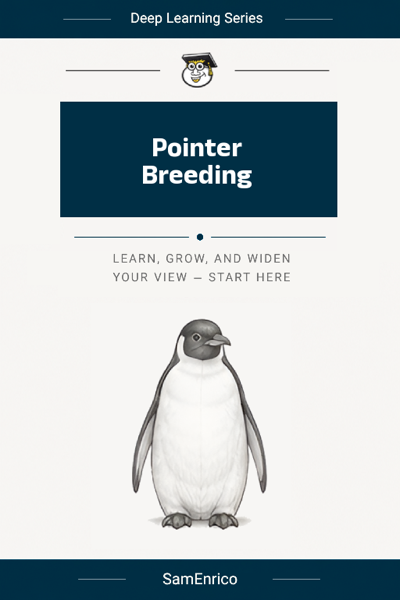
Non-FictionInformativeEducational
Pointer Breeding eBook
A Coursebook on Pointer Breeding
A Coursebook on Pointer Breeding
Formats
Free sample
Chapter 1: The Standing Silence...–- Before the first dog ever froze on point, before the shotgun’s roar became the signal for partnership, there was a problem: how do you catch a bird you cannot see?The answer took four hundred years to perfect, and it lives today in the bones, nose, and patience of every Pointer. This chapter is not a timeline. It is an origin story — one that explains why a dog that stands still became the most explosive hunting machine ever bred, and why you, as a breeder, are holding a living artifact of that transformation.The Pre-Gunpowder Puzzle: Why “Setting” Was Not Yet Pointing To understand the Pointer, you must first understand a world without shotguns. Before the 1600s, hunting birds meant nets, falcons, or bows. Nets required stealth: a hunter needed to throw a weighted net over a covey of birds before they flushed.
Falcons required a different skill — the falconer flushed the bird, and the falcon chased it in the air. But the net hunter faced a maddening problem: birds have eyes on the sides of their heads and can see a human from two hundred yards. How do you walk within net range of a bird that watches you the entire approach?The solution was the “setting dog.” These early dogs — ancestors of modern setters and pointers — did not point. They crouched, or “set,” on the ground, often flattening themselves so completely that they seemed to melt into the grass. The hunter held a long rope attached to the dog’s collar.
When the dog smelled birds, it would drop to the ground and freeze. The hunter walked forward, using the dog as a living anchor, and threw the net over the birds. The dog’s job was not to indicate precise location — it was to become invisible.But the setting dog had limits. Crouching put the dog’s nose close to the ground, which was good for scent, but it also meant the dog could not see the birds flush. More importantly, the hunter could not see the dog in tall grass.
A crouching dog at fifty yards might as well be a rock. The partnership worked in open fields but failed in cover.Then came the gun.The Wing Gun Revolution: How Firearms Forged the Upright Point The flintlock shotgun — called the “wing gun” because it was used for birds on the wing — appeared in the late 1600s and spread through Europe in the 1700s. For the first time, a hunter could kill a bird in flight. This changed everything. The net became obsolete.
The new requirement was range: the hunter needed to walk within shotgun range (thirty to forty yards) of a bird, flush it, and shoot it before it escaped.The setting dog’s crouch became a liability. A crouching dog could not be seen in tall grass, and the hunter, unable to locate the dog, would either step on the birds (flushing them too early) or overshoot the dog (dangerous with a flintlock’s wide pattern). Hunters began favoring dogs that stood upright on point — tall enough to see over grass, rigid enough to signal “the birds are here.”But standing upright was not natural. The setting dog’s crouch was a predator’s instinct: predators lower their profile to avoid detection. Asking a dog to stand tall on point was asking it to suppress a million years of evolution.
The dogs that could do it — that could override the crouch and hold a standing freeze — were rare. Those dogs became the foundation of the Pointer breed.The transformation happened region by region. In Spain, hunters bred dogs with wide noses and extraordinary stamina — the Spanish Pointer, a heavy-boned, slow-moving dog that could hunt all day at a walk. In France, the braque (from the French braquer, meaning “to point”) developed a more upright posture and a more intense stare. In England, foxhounds contributed speed and endurance, while the now-extinct English White Setter contributed the “set” instinct that, when crossed with upright-standing dogs, produced the modern Pointer’s signature rigid point.By 1800, the English Pointer — as distinct from the Spanish and French varieties — had emerged.
It was leaner than its Spanish cousin, faster than its French cousin, and more intense than any setting dog. It stood with its tail at eleven o’clock or twelve, its nose extended, one front paw cocked slightly, every muscle locked. This was not a crouch. This was a declaration.The Anatomy of a Point: Why Stillness Is More Powerful Than Speed Before we discuss the famous kennels and bloodlines, you must understand what the Pointer’s point actually is — because without that understanding, breeding decisions become arbitrary.A point is not simply “the dog stops.” A point is a specific suite of behaviors: the freeze (all movement ceases), the stretch (neck extended, nose aimed at the bird), the tail lock (rigid, often elevated), and the stare (eyes fixed, pupils dilated, sometimes with a slight tremor in the lip). These behaviors are not learned.
They are hardwired into the canine hunting sequence: search, locate, stalk, freeze, flush, chase, catch. The freeze is the critical moment — the predator’s calculation that moving will scare the prey. In wolves, the freeze lasts a second or two before the chase. In Pointers, selective breeding has stretched that freeze from two seconds to two minutes or more.Why would a dog hold a freeze that long? Because the human partner has taken over the flush and chase.
The dog has learned (through generations of selection, not individual training) that holding the point allows the human to approach and flush the bird, and that the reward — the shot, the fall, the retrieval — follows reliably. The dog’s hunting sequence has been literally edited: the freeze has been extended, the chase suppressed, the catch delegated to the human.This is the miracle of the Pointer. The dog has outsourced the kill to the human in exchange for more birds. It is a biological contract written in genes.The quality of the point — its intensity, duration, and style — is heritable. Studies of pointing breeds show that pups from parents with “high-intensity” points (head high, tail rigid, muscle tremors visible) are significantly more likely to exhibit the same intensity than pups from parents with “low-intensity” points (head low, tail relaxed, brief duration).
This heritability is not perfect — environment and training matter — but it is powerful enough that breeders have been selecting for point intensity for two hundred years, often without knowing the genetics.Now you know: when you see a Pointer lock up on a covey of quail, you are seeing two hundred generations of selective breeding compressing a wolf’s two-second hesitation into a two-minute sculpture.The Great Kennels of the 1800s: Bang, Mussel, and the Moorlands No history of the Pointer is complete without the names that became legends — not because of sentiment, but because those names still appear in the pedigrees of champion dogs today. Understanding these kennels is not antiquarianism. It is knowing the genetic bottlenecks and triumphs that shaped the modern breed.The Reverend William Heathcote’s “Bang” Line (c. 1770-1810)The first Pointer of record that can be…
This is the end of the free sample. Get the eBook to keep going. Buy now
About this book
Details
- Author
- Callender Gilma
- Publisher
- SamEnrico
- Language
- English
- Genre
- Non-Fiction, Informative, Educational
- Released
- 2026-05-08
- Pages (approx.)
- 136
- Available as
- eBook, Audiobook

Read better in the ZLOADR app
Your eBooks on your phone or tablet. Sign in with your SamEnrico account and start reading.
More by Callender Gilma
 Quit Smoking Dream Incubation GuideCallender Gilma$11.99
 Active Listening For NetworkersCallender Gilma$11.99
 Parental Anger Journal WorkbookCallender Gilma$11.99
 The Mixed IBS GuideCallender Gilma$11.99
 The Dorothy Hodgkin CrystalsCallender Gilma$11.99
 The Bitcoin Laundromat: How a College Kid Built a $100M Money Mule EmpireCallender Gilma$11.99
 Understanding Theodor–hertz–goodman SyndromeCallender Gilma$17.99
 Letters of Credit SimplifiedCallender Gilma$12.99
 Madrid Seniority ClaimCallender Gilma$12.99
 How to Start a Iron and Steel Forging BusinessCallender Gilma$11.99
You may also like
 Hong Kong Handover 1997Dunn Johnnie$11.99
 Zumba For Postnatal Recovery CourseNeal Christian$11.99
 Zumba for BeginnersLadner Nikia$11.99
 YouTube Comment Mining GuideHumes Pandora$12.99
 Worry Box MeditationCarlin Rudy$11.99
 Workplace Stress MeditationNguyen Lynn$11.99
 Workplace Stress and Sleep RepairHawley Ivory$11.99
 Workplace Perfectionism CureDelaney Jeffry$11.99
 Workplace Injustice Anger GuideWallen Isabelle$11.99
 Work Addiction and Burnout LinkGreenwood Ester$11.99
 Women in Yoga and WellnessBeattie Galina$11.99
 Women in Stand Up ComedyChun Evangeline$11.99