
Non-FictionInformativeEducational
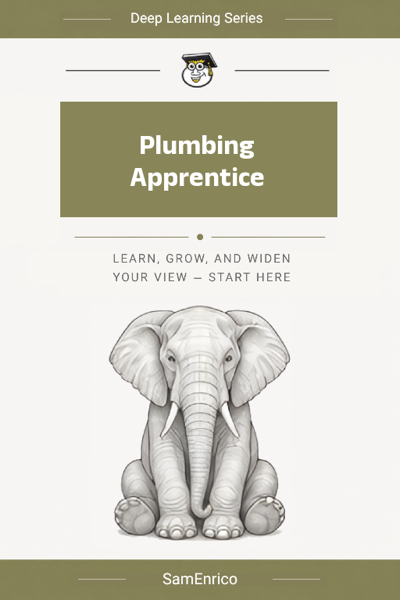
Plumbing Apprentice eBook
A Coursebook on Plumbing Apprentice
A Coursebook on Plumbing Apprentice
Formats
Free sample
Chapter 1: Before the Wrench...--–- The first thing you need to understand about plumbing is that it has nothing to do with wrenches. Not really. Wrenches are just metal. They don't save lives. They don't stop epidemics.
They don't separate civilization from the raw, open sewers of the Middle Ages. But a plumber does. A plumber with a proper code book, a working knowledge of traps and vents, and the integrity to refuse a bribe to cross-connect a sewer line to a drinking water main—that person is a silent guardian of public health. The wrench is just the tool. You are the weapon against cholera, typhoid, and hepatitis.This chapter is not about pipe diameters or slope calculations.
You will learn those in later chapters. This chapter is about why you are entering a profession that kills more people through negligence than any other trade saves through competence. It is about the weight of that responsibility and the path you must walk to earn the title of journeyman plumber.The Ghosts of the Broad Street Pump London, 1854. The Soho district is dying. In ten days, nearly 500 people will be dead.
The symptoms are violent and humiliating: explosive diarrhea, vomiting, leg cramps, and a thirst so intense that victims drink water even as it pours through them. The medical establishment calls it "miasma"—bad air rising from the filthy streets. They prescribe opium, brandy, and bloodletting. Nothing works. The dead are buried in mass graves.One man disagrees with the miasma theory.
Dr. John Snow is a physician and a pioneer of anesthesia, but his greatest discovery will come from a map and a pump handle. Snow walks the streets of Soho, interviewing terrified families, marking each death on a map of the neighborhood. He notices a pattern. The deaths cluster around a single water pump on Broad Street.
Not all deaths—some are outside the cluster—but most.Snow asks the local authorities to remove the handle of the Broad Street pump. They are skeptical but comply. The epidemic ends. Almost immediately.What Snow suspected—and what later microbiologists would prove—is that cholera is waterborne. A single contaminated well, fed by a leaking cesspool just three feet away, had poisoned the drinking water of an entire neighborhood.
The pump handle removal did not cure the sick. It simply stopped more people from drinking death.Here is the lesson for every plumbing apprentice: A single cross-connection between sewage and drinking water can kill hundreds. No gun. No bomb. Just a pipe installed wrong, a repair done cheap, or a code violation accepted as "good enough."Modern plumbing codes exist because of the Broad Street pump and thousands of similar failures.
Every requirement in the International Plumbing Code (IPC) and the Uniform Plumbing Code (UPC) is written in the blood of people who died from bad plumbing. When you skip a trap primer, you risk sewer gas entering a nursing home. When you fail to install a backflow preventer on a boiler feed, you risk poisoning an entire apartment building. When you slope a drain backward, you risk the slow accumulation of waste and the eventual eruption of raw sewage into someone's basement.You are not learning to fix toilets. You are learning to prevent pandemics.Why "Just a Plumber" is an Insult to the Dead There is a joke that circulates among tradespeople: "What's the difference between a plumber and a doctor?
The doctor doesn't have to clean up after the plumber." It's funny because it reverses the perceived status. But the joke misses the point entirely.A doctor treats disease after it appears. A plumber prevents disease before it starts. You are the preemptive strike. You are the reason a mother can fill a bathtub for her infant without worrying about fecal coliform bacteria.
You are the reason a restaurant can serve dishwater-clean plates to hundreds of customers. You are the reason a city of millions can flush its toilets without poisoning its own water supply.The World Health Organization estimates that improved sanitation reduces diarrhea-related deaths by nearly 40 percent. In developing countries where plumbing infrastructure is absent, waterborne diseases kill more children than AIDS, malaria, and measles combined. The simple act of separating sewage from drinking water—something a first-year apprentice learns in week three—is one of the most effective public health interventions in human history.So when someone asks what you do, and you say "plumber," and they nod with that vague look of mild condescension, remember: they are standing on a floor that drains properly, drinking from a tap that delivers safe water, and living in a home that does not reek of methane and hydrogen sulfide. They are breathing air that is not poisoned by sewer gas.
They are alive because of plumbing. They just don't know it.You will not receive a parade. You will not be thanked. You will crawl under houses through mud and spiderwebs. You will stand in basements with sewage backing up around your boots.
You will solder copper pipe in tight attics on 100-degree days. And then you will drive home, shower off the filth, and sleep the sleep of someone who has done honest work.That is the trade. It is not glamorous. It is essential.The Two Bibles: IPC vs. UPCBefore you can call yourself a plumber, you must understand that the United States does not have a single national plumbing code.
Instead, we have two major families of codes, and your state or local jurisdiction adopts one of them. You will need to know which one governs your work, because the differences are not trivial.The International Plumbing Code (IPC) is published by the International Code Council (ICC). It is the dominant code in most of the United States, including much of the Midwest, the South, and the East Coast. The IPC is performance-based. It tells you what result you must achieve (e.g., adequate venting to prevent trap seal loss) but gives you more flexibility in how you achieve it.
The IPC allows wet venting more broadly, permits air admittance valves (AAVs) in many jurisdictions, and generally takes a "if it works safely, it's acceptable" approach.The Uniform Plumbing Code (UPC) is published by the International Association of Plumbing and Mechanical Officials (IAPMO). It dominates the West Coast, including California, Oregon, Washington, Arizona, and Nevada. The UPC is prescriptive. It tells you exactly how to achieve the result—down to specific pipe sizes, fitting types, and venting configurations. The UPC requires individual vents for most fixtures, restricts wet venting severely, and generally prohibits AAVs entirely.
It is a stricter, more conservative code.Why do we have two codes? History, politics, and regional preferences. The UPC evolved from the plumbing practices of the American West, where water scarcity and seismic activity demanded more conservative designs. The IPC emerged from a coalition of building officials who wanted a single, unified code system. Neither is "right" or "wrong." Both produce safe plumbing when followed correctly.As an apprentice, your first task is to find out which code applies in your jurisdiction.
Your employer will know. Your local building department will enforce one or the other, and in some rare cases, a…
This is the end of the free sample. Get the eBook to keep going. Buy now
About this book
Details
- Author
- Edmonds Jordan
- Publisher
- SamEnrico
- Language
- English
- Genre
- Non-Fiction, Informative, Educational
- Released
- 2026-06-02
- Pages (approx.)
- 120
- Available as
- eBook, Audiobook

Read better in the ZLOADR app
Your eBooks on your phone or tablet. Sign in with your SamEnrico account and start reading.
More by Edmonds Jordan
 The Listening Volunteer GuideEdmonds Jordan$11.99
 DBT Skills Coaching GuideEdmonds Jordan$11.99
 The Diarrhea IBS GuideEdmonds Jordan$11.99
 Repairing Bonds After Angry BlowupsEdmonds Jordan$11.99
 The Niels Bohr Quantum AtomEdmonds Jordan$11.99
 Fintech Solutions for African TradeEdmonds Jordan$12.99
 ARIPO Validation GuideEdmonds Jordan$12.99
 Understanding Thanos–Stewart–zonana SyndromeEdmonds Jordan$17.99
 How to Start a Hobby in WritingEdmonds Jordan$11.99
You may also like
 Hong Kong Handover 1997Dunn Johnnie$11.99
 Zumba For Postnatal Recovery CourseNeal Christian$11.99
 Zumba for BeginnersLadner Nikia$11.99
 YouTube Comment Mining GuideHumes Pandora$12.99
 Worry Box MeditationCarlin Rudy$11.99
 Workplace Stress MeditationNguyen Lynn$11.99
 Workplace Stress and Sleep RepairHawley Ivory$11.99
 Workplace Perfectionism CureDelaney Jeffry$11.99
 Workplace Injustice Anger GuideWallen Isabelle$11.99
 Work Addiction and Burnout LinkGreenwood Ester$11.99
 Women in Yoga and WellnessBeattie Galina$11.99
 Women in Stand Up ComedyChun Evangeline$11.99