
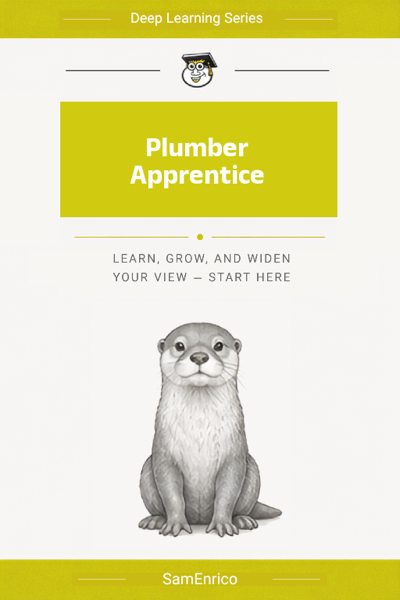
Non-FictionInformativeEducational
Plumber Apprentice eBook
A Coursebook on Plumber Apprentice
A Coursebook on Plumber Apprentice
Formats
Free sample
Chapter 1: The Buried Foundation...–- The smell hits you first. Not the sharp, chemical bite of PVC primer or the dusty warmth of old cast iron, but something older, more fundamental: damp earth, cool clay, and the faint, almost metallic scent of water that has traveled through darkness for miles. You are standing at the edge of an open trench on a new construction site, a hard hat perched on your head that still feels too new, too clean. Below, a journeyman plumber is knee-deep in mud, fitting together lengths of thick, bell-end pipe. He looks up, wipes his forehead with the back of a dirty glove, and shouts, "Welcome to the underground, kid.
This is where we earn our keep." That moment – the first time you truly understand that everything civilization relies on runs beneath its feet – is the moment you stop being someone who is learning about plumbing and start becoming a plumber.This book exists to guide you through that transformation. But before you learn to solder copper, calculate a 45-degree offset, or read a stack of blueprints, you must first understand something that no code book explicitly states: plumbing is the single most important public health profession ever created. Not heating, not electricity, not even clean water delivery alone. It is the combined system of bringing safe water in and carrying waste away that raised human life expectancy from barely 40 years to over 80 in developed nations. The 19th-century cholera epidemics that killed millions were not stopped by antibiotics or vaccines.
They were stopped by plumbers installing cast iron pipes and clay sewers, by the invention of the P-trap, by the simple, revolutionary idea that human waste should never touch drinking water.The Invisible Profession Every day, billions of people turn on faucets, flush toilets, and run dishwashers without a second thought. Water appears. Waste disappears. This magical expectation is the highest compliment paid to the plumbing trade – you have succeeded so completely that no one notices you exist. But the moment a pipe freezes, a sewer backs up, or a water heater fails, the plumber becomes the most important person on the property.
You are not a repairman. You are a public health first responder.Let that sink in. When a restaurant’s grease trap overflows, you are preventing a biological hazard from reaching the municipal system. When a homeowner’s water tests positive for bacteria, you are the one who finds the cross-connection that could make a family sick. When a hospital’s medical gas line needs installation, you are literally helping keep patients alive.
The trade is not about wrenches and pipe dope; it is about protecting the boundary between the human body and the environmental hazards that have killed more people than all wars combined.This chapter lays the foundation for everything that follows. You will learn where modern plumbing came from, why we have building codes, and how water makes its complete journey from source to sky. You will also learn the single most important skill that separates a parts-changer from a true professional: the ability to think like a plumber, to see the system behind the walls, to understand that every pipe tells a story about pressure, gravity, and the relentless pursuit of equilibrium.The Ancient Awakening: From Open Sewers to Public Health Long before the first plumbing code was written, humans understood that water was both life and death. The earliest permanent settlements – Jericho, Çatalhöyük, the Indus Valley – all featured some form of water management. Wells, drainage ditches, and even primitive indoor latrines have been found dating back 7,000 years.
But it was the Romans who elevated plumbing to an art form and a civic duty.The Roman Blueprint Between 312 BCE and 226 CE, Rome constructed eleven aqueducts that brought over 300 million gallons of fresh water daily into the city. These stone and concrete channels relied entirely on gravity, dropping only 17 feet per mile on average – a slope so subtle you could walk beside one for hours without noticing you were descending. The water fed public fountains, baths, and the homes of the wealthy. More importantly, the Romans built the Cloaca Maxima (Greatest Sewer), a massive underground channel that drained the Roman Forum and carried waste to the Tiber River. They understood the principle that still governs plumbing today: water seeks its own level, and waste moves downhill.The word "plumbing" itself comes from the Latin plumbum, meaning lead.
Roman pipes were made of lead sheets wrapped around a wooden mandrel and soldered along the seam. The lead leached into the water, and some historians believe lead poisoning contributed to the fall of Rome – a cautionary tale about material selection that we still heed today. (Modern codes strictly limit lead content in plumbing materials; the Safe Drinking Water Act of 1986 banned lead solder and fixtures with more than 8 percent lead.)The Dark Ages and the Return of Disease After the fall of Rome, much of Europe abandoned centralized sanitation. Wells were dug next to cesspits. Chamber pots were emptied into streets.
The Thames River in London became an open sewer. In 1854, a physician named John Snow mapped a cholera outbreak in London’s Soho district and traced the source to a single water pump on Broad Street. The pump handle was removed, and the outbreak ended. Snow had just proven what we now take for granted: waterborne disease travels through contaminated water.But Snow’s discovery was not enough. What London needed was a system – a deliberate, engineered separation between drinking water and waste.
That system came from an unlikely source: a British parliamentarian named Sir Joseph Bazalgette. Between 1859 and 1875, Bazalgette built 82 miles of intercepting sewers beneath London, designed to carry waste eastward instead of letting it seep into the Thames. His sewers were built with brick, set on concrete foundations, and sloped at a precise grade to maintain self-cleaning velocity. They are still in use today. Bazalgette’s work, combined with the filtration and chlorination of drinking water, eliminated cholera from London.
The lesson was clear: a properly designed plumbing system is a public health intervention.The Birth of Modern Codes: Why We Have Rules Plumbing codes did not emerge from a committee room. They were written in the blood of cholera victims, typhoid fever patients, and children who died from lead poisoning. Every rule in the International Plumbing Code (IPC) or Uniform Plumbing Code (UPC) is a response to a past failure. When you hear an old plumber say, "Code is the minimum you can do and still be legal," understand that the minimum is still enormously sophisticated.The Two Giants: IPC vs. UPCIn North America, plumbing is governed by one of two major model codes.
The International Plumbing Code (IPC) , published by the International Code Council (ICC), is performance-based. It tells you what you must achieve (e.g., a trap seal must be maintained) but allows flexibility in how you achieve it (multiple venting arrangements may be acceptable). The Uniform Plumbing Code (UPC) , published by the International Association of Plumbing and Mechanical Officials (IAPMO), is prescriptive. It tells you exactly how to do something (e.g., a vent must be sized at one-half the drain diameter and…
This is the end of the free sample. Get the eBook to keep going. Buy now
About this book
Details
- Author
- Culver Alexander
- Publisher
- SamEnrico
- Language
- English
- Genre
- Non-Fiction, Informative, Educational
- Released
- 2026-06-02
- Pages (approx.)
- 152
- Available as
- eBook, Audiobook

Read better in the ZLOADR app
Your eBooks on your phone or tablet. Sign in with your SamEnrico account and start reading.
More by Culver Alexander
 Holiday Suicide Attempt Survivor GuideCulver Alexander$11.99Holiday Suicide Attempt Survivor GuideCulver Alexander$11.99
 Russian Jewish Tech ImmigrantsCulver Alexander$11.99
 Exercise Intensity for HGHCulver Alexander$11.99
 ABCDE for Executive Assistants GuideCulver Alexander$11.99
 Literature Discussion AI GuideCulver Alexander$11.99
 The Tongue of the World: The Legendary Polyglots of the Great Zimbabwe CourtCulver Alexander$11.99
 How to Become a ClockerCulver Alexander$11.99
 Time Blocking for Executive WellnessCulver Alexander$12.99
 USA Raise Rejection RecoveryCulver Alexander$12.99
 Understanding Mcgillivray SyndromeCulver Alexander$17.99
You may also like
 Hong Kong Handover 1997Dunn Johnnie$11.99
 Zumba For Postnatal Recovery CourseNeal Christian$11.99
 Zumba for BeginnersLadner Nikia$11.99
 YouTube Comment Mining GuideHumes Pandora$12.99
 Worry Box MeditationCarlin Rudy$11.99
 Workplace Stress MeditationNguyen Lynn$11.99
 Workplace Stress and Sleep RepairHawley Ivory$11.99
 Workplace Perfectionism CureDelaney Jeffry$11.99
 Workplace Injustice Anger GuideWallen Isabelle$11.99
 Work Addiction and Burnout LinkGreenwood Ester$11.99
 Women in Yoga and WellnessBeattie Galina$11.99
 Women in Stand Up ComedyChun Evangeline$11.99