
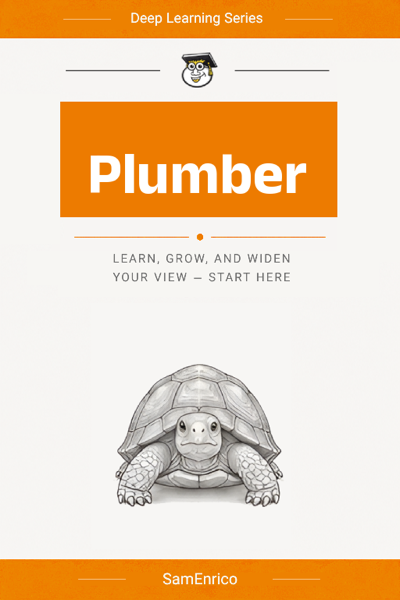
Plumber eBook
A Coursebook on Plumber
by Ortega Agnes
A Coursebook on Plumber
Formats
Free sample
Chapter 1: The Buried Foundation--Every time you flush a toilet, turn on a faucet, or step into a hot shower, you are trusting a system that took thousands of years to perfect. More importantly, you are trusting the person who installed, repaired, or designed that system. You are trusting that they understood something far more important than pipe sizes and fitting allowances. You are trusting that they understood public health.This is the single most important truth about plumbing that most people never learn. Plumbing is not about copper and PVC.
It is not about wrenches and soldering torches. It is about keeping human waste away from human drinking water. It is about preventing the invisible, odorless, tasteless contamination that has killed more people than all wars combined. Before germ theory, before antibiotics, before vaccines, the single greatest advance in human life expectancy came from something simple: putting a barrier between a toilet and a faucet.If you are reading this book, you are likely considering a career in plumbing, already working as an apprentice, or a homeowner who wants to understand the systems that keep your family safe. Whatever your reason, you need to start here.
Not with tools. Not with math. Not with code tables. You need to start with why plumbing matters, who you will become in this trade, and what rules govern everything you will ever install.This chapter lays that foundation. You will learn where plumbing came from and why its history is written in graveyards.
You will learn the four career stages of a plumber, from apprentice to contractor, and how to choose between union and non-union paths. You will learn what plumbing codes actually are, why they exist, and why ignoring them is not just illegal but dangerous. You will learn the three non-negotiable principles that every working plumber must internalize until they become instinct. And you will learn the professional ethics and communication skills that separate a technician who works from a master who gets called back.By the end of this chapter, you will understand something that takes most apprentices years to realize: plumbing is not a job. It is a public trust.The Hidden History of Plumbing: Why Graveyards Tell the Story Before we talk about pipes and codes, we need to talk about death.
Specifically, we need to talk about cholera.In 1854, a physician named John Snow mapped a cholera outbreak in London's Soho district. At the time, most people believed cholera spread through "miasma" – bad air from rotting organic matter. Snow suspected something else. He plotted every death on a map and found they clustered around a single water pump on Broad Street. When he removed the pump handle, the outbreak ended.
The cause was not bad air. It was water contaminated with sewage from a leaking cesspool just three feet from the well.That pump handle is the birthplace of modern plumbing.Before that discovery, cities were essentially open sewers. The Romans had built magnificent aqueducts and public latrines, but after the empire fell, Europe spent a thousand years forgetting what they knew. Chamber pots were emptied into streets. Cesspools leaked into wells.
Drinking water and human waste mixed freely. The word "plumbing" comes from the Latin plumbum for lead, because the Romans used lead pipes – a material that probably contributed to cognitive decline across the empire, though they never knew it.The nineteenth century changed everything. Cholera epidemics killed millions. Typhoid fever thrived in contaminated water. Cities realized that their survival depended on separating waste from water.
London built the first modern sewer system. Paris followed. New York, Boston, and Chicago dug tunnels and laid pipes. By 1900, indoor plumbing had shifted from a luxury of the rich to an expectation of the middle class.But here is what matters for you: the code books you will study are not arbitrary rules invented by bureaucrats. Every code provision exists because someone died.
The requirement that a trap must maintain a water seal exists because sewer gas – methane, hydrogen sulfide, ammonia – killed people who fell asleep in rooms with dry traps. The requirement that potable water pipes must never cross drainage pipes exists because cross-connections sent sewage into drinking water and caused outbreaks. The requirement that vents must rise to the roof exists because trapped air in drain lines would siphon traps dry, opening a direct path from the sewer to your lungs.When you memorize code tables, you are memorizing graveyards. That sounds dramatic. It is meant to.
The best plumbers never forget that their work is a barrier between human waste and human life. If you forget that, you become dangerous.The Four Pathways: From Apprentice to Contractor Now let us talk about you. Where do you fit in this profession?Plumbing offers one of the clearest career ladders in the skilled trades. You start at the bottom, learn under supervision, pass exams, and climb. At each stage, your responsibilities, pay, and legal authority expand.Apprentice The apprentice is a learner.
You work under the direct supervision of a journeyman or master plumber. You dig trenches. You carry materials. You cut and measure pipe while someone watches. You learn by doing, by watching, and by making mistakes that someone catches before they become disasters.Apprenticeships typically last two to five years.
The variation depends on your state, your union or non-union program, and how quickly you accumulate required hours. Most states require between 5,000 and 8,000 hours of on-the-job training, plus classroom instruction ranging from 144 to 300 hours per year.During your apprenticeship, you will learn tool identification and safe use, basic pipe joining methods including soldering and threading and solvent welding, blueprint reading, code basics, fixture installation, and safety protocols.Your pay as an apprentice starts between 40 and 60 percent of a journeyman's wage. You get raises as you accumulate hours and pass milestone exams. The best apprentices treat every task, even digging a trench, as a chance to learn. They ask questions.
They show up early. They never pretend to understand something they do not.Journeyman The journeyman is a fully trained plumber who can work independently. You have passed your state's journeyman exam. You know the code. You can read blueprints.
You can run a crew of apprentices. You can install any system covered by this book.But here is what surprises many new journeymen: passing the exam does not mean you know everything. It means you know enough to be dangerous. The real learning begins now. Every service call, every new construction project, every weird problem that no textbook anticipated – that is your education.Journeymen typically earn between 50,000and50,000 and 50,000and90,000 annually, depending on location, specialization, and whether you are union or non-union.
Top earners in high-cost areas or with specialized skills such as medical gas or backflow testing or commercial systems can exceed $120,000.To become a journeyman, you must complete your apprenticeship hours, pass a written exam that typically runs four to six hours and covers code, math, blueprint reading, and safety, pass a practical exam that demonstrates hands-on skills, and meet any state-specific requirements such as background checks or continuing education.Master Plumber The master plumber has achieved the highest level of technical competence. You have…
This is the end of the free sample. Get the eBook to keep going. Buy now
About this book
Details
- Author
- Ortega Agnes
- Publisher
- SamEnrico
- Language
- English
- Genre
- Non-Fiction, Informative, Educational
- Released
- 2026-05-18
- Pages (approx.)
- 159
- Available as
- eBook, Audiobook

Read better in the ZLOADR app
Your eBooks on your phone or tablet. Sign in with your SamEnrico account and start reading.
More by Ortega Agnes
 LinkedIn Endorsement Culture TrapOrtega Agnes$11.99
 HIIT For SoccerOrtega Agnes$11.99
 Financial Stress Midlife GuideOrtega Agnes$11.99
 Sugar Addiction and Candida OvergrowthOrtega Agnes$11.99
 The Phantom of the Rio: The Vanishing of the Brazilian Diamond KingOrtega Agnes$11.99
 How to Start a Billiard Parlors BusinessOrtega Agnes$11.99
 Executive Email Blocking GuideOrtega Agnes$12.99
 Learn to Play the MarimbaOrtega Agnes$11.99