
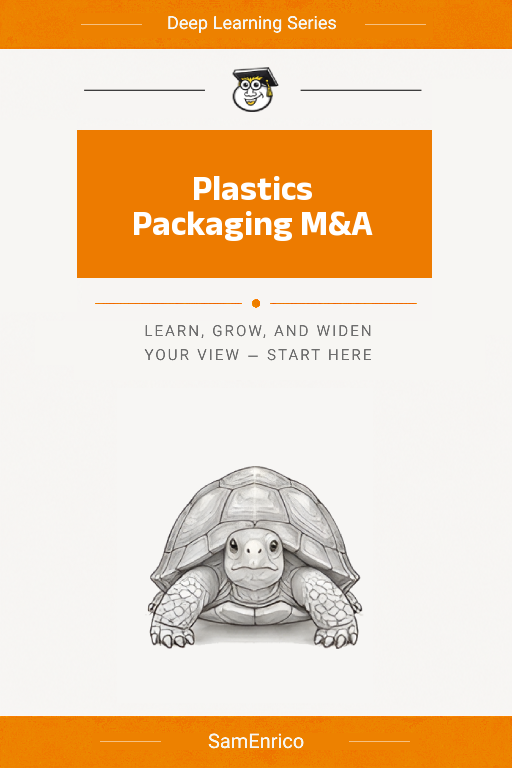
Plastics Packaging M&A
Identify rigid and flexible packaging targets for
Identify rigid and flexible packaging targets for Amcor, Berry Global, Sealed Air, and Sonoco.
Formats
About this book
Free sample
Chapter 1: The Great Unwrapping...--The conference room on the 34th floor of One South Wacker Drive in Chicago smelled of stale coffee and desperation. It was November 2022, and the senior leadership team of a $2.8 billion rigid plastics packaging company—let us call it “Midwest Containers”—had just finished a nine-hour strategy offsite. The flip charts were covered with SWOT analyses and five-year forecasts. The consultant from Mc Kinsey had flown back to New York. And the CEO, a third-generation packaging veteran named Frank, was staring at a single number on a single page: the company’s EV/EBITDA multiple over the past five years.It had gone from 8.2x in 2018 to 6.1x in 2022.Over the same period, Amcor’s multiple had expanded from 9.5x to 11.3x.
Sealed Air’s had held steady around 10x. Even Sonoco, a company Frank had always dismissed as “too boring to matter,” had seen its multiple rise from 7.8x to 9.4x.“What are we doing wrong?” Frank asked the room.No one had a good answer. But the answer was sitting in plain sight, buried in the appendix of the consultant’s deck. Midwest Containers operated 19 manufacturing plants across eight product categories: beverage bottles, food containers, industrial pails, automotive parts, medical device housings, caps and closures, thermoformed trays, and a small custom molding business that made parts for lawnmowers. Nineteen plants.
Eight categories. One confused stock price.The conglomerate era of plastic packaging was over. Frank’s company just did not know it yet.The Conglomerate Discount: Why More Is Less The story of Midwest Containers is not an outlier. It is a parable for an entire industry that spent three decades believing that diversification was a virtue. From the 1980s through the early 2010s, the largest packaging companies in the world operated as mini-conglomerates.
They believed that owning a beverage bottle plant in Ohio, a medical tubing facility in Ireland, a flexible film converter in Thailand, and a metal can factory in Brazil spread risk and smoothed earnings. A downturn in beverages would be offset by strength in healthcare. A resin price spike would…
This is the end of the free sample. Get the eBook to keep going. Buy now
Contents
- Chapter 1
- Chapter 2
- Chapter 3
- Chapter 4
- Chapter 5
- Chapter 6
- Chapter 7
- Chapter 8
- Chapter 9
- Chapter 10
- Chapter 11
- Chapter 12
Details
- Author
- Fairbanks Ferne
- Publisher
- SamEnrico
- Language
- English
- Genre
- Non-Fiction, Strategic Atlas, Packaging M&A
- Released
- 2026-06-01
- Pages (approx.)
- 156
- Available as
- eBook, Audiobook

Read better in the ZLOADR app
Your eBooks on your phone or tablet. Sign in with your SamEnrico account and start reading.
More by Fairbanks Ferne
 Weekly Interruption Audit WorkbookFairbanks Ferne$11.99
 Indian Agent Remote ManagementFairbanks Ferne$11.99
 The Samson Raphael Hirsch Neo OrthodoxyFairbanks Ferne$11.99
 Anthropology Essay AI GuideFairbanks Ferne$11.99
 Workplace Microaggression Anger ResponseFairbanks Ferne$11.99
 The Healers of Nubia: Medicine and Majesty in the Land of the NileFairbanks Ferne$11.99
 Understanding PneumothoraxFairbanks Ferne$17.99
 QuickBooks for Contractors GuideFairbanks Ferne$12.99
 BakingFairbanks Ferne$11.99
 How to Start a Optical and Precision Goods (retail) Business (Beginners Guide)Fairbanks Ferne$11.99