
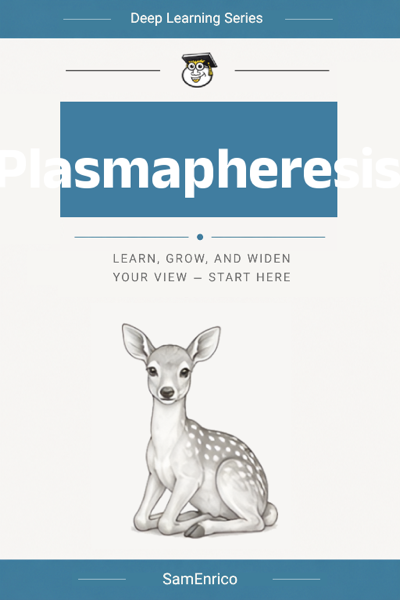
Non-FictionInformativeEducational
Plasmapheresis Audiobook
A Coursebook on Plasmapheresis
by Padgett Nia
A Coursebook on Plasmapheresis
Formats
Free sample
Chapter 1: The Cleansing Current--– The first time I saw a patient’s blood turn from a murky, dangerous soup into something clear and hopeful, I realized we had been thinking about disease all wrong. For centuries, medicine has searched for the perfect drug—the single molecule that would silence a rogue immune system, dissolve a toxic protein, or restore balance to a body under attack from itself. But what if the most powerful therapy isn’t a drug at all? What if it’s simply the removal of the very fluid that carries the disease?Plasmapheresis—the process of separating plasma from blood cells, discarding the “sick” plasma, and returning cleansed blood to the patient—is one of the most dramatic, life-saving, and yet misunderstood procedures in modern medicine. It saves patients who would otherwise die within hours from thrombotic thrombocytopenic purpura (TTP).
It restores the ability to walk in patients paralyzed by Guillain-Barré syndrome. It buys time for transplant recipients whose bodies are rejecting new organs. And yet, ask most doctors outside of hematology, neurology, or nephrology what plasmapheresis actually does, and you’ll get a shrug.This chapter tells the story of how we learned to clean blood—from the ancient practice of bloodletting to the high-tech centrifuges and filters of today. More importantly, it introduces the core principle that makes plasmapheresis work: solute drag, the idea that when you remove plasma non-selectively, you drag out everything dissolved within it, including the antibodies, immune complexes, toxins, and inflammatory proteins that cause disease. Understanding this principle is the key to understanding why plasmapheresis works for some diseases, fails for others, and why modern technologies are now trying to selectively override it.The Ancient Roots: Bloodletting and the Humoral Theory Before we had centrifuges, before we had sterile catheters, before we even knew what plasma was, healers believed that disease was caused by an imbalance of four bodily humors: blood, phlegm, black bile, and yellow bile.
Blood, being the most accessible humor, was the primary target for rebalancing. For over two thousand years, from ancient Egypt through medieval Europe and well into the 19th century, bloodletting was the most common medical procedure in the world.The Egyptians practiced bloodletting as early as 1000 BCE, using thorns or fish teeth to open veins. Hippocrates, the father of Western medicine, wrote extensively about the therapeutic removal of blood for conditions ranging from pneumonia…
This is the end of the free sample. Get the Audiobook to keep going. Buy now
About this book
Details
- Author
- Padgett Nia
- Publisher
- SamEnrico
- Language
- English
- Genre
- Non-Fiction, Informative, Educational
- Released
- 2026-05-06
- Pages (approx.)
- 160
- Available as
- eBook, Audiobook

Listen in the VoxFlicks app
Audiobooks and audio dramas wherever you go. Sign in with your SamEnrico account and press play.
More by Padgett Nia
 Metta for VeteransPadgett Nia$11.99
 Antiphospholipid Syndrome Loss WorkbookPadgett Nia$11.99
 The South Carolina FivePadgett Nia$11.99
 Beverage ESG ScorecardPadgett Nia$11.99
 The Public Speaking NonverbalsPadgett Nia$11.99
 Cleopatra and Antony: The Power Couple Who United Egypt and RomePadgett Nia$11.99
 Week Four Mentor Message BlastPadgett Nia$12.99
 Chinese Suppliers for DropshippingPadgett Nia$12.99
 Understanding Scheie SyndromePadgett Nia$17.99
 10 Ways to Use Dhania-jeera Powder (Recipe Book)Padgett Nia$11.99
You may also like
 Hong Kong Handover 1997Dunn Johnnie$11.99
 Zumba For Postnatal Recovery CourseNeal Christian$11.99
 Zumba for BeginnersLadner Nikia$11.99
 YouTube Comment Mining GuideHumes Pandora$12.99
 Worry Box MeditationCarlin Rudy$11.99
 Workplace Stress MeditationNguyen Lynn$11.99
 Workplace Stress and Sleep RepairHawley Ivory$11.99
 Workplace Perfectionism CureDelaney Jeffry$11.99
 Workplace Injustice Anger GuideWallen Isabelle$11.99
 Work Addiction and Burnout LinkGreenwood Ester$11.99
 Women in Yoga and WellnessBeattie Galina$11.99
 Women in Stand Up ComedyChun Evangeline$11.99