
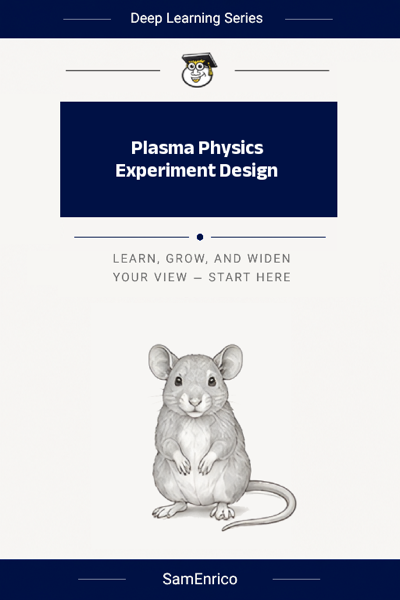
Non-FictionInformativeEducational
Plasma Physics Experiment Design eBook
A Coursebook on Plasma Physics Experiment Design
A Coursebook on Plasma Physics Experiment Design
Formats
Free sample
Chapter 1: The Measurement Paradox-- The first time I watched a graduate student destroy a $50,000 vacuum system, I learned something that no textbook had ever taught me. She had done everything right — the calculations were flawless, the components were top-grade, and the experimental plan had been approved by three senior scientists. But she forgot one thing: the plasma she was trying to measure did not want to be measured. As her Langmuir probe swept through its voltage range, the plasma changed. The very act of inserting knowledge into the system corrupted the knowledge itself.
The probe didn't just read the plasma — it rewrote it. The vacuum system survived, barely, but her experiment did not. Six months of preparation yielded data that answered no questions because she had asked the wrong question: not "what is this plasma doing?" but rather "how can I measure it without changing it?"That event, witnessed in a basement laboratory at midnight, encapsulates the central paradox of experimental plasma physics. You cannot observe the fourth state of matter without disturbing it. The tools you use to see become part of the system you are trying to understand.
This is not a limitation to be cursed — it is the defining characteristic of our discipline, the puzzle that makes plasma experimentation endlessly fascinating and perpetually humbling.This book exists because no other text teaches the complete arc of plasma experiment design. There are excellent books on plasma theory (Chen, Goldston, Rutherford, Bellan). There are encyclopedic references on diagnostics (Hutchinson, Griem, Wesson). There are detailed guides to vacuum systems and power supplies. But nowhere between two covers will you find a unified treatment that takes you from the first glimmer of a research question to the final published uncertainty budget, passing through hardware selection, diagnostic integration, signal processing, and the hard-won wisdom that comes only from mistakes.
This book is that missing bridge.Why Experiment When Theory and Simulation Exist?A reasonable question, asked by every new graduate student and by more than a few funding agencies: if we have sophisticated theories of plasmas — magnetohydrodynamics, kinetic theory, gyrokinetics — and if we have supercomputers that can simulate billions of particles, why do we need experiments at all? The answer reveals the fundamental epistemology of plasma physics.The interplay among theory, simulation, and experiment forms a tripod. Remove any leg, and the structure collapses. Theory provides the language and the laws — Maxwell's equations, the Vlasov equation, the transport coefficients. Simulation solves these equations in regimes too complex for analytic solution.
But both theory and simulation rest on assumptions: that collisions are correctly approximated, that boundary conditions are accurately specified, that the turbulence model captures the essential physics. Only experiment can tell you whether those assumptions correspond to reality.Three purposes of experiments. First, experiments discover new phenomena. The tokamak's H-mode, the density limit, the sawtooth instability — none were predicted before they appeared in data. Second, experiments validate models.
Does the gyrokinetic code predict the measured heat flux? If yes, confidence grows; if no, theory must evolve. Third, experiments benchmark simulations. Given identical initial conditions, does the simulation reproduce what the plasma actually does? This is verification of the simulation itself, distinguishing code bugs from missing physics.The humility of measurement.
I once asked a senior fusion scientist why his experiment, despite fifty years of refinement, still surprised him weekly. He answered: "Because plasma is a million times more creative than I am. It will find a way to do something I never imagined. My job is to watch carefully enough to see it." This is not anti-intellectualism. It is the recognition that nature has veto power over all of our beautiful mathematics.A Brief History of Experimenting with the Fourth State To understand where we are, we must understand where we came from.
The history of plasma experimentation is a record of clever people inventing ways to ask plasmas questions — and of plasmas answering in unexpected dialects.Langmuir's revolution (1920s). Irving Langmuir, working at General Electric, was trying to understand the glowing discharges inside vacuum tubes. He did something that seems obvious in retrospect but was radical at the time: he stuck a wire into the discharge and measured the current as he varied the voltage on that wire. The resulting I-V characteristic curves contained, encoded in their shape, the electron temperature, the electron density, and the plasma potential. The Langmuir probe, now nearly a century old, remains the most widely used plasma diagnostic in the world — not because it is the most accurate, but because it is the simplest physical window into the fourth state.Langmuir also gave plasma its name.
Watching the glowing discharge oscillate and flow, he thought of blood plasma carrying red blood cells — the positive ions as corpuscles moving through a sea of electrons. The name stuck, even though blood plasma is a liquid and its behavior has little in common with a magnetized fusion plasma. Science is full of such poetic accidents.The fusion impulse (1950s-1970s). The hydrogen bomb proved that fusion was possible on Earth, albeit in a millisecond-long, uncontrolled explosion. The dream of controlled fusion power — a star in a bottle, generating limitless clean energy — drove an immense investment in plasma experimentation.
The first magnetic confinement devices were whimsically named: the stellarator (built by Lyman Spitzer, who claimed he just liked the sound of the word), the pinch machine (because it pinched the plasma), the mirror machine (because it reflected particles back into the confinement region). Most of these early machines failed spectacularly. Plasmas would writhe, break apart, slam into walls, and extinguish themselves in microseconds — far shorter than the seconds needed for net energy production.But the failures taught essential lessons. They revealed instabilities: the kink, the tearing mode, the ballooning mode, each with its own signature and its own cure. Every stability boundary discovered was a constraint on what magnetic configurations could work.
By the 1980s, the tokamak — a Soviet invention that wrapped the magnetic field into a twisted donut — emerged as the leading configuration, achieving temperatures above 100 million degrees Celsius and confinement times measured in seconds rather than milliseconds.The precision era (1980s-2000s). With large tokamaks like JET (Europe), TFTR (United States), and JT-60 (Japan), the challenge shifted from "how to confine plasma at all" to "how to measure what is happening inside." The era of the single Langmuir probe ended. A modern tokamak experiment now deploys dozens of diagnostics simultaneously: laser interferometers measuring density, Thomson scattering systems mapping temperature, magnetic coils tracking instabilities, spectrometers identifying impurities, bolometers measuring radiated power, neutron detectors counting fusion reactions. The data rate from a single experiment can exceed a gigabyte per second.This abundance of data created its own challenges. How do you combine measurements from eight different diagnostics, each with its own calibration, its own noise characteristics, its own spatial and temporal resolution, into a coherent picture of the plasma?
The answer — reconstruction techniques, tomographic inversion, Bayesian inference — became the third pillar of experiment design, equal in importance to hardware and analysis.The reproducibility crisis (2010s-present). Plasma physics has not been immune to the broader scientific crisis of reproducibility. A 2018 survey of magnetic fusion experiments found that fewer than…
This is the end of the free sample. Get the eBook to keep going. Buy now
About this book
Details
- Author
- Molina Ayanna
- Publisher
- SamEnrico
- Language
- English
- Genre
- Non-Fiction, Informative, Educational
- Released
- 2026-05-06
- Pages (approx.)
- 147
- Available as
- eBook, Audiobook

Read better in the ZLOADR app
Your eBooks on your phone or tablet. Sign in with your SamEnrico account and start reading.
More by Molina Ayanna
 Identity Based Habit ChangeMolina Ayanna$11.99
 Playground Parent Chat WorkbookMolina Ayanna$11.99
 Extinction Emotional EatingMolina Ayanna$11.99
 Loving Kindness Meditation PrimerMolina Ayanna$11.99
 Loving Kindness Walking PracticeMolina Ayanna$11.99
 The Hollow Man of Whitechapel: A Ripper’s ShadowMolina Ayanna$11.99
 The Forgotten Caravan: Sven Hedin's Lost Expedition Through the TaklamakanMolina Ayanna$11.99
 Understanding Goldstein–hutt SyndromeMolina Ayanna$17.99
 A Beginners Guide to Chromino (Volume 1)Molina Ayanna$11.99
 One Page Ecommerce Marketing PrimerMolina Ayanna$12.99
 Freemium to Premium LadderMolina Ayanna$12.99
You may also like
 Hong Kong Handover 1997Dunn Johnnie$11.99
 Zumba For Postnatal Recovery CourseNeal Christian$11.99
 Zumba for BeginnersLadner Nikia$11.99
 YouTube Comment Mining GuideHumes Pandora$12.99
 Worry Box MeditationCarlin Rudy$11.99
 Workplace Stress MeditationNguyen Lynn$11.99
 Workplace Stress and Sleep RepairHawley Ivory$11.99
 Workplace Perfectionism CureDelaney Jeffry$11.99
 Workplace Injustice Anger GuideWallen Isabelle$11.99
 Work Addiction and Burnout LinkGreenwood Ester$11.99
 Women in Yoga and WellnessBeattie Galina$11.99
 Women in Stand Up ComedyChun Evangeline$11.99