
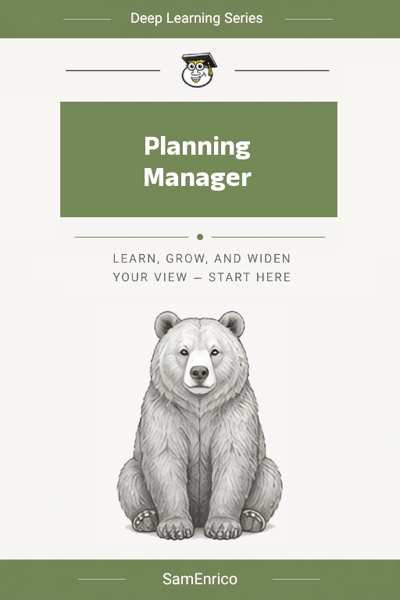
Non-FictionInformativeEducational
Planning Manager eBook
A Coursebook on Planning Manager
by Paz Jules
A Coursebook on Planning Manager
Formats
Free sample
Chapter 1: The Scheduling Lie--–- The email arrived at 6:47 PM on a Tuesday. Sarah, a senior planning manager at a mid-sized logistics firm, had just finished what she thought was her masterpiece—a 47-page project schedule, color-coded by priority, with dependencies mapped across six departments. She had sacrificed her lunch break, canceled a dentist appointment, and ignored three calls from her daughter’s school to finish it. Her boss had asked for it “by end of day,” and Sarah delivered. She hit send, leaned back in her chair, and felt something she rarely allowed herself to feel: proud.The reply came seventeen minutes later.
Not from her boss, but from the head of operations, cc’ing the entire leadership team. The message was brief: “This plan is beautiful. But we shipped the wrong product to our biggest client yesterday. Where was this plan then?”Sarah’s stomach dropped. She had spent two weeks building a schedule that would optimize next quarter’s deliveries.
But the building was literally on fire. Not metaphorically. Two floors down, a team was frantically trying to recall a mis-shipped order that would cost the company $400,000 in penalties. Sarah’s beautiful plan was already obsolete.She had confused being busy with being effective. She had confused scheduling with planning.
And she had just learned the hardest lesson a planning manager can learn: no one cares about your Gantt chart when the building is on fire.The Most Damaging Stereotype in Business If you are reading this book, you have likely experienced some version of Sarah’s story. You are the person in your organization responsible for “the plan.” And yet, you spend most of your time fighting fires that should have been anticipated. Your calendar is a graveyard of cancelled planning sessions. Your team treats your deadlines as suggestions. And somewhere along the way, you started to believe that this is just what planning is—a thankless, invisible grind of updating spreadsheets that no one reads.Let me tell you something that might upset you: you have been lied to.The lie is subtle but devastating.
It is the lie that planning is about filling out templates, building schedules, and tracking tasks. It is the lie that a planning manager is a clerical role—a step above data entry, a step below real decision-making. It is the lie that your job is to document what everyone else decides.This chapter exists to destroy that lie.Drawing on decades of management research—from Peter Drucker’s The Effective Executive to Richard Rumelt’s Good Strategy/Bad Strategy—this book will reframe the planning manager not as a clerk, but as the organization’s most strategic asset. You are not a scheduler. You are a radar system.
You detect threats before they become crises. You identify opportunities before competitors do. You build the bridge between what leadership wants and what operations can actually deliver.But to become that person, you must first unlearn everything you have been taught about what planning means.Operational Scheduling vs. Strategic Planning: The Critical Distinction The confusion at the heart of most broken organizations is the failure to distinguish between two fundamentally different activities: Operational Scheduling and Strategic Planning.Operational Scheduling Strategic Planning Time horizon Days to weeks Quarters to years Focus Tasks, deadlines, handoffs Capabilities, risks, opportunities Decision type Reactive (responds to inputs)Proactive (shapes the future)Success metric"Did we hit the deadline?""Did we build the right thing?"Typical tools Gantt charts, calendars, to-do lists SWOT, PESTLE, OKRs, scenarios Who does it Junior planners, coordinators Senior managers, strategic leaders Operational scheduling is important. Do not misunderstand me.
Someone needs to make sure the truck leaves at 2:00 PM and the report is filed by Friday. But operational scheduling is not strategic planning. It is the tactical execution of decisions that should have been made weeks or months earlier.Strategic planning, by contrast, is the work of shaping the future. It asks: What should we stop doing? What are we assuming that might be wrong?
Where is our biggest vulnerability? Strategic planning is not about filling time slots. It is about engineering uncertainty out of the system.Here is the problem: most organizations reward operational scheduling and ignore strategic planning. The manager who sends a perfectly formatted calendar at 11:00 PM gets a "great work" email. The manager who spends Tuesday morning thinking about next year’s supply chain risks gets asked, "What did you actually do today?"This book exists to flip that equation.
The planning manager who masters strategic foresight becomes unfireable. Not because they work long hours, but because they see what others miss.The Eight Planning Activities: A Holistic Framework To understand the full scope of the planning manager’s role, we must move beyond the narrow view of "scheduling" and embrace a more comprehensive framework. Based on decades of operations and management research, strategic planning encompasses eight distinct activities:1. Forecasting – Predicting future demand, resource needs, and environmental conditions. Forecasting is not about being "right." It is about quantifying uncertainty and building ranges.2.
Programming – Sequencing activities and allocating resources over time. This is where most people stop. But programming is only one of eight.3. Staffing – Determining the people, skills, and training required to execute the plan. Staffing connects planning to human resources.4.
Standards – Defining the quality, safety, and performance metrics that the plan must achieve. Without standards, "on time" means nothing if quality collapses.5. Procedures – Documenting the repeatable processes that will be used to execute the plan. Procedures are the difference between heroics and reliability.6. Materials – Ensuring the physical inputs (inventory, supplies, equipment) are available when and where they are needed.7.
Facilities – Aligning physical space, equipment, and infrastructure with the plan’s requirements.8. Budgeting – Allocating financial resources and tracking expenditures against the plan.Notice something important: only two of these eight activities (Programming and Forecasting) are what most people call "planning." The other six are where the real leverage lies. A planning manager who only updates schedules is using 25% of their potential toolkit. A planning manager who masters all eight becomes the central nervous system of the organization.Throughout this book, each of these eight activities will be explored in depth. But for now, simply recognize that the clerical-scheduler stereotype is a gross simplification.
You are responsible for far more than calendars.The Three Hats of the Planning Manager One reason the planning role is so misunderstood is that it is actually three roles in one. No single job title captures the diversity of responsibilities. Based on how top planning managers spend their time, we can identify three distinct "hats":Hat Time Allocation Primary Chapters Core Question Strategic Hat20%2, 3, 12"Are we doing the right things?"Operational Hat50%4, 5, 6, 9, 10, 11"Are we doing things right?"Leadership/Coaching Hat30%7, 8"Are our people growing?"The Strategic Hat (20% of your time) is about direction. When you wear this hat, you are scanning the external environment, setting long-term goals, and stress-testing assumptions. This hat feels "unproductive" to organizations that value visible activity.
But it is the hat that creates the most value. One good strategic insight—a risk avoided, an opportunity seized—can be worth months of operational work.The Operational Hat (50% of your time) is about execution.…
This is the end of the free sample. Get the eBook to keep going. Buy now
About this book
Details
- Author
- Paz Jules
- Publisher
- SamEnrico
- Language
- English
- Genre
- Non-Fiction, Informative, Educational
- Released
- 2026-06-02
- Pages (approx.)
- 129
- Available as
- eBook, Audiobook

Read better in the ZLOADR app
Your eBooks on your phone or tablet. Sign in with your SamEnrico account and start reading.
More by Paz Jules
 Self Hypnosis For GymnastsPaz Jules$11.99
 Vulvodynia Mindfulness GuidePaz Jules$11.99
 The Thank You Note SystemPaz Jules$11.99
 Emotional Eating Support GroupPaz Jules$11.99
 Crisis PR Executive GuidePaz Jules$11.99
 Breakaway: The Forgotten Republic of the Rio GrandePaz Jules$11.99
 The Frozen Equation: How a South African Scientist Unlocked Antarctica's Energy SecretsPaz Jules$11.99
 How to Become a Mold ParterPaz Jules$11.99
 Aliexpress to Brazil GuidePaz Jules$12.99
 Data Presentation Handbook for Team LeadsPaz Jules$12.99
 Understanding Fairbank DiseasePaz Jules$17.99
You may also like
 Hong Kong Handover 1997Dunn Johnnie$11.99
 Zumba For Postnatal Recovery CourseNeal Christian$11.99
 Zumba for BeginnersLadner Nikia$11.99
 YouTube Comment Mining GuideHumes Pandora$12.99
 Worry Box MeditationCarlin Rudy$11.99
 Workplace Stress MeditationNguyen Lynn$11.99
 Workplace Stress and Sleep RepairHawley Ivory$11.99
 Workplace Perfectionism CureDelaney Jeffry$11.99
 Workplace Injustice Anger GuideWallen Isabelle$11.99
 Work Addiction and Burnout LinkGreenwood Ester$11.99
 Women in Yoga and WellnessBeattie Galina$11.99
 Women in Stand Up ComedyChun Evangeline$11.99