
Non-FictionFirst 30 DaysDecision Making
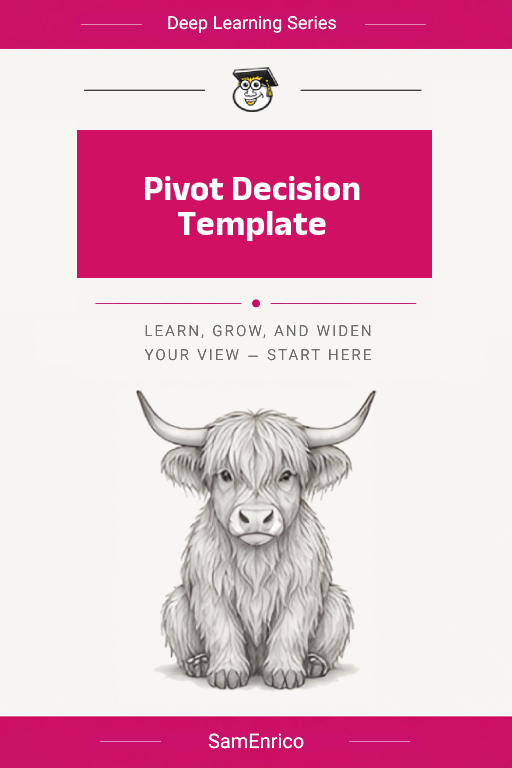
Pivot Decision Template eBook
Evaluate whether to pivot, persevere, or kill your
Evaluate whether to pivot, persevere, or kill your idea using a one page decision framework.
Formats
Free sample
Chapter 1: The $10 Million Mistake--The first time I watched a founder destroy his company, I was sitting in a borrowed conference room in San Francisco, drinking cold coffee, and listening to a man explain why he couldn't possibly stop.He had raised eight million dollars. Thirty-seven engineers had been working for eighteen months. They had built a beautiful piece of software that nobody wanted. When I asked him what would make him kill the project, he looked at me like I had suggested setting fire to his child."Nothing," he said. "We've come too far."Eight months later, his company was dead.
Not because the idea was bad. Not because the market shifted. Not because the team was incompetent. The company died because its founder had no system for knowing when to stop. He had raised money, hired people, built features, and attended meetings—all of which felt like progress.
But progress toward what? He couldn't answer that question because he had never asked it. He only knew that stopping felt like failure, and failure was not an option.So he chose the only path available to him: he kept going. He kept going until the bank account hit zero. He kept going until the engineers started leaving.
He kept going until his investors finally forced the shutdown. By then, the eight million dollars was gone. The eighteen months were gone. And the only thing left was the most expensive lesson he would ever learn: gut instinct is not a strategy.The Binary Trap That Kills Companies Here is the problem that this book exists to solve. For the past twenty years, the startup world has been dominated by a single framework: the choice between "pivot" and "persevere." Eric Ries introduced these terms in The Lean Startup, and they were revolutionary for their time.
Finally, there was language to describe the two paths available to an uncertain entrepreneur. You could either change direction (pivot) or stay the course (persevere).But here is the dangerous secret that nobody talks about: a binary choice between two options is not enough. In fact, forcing leaders into an either/or box ignores two critical strategic realities that matter more than almost anything else.The first reality is aggressive scaling. What happens when your idea is working not just well, but spectacularly well? What happens when the data is clear, the unit economics are positive, and the market is pulling the product out of your hands?
In that moment, "persevere" is not the right answer. Persevere implies caution, patience, incremental progress. But what you actually need is to pour gasoline on the fire. You need to hire fifty salespeople, not five. You need to buy ads, not test them.
You need to double down with the kind of conviction that looks reckless to outsiders but feels inevitable to those inside.The second reality is graceful killing. What happens when the idea is not working and the data is clear that it will never work? In the binary framework, your only options are to pivot (change direction) or persevere (keep going). But both of those assume continuation. Neither gives you permission to stop.
So founders keep going. They keep pivoting from one hypothesis to another, burning runway with each turn, until there is nothing left to burn. They treat "kill" as the worst possible outcome, when in fact it is often the smartest, bravest, most financially responsible decision available.The founder I watched destroy his company had fallen into this binary trap. He thought his choices were to pivot (change the product) or persevere (keep building). Neither option included stopping.
So he kept building. He kept building until the money ran out, at which point the decision was made for him—but at the highest possible cost.The Four Outcomes You Actually Need This book introduces a different framework. Not a binary choice, but a matrix with four distinct outcomes. Each outcome is triggered by a specific combination of two variables: your probability of success and your remaining runway.Here are the four outcomes, which we will spend the rest of this book learning to execute:Scale. This is what you do when the data shows a high probability of success (above seventy-five percent) and your unit economics are positive.
Scale means aggressive growth. It means shifting from discovery mode to execution mode. It means pouring resources into what is working with the full knowledge that hesitation at this moment is more dangerous than recklessness.Persevere. This is what you do when the data is inconclusive. You are neither clearly succeeding nor clearly failing.
Your probability of success is somewhere between twenty-five and seventy-five percent. In this zone, you do not guess. You do not hope. You run a single, time-boxed experiment designed to resolve the specific unknown that is keeping you stuck. Then you set a clock.
And when the clock runs out, you move to one of the other three outcomes.Pivot. This is what you do when the probability of success is low (below twenty-five percent) but you still have valuable assets that can be redeployed. A pivot is not a failure. It is a strategic shift that preserves your anchors—technology, team expertise, customer relationships, brand equity—while changing your hypothesis about customers, problems, solutions, or business models.Kill. This is what you do when the probability of success is very low (below ten percent) or you have no runway left or you have no new hypotheses worth testing.
Kill means stop. Immediately. Celebrate what you learned. Reallocate the resources to the next bet. And walk away with your head held high, because you made the hard decision that most founders are too afraid to make.These four outcomes are the entire engine of this book.
Every chapter, every tool, every template exists to help you answer one question: given the data I have right now, which of these four outcomes is the right one?Why "Persevere" Is the Most Dangerous Word in Business Before we go any further, I need to say something that might sound controversial. Of the four outcomes, the one that destroys the most value is not Kill. It is not Pivot. It is Persevere.Here is why. When most people hear "persevere," they hear permission to continue.
They hear encouragement to keep doing what they are doing. They hear a virtue—persistence, grit, determination. And in many contexts, those are virtues. But in the context of uncertain product decisions, "persevere" has become a trap. It has become the default answer for leaders who do not have the courage to choose any of the other three options.I have sat through hundreds of decision meetings.
In almost every one, when the data was inconclusive, the group defaulted to "let's keep going and see what happens." That is not a decision. That is the absence of a decision. That is drift. And drift is the silent killer of startups.The founder with eight million dollars did not decide to drift. He drifted because he had no system for doing anything else.
He did not have the data to Scale. He did not have a new hypothesis to Pivot. He could not…
This is the end of the free sample. Get the eBook to keep going. Buy now
About this book
Details
- Author
- Fisher Aubrey
- Publisher
- SamEnrico
- Language
- English
- Genre
- Non-Fiction, First 30 Days, Decision Making
- Released
- 2026-06-01
- Pages (approx.)
- 142
- Available as
- eBook, Audiobook

Read better in the ZLOADR app
Your eBooks on your phone or tablet. Sign in with your SamEnrico account and start reading.
More by Fisher Aubrey
 Grief and Relationship StrainFisher Aubrey$11.99
 Perimenopause Irregular PeriodsFisher Aubrey$11.99
 Stress and Gait BalanceFisher Aubrey$11.99
 Self Talk for MeditationFisher Aubrey$11.99
 Black Hole RelaxationFisher Aubrey$11.99
 Re engagement Winback CampaignFisher Aubrey$11.99
 ABCDE for CoachesFisher Aubrey$11.99
 PNE Master GuideFisher Aubrey$11.99
 The Prophet and the Algorithm: How a Tech Guru Built a Digital CultFisher Aubrey$11.99
 The Crown of the Atlantic: Portugal's Golden Age of ExplorationFisher Aubrey$11.99
 How to Produce Plastic MaterialsFisher Aubrey$11.99
 Ghana Payment Gateway GuideFisher Aubrey$12.99
You may also like
 Hong Kong Handover 1997Dunn Johnnie$11.99
 Zumba For Postnatal Recovery CourseNeal Christian$11.99
 Zumba for BeginnersLadner Nikia$11.99
 YouTube Comment Mining GuideHumes Pandora$12.99
 Worry Box MeditationCarlin Rudy$11.99
 Workplace Stress MeditationNguyen Lynn$11.99
 Workplace Stress and Sleep RepairHawley Ivory$11.99
 Workplace Perfectionism CureDelaney Jeffry$11.99
 Workplace Injustice Anger GuideWallen Isabelle$11.99
 Work Addiction and Burnout LinkGreenwood Ester$11.99
 Women in Yoga and WellnessBeattie Galina$11.99
 Women in Stand Up ComedyChun Evangeline$11.99