
Non-FictionInformativeEducational
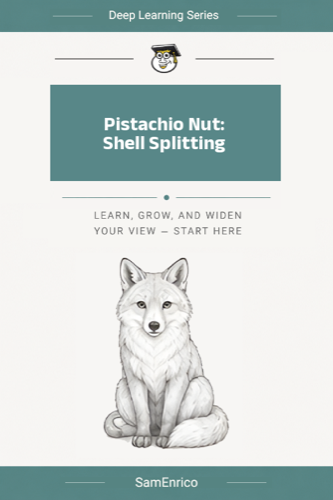
Pistachio Nut: Shell Splitting eBook
This harvesting publication, published by SamEnric
This harvesting publication, published by SamEnrico, covers Pistachio Nut: Shell Splitting
Formats
Free sample
Chapter 1: The Reluctant Crack...–- On a warm September morning in California’s Central Valley, a single pistachio nut reaches the exact moment of its transformation. Inside its greenish-tan shell, the kernel has swollen to its maximum size, absorbing the last of the summer’s regulated irrigation. The shell, which has protected the seed for months along its journey from flower to fruit, now becomes a prison. The kernel presses outward. The suture line—a natural seam running the length of the shell—begins to separate.
First a whisper of a gap, then a hairline fracture, then an audible pop that no human hears but every grower prays for. The nut has split. It is ready.This moment—the dehiscence of a pistachio shell—is one of the most economically significant biological events in modern agriculture. Yet for most of human history, it was also one of the least understood. The split was treated as a mystery, a gift from the tree, or simply luck.
Growers knew that some trees produced nuts that opened easily and others produced “rocks” that remained sealed. They knew that some seasons brought abundant splits and others brought disappointment. But they did not know why.Understanding the biology of the split is not an academic exercise. It is the foundation upon which the entire pistachio industry is built. Without a split, there is no saleable product.
Without a split, there is no snack food, no holiday bowl, no green-and-purple kernel peeking through an inviting opening. Without a split, the closed-shell nut becomes what processors call “dead weight”—a kernel trapped in an unbreakable tomb. Mechanical force cannot liberate it without destroying it. The only reliable way to obtain a whole, beautiful, marketable pistachio kernel is to encourage the nut to split itself, on its own terms, according to its own biological clock.This chapter reveals the anatomy, physiology, and evolutionary logic of that reluctant crack. It explains the three layers of the pistachio fruit, the mechanics of dehiscence, the disorders that prevent splitting, and the crucial distinction between a desirable split and a dangerous one.
By the end, the reader will understand that the split is not a random event but a precisely orchestrated biological process—and that every intervention described in later chapters, from irrigation management to hydraulic pressing, is an attempt to mimic, encourage, or complete what nature began.The Anatomy of a Split: Three Layers, One Goal To understand how a pistachio splits, one must first understand what a pistachio actually is. Botanically speaking, the pistachio nut is not a true nut. It is a drupe—the same category of fruit that includes peaches, plums, and olives. A drupe consists of three distinct layers, and in the pistachio, each layer plays a specific role in the split.The outermost layer is the exocarp, commonly called the hull. In a fresh pistachio hanging on the tree, the hull is fleshy, slightly waxy, and ranges in color from greenish-yellow to deep reddish-purple depending on the cultivar and maturity.
The hull protects the inner layers from insects, birds, and fungal attack. It also contains compounds that deter pests. As the nut matures, the hull begins to dry and separate from the layer beneath it—a process called dehiscence of the hull. This separation is the first visual sign that harvest is approaching. When a grower sees the hull pulling away from the shell, they know the nut is entering its final stage of development.Beneath the hull lies the endocarp, which is the hard, beige shell that consumers recognize as the pistachio shell.
The endocarp is composed of sclerenchyma cells—thick-walled, lignified cells that provide extraordinary strength. Under a microscope, the shell resembles a concrete block wall, with individual cells interlocked so tightly that they can resist significant pressure. Yet along one side of the nut, running from stem to tip, the endocarp is thinner and less reinforced. This is the suture line. It is not a crack or a defect.
It is a deliberate weak point, an engineered failure zone that evolution has refined over millions of years.Inside the endocarp is the kernel, also called the seed or the edible portion. The kernel is the actual pistachio plant embryo, surrounded by a papery seed coat that ranges from tan to deep purple. The kernel contains the genetic material for a new tree, stored fats and proteins to fuel germination, and—fortunately for consumers—a rich, buttery flavor that makes pistachios one of the most popular nuts in the world.The relationship between these three layers determines whether a nut will split. As the kernel matures, it absorbs water and nutrients from the tree. It swells.
The endocarp, now fully hardened, cannot expand. The only place where pressure can be relieved is the suture line. The kernel pushes against the shell from the inside, and the suture begins to separate. When the internal pressure exceeds the mechanical strength of the suture, the shell cracks open. The kernel is now exposed to the outside world—which, for the tree, is the goal.
The split allows the seed to escape and germinate when conditions are right. For the grower, the split signals that the nut is ready for harvest.The Mechanics of Dehiscence: Pressure, Time, and Water Dehiscence is not instantaneous. It unfolds over days or even weeks, and it follows a predictable sequence. Understanding this sequence is essential for any grower or processor because interventions that disrupt the sequence—drought, excessive irrigation, early harvest, delayed harvest—can prevent the split entirely.The process begins with the accumulation of turgor pressure inside the kernel. Turgor pressure is the force exerted by water against the cell walls of the kernel.
As the tree transports water and dissolved nutrients into the fruit, the kernel’s cells become engorged. They expand, but because they are confined within the rigid endocarp, the only direction for expansion is inward—against the kernel’s own structure—and outward—against the shell. The outward force is what stresses the suture.But water alone is not enough. The kernel must also accumulate dry matter—carbohydrates, proteins, and oils—that increases its physical volume. This is why split rates are higher in seasons with adequate sunlight and moderate temperatures.
Photosynthesis drives dry matter accumulation. Without it, the kernel remains small, and even abundant water cannot create enough pressure to force the suture apart.The timing of dehiscence is equally critical. In a typical growing season, pistachios reach their final size approximately 100 to 120 days after full bloom. For the next 30 to 40 days, the kernel continues to accumulate dry matter while the hull begins to dry and separate. The actual split usually occurs during this period, when the hull has pulled away but the shell is still moist enough to be flexible.
If the shell becomes too dry before the split occurs, it can harden into a rigid structure that the kernel cannot crack. Conversely, if the kernel runs out of water before the split is complete, the pressure drops and the suture may only partially separate—a condition called a “partial split” or “zipper split,” which is unacceptable for Grade A markets.The single most important environmental factor…
This is the end of the free sample. Get the eBook to keep going. Buy now
About this book
Details
- Author
- Croteau Elvis
- Publisher
- SamEnrico
- Language
- English
- Genre
- Non-Fiction, Informative, Educational
- Released
- 2026-05-18
- Pages (approx.)
- 154
- Available as
- eBook, Audiobook

Read better in the ZLOADR app
Your eBooks on your phone or tablet. Sign in with your SamEnrico account and start reading.
More by Croteau Elvis
 Attributional Anger RestructuringCroteau Elvis$11.99
 Fear of Failure in Asking for HelpCroteau Elvis$11.99
 The Low Income Coping GuideCroteau Elvis$11.99
 Suicide Concern ConversationsCroteau Elvis$11.99
 The Mother's Vegas ShowgirlCroteau Elvis$11.99
 Weight Loss Surgical AdaptationCroteau Elvis$11.99
 Housing Cost Anxiety ReliefCroteau Elvis$11.99
 The Clown of Cairo: Egypt's Forgotten Serial KillerCroteau Elvis$11.99
 The Essential Guide to Traditional BluegrassCroteau Elvis$11.99
 Venture Debt for Family OfficesCroteau Elvis$12.99
 Email Fasting for ProfessionalsCroteau Elvis$12.99
 How to Produce Electrical MotorsCroteau Elvis$11.99
You may also like
 Hong Kong Handover 1997Dunn Johnnie$11.99
 Zumba For Postnatal Recovery CourseNeal Christian$11.99
 Zumba for BeginnersLadner Nikia$11.99
 YouTube Comment Mining GuideHumes Pandora$12.99
 Worry Box MeditationCarlin Rudy$11.99
 Workplace Stress MeditationNguyen Lynn$11.99
 Workplace Stress and Sleep RepairHawley Ivory$11.99
 Workplace Perfectionism CureDelaney Jeffry$11.99
 Workplace Injustice Anger GuideWallen Isabelle$11.99
 Work Addiction and Burnout LinkGreenwood Ester$11.99
 Women in Yoga and WellnessBeattie Galina$11.99
 Women in Stand Up ComedyChun Evangeline$11.99