
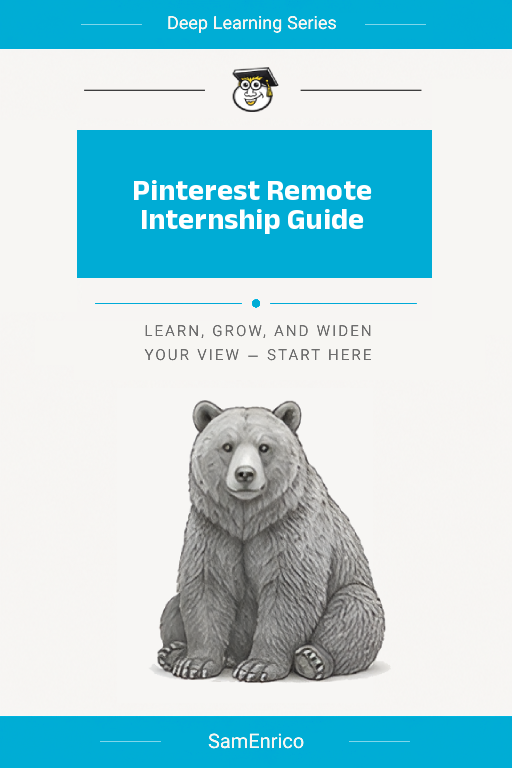
Non-FictionVirtual Work ExperienceVisual Guide
Pinterest Remote Internship Guide eBook
Secure a virtual internship at Pinterest. Visual d
Secure a virtual internship at Pinterest. Visual discovery, image recognition, and remote content curation.
Formats
Free sample
Chapter 1: The Pin Flex Decoder--–- The rejection email arrived at 10:17 AM on a Tuesday. Julia Chen, a junior studying information science at the University of Washington, had spent six weeks tailoring her Pinterest internship application. She had watched every “Day in the Life” video on You Tube. She had optimized her résumé with keywords like “visual discovery” and “user engagement.” She had even redesigned her Linked In profile photo to mimic the soft, aspirational aesthetic of a Pinterest mood board. And still, the email said the same thing it said to thousands of others: “After careful consideration, we have decided to move forward with other candidates.”Julia did what any rational, frustrated applicant would do.
She texted her friend who had actually gotten the internship the previous summer. “What did you do that I didn’t?”The answer was not what she expected. Her friend didn’t have a higher GPA. Didn’t go to a more prestigious school. Didn’t have a family connection at Pinterest.
What she had was something far simpler and far more elusive: she understood the difference between remote, hybrid, and distributed teams—and she had structured her entire application and interview strategy around that difference.“I didn’t just say I wanted to work remotely,” her friend explained. “I proved I knew what Pin Flex actually meant.”This chapter is about becoming that friend. It is about decoding Pinterest’s remote-first philosophy so thoroughly that you can speak about it with the confidence of someone who has already worked there. By the end of this chapter, you will understand not just the what of Pin Flex, but the why and the how. You will know what “remote within the country” actually means for your taxes, your time zone, and your chances of getting a return offer.
You will debunk the myths that trip up 80% of applicants. And you will set up a home office—without spending a dime you don’t have—that signals visual professionalism before you even say hello.Let us begin with a truth that Pinterest itself will not tell you directly: most applicants fail the remote readiness test before they ever submit an application.The Three Models You Must Know Pinterest categorizes its workforce into three distinct operational models. Knowing the difference is not trivia—it is the difference between sounding like a tourist and sounding like a future Pintern.Fully Remote means the employee never enters a Pinterest office. Their home address is their official work location. They receive equipment shipped to that address.
Their taxes are calculated based on that jurisdiction. Their performance is evaluated solely on output, not presence. Approximately 40% of Pinterest’s engineering and product teams operate in this model, according to internal data shared at the 2024 Pin Flex town hall.Hybrid means the employee is expected to be in a physical Pinterest office a specific number of days per week—usually two to three. This model is most common among sales, partnerships, and executive leadership roles, where in-person relationship building remains valuable. If you see a job description that says “San Francisco” or “New York” without the word “remote,” assume hybrid.Distributed is the model that confuses most applicants.
Distributed means the team has no physical headquarters. Members are scattered across time zones and locations, but they operate asynchronously by design, not by accident. Distributed teams at Pinterest have documented “core collaboration hours” (typically 10 AM to 2 PM Pacific Time) but otherwise allow full flexibility. The key distinction: distributed teams are optimized for remote work, while hybrid teams are tolerating it.Here is the insight that will set you apart: Pinterest’s internship program is primarily distributed, not hybrid. Even interns who live near a Pinterest office are rarely required to come in.
The company uses the internship as a proving ground for its long-term remote vision. When you apply, you are not applying for a job that happens to be remote. You are applying for a job that was designed to be remote from the ground up.In your interview, when they ask “Why are you interested in remote work?” do not say “because I like sleeping in” or “because I want to travel.” Say this instead: “I am interested in distributed teamwork because I understand that async communication, documented decision-making, and output-based evaluation are the future of tech. Pinterest’s Pin Flex culture aligns with how I work best.”That answer signals that you have done your homework. Most applicants do not.
Be the one who does.The Geography Trap: What “Remote Within the Country” Actually Means One of the most common sources of confusion—and rejected applications—is the phrase “remote within the country” that appears on Pinterest job postings. Let us decode it precisely.When Pinterest says you can work remotely from anywhere in the United States (or Canada, or the UK, depending on the posting), they mean anywhere with an established legal entity. You cannot move to a country where Pinterest has no office and no tax registration. You cannot work from a beach in Thailand for three months, even if you have good Wi-Fi. You cannot “digital nomad” your way through the internship.Why?
Three reasons, each more important than the last.First, tax compliance. Pinterest must withhold payroll taxes based on where you physically perform work. If you work from Texas for ten weeks and Florida for two weeks, the company needs to track that. Most interns do not want to deal with that complexity, and neither does Pinterest. The official policy is one primary work location for the duration of the internship.Second, labor laws.
Different states have different requirements for meal breaks, overtime, and equipment reimbursement. Pinterest’s legal team has approved specific states for remote work. If you live in a state not on that list, you cannot be hired as a remote intern. This is non-negotiable.Third, time zone coordination. While Pinterest is asynchronous-friendly, certain meetings—like sprint planning, design critiques, and intern cohort events—happen during Pacific Time business hours.
If you apply from the East Coast, you will be expected to start your day at 8 AM ET to align with 5 AM PT meetings? No. Actually, the expectation is that you adjust your schedule to core hours. East Coast interns typically work 9 AM to 5 PM ET, which overlaps with 6 AM to 2 PM PT. That overlap is sufficient.
But if you apply from Hawaii, your overlap with PT is minimal. That does not disqualify you, but you will need to demonstrate extreme async proficiency.The actionable takeaway: before you apply, check whether your state is on Pinterest’s approved remote work list. This information is not published, but it is discoverable through Linked In searches. Find five current Pinterns on Linked In. Look at their locations.
If none are from your state, that is a yellow flag. Reach out to a recruiter and ask directly: “Is [your state] approved for remote internships?” Do this before you spend hours on your application.The Myths That Will Sink Your Application Let us clear the underbrush of misinformation that spreads through Reddit, Discord, and university career forums. These myths cost applicants their dream internships every single cycle.Myth…
This is the end of the free sample. Get the eBook to keep going. Buy now
About this book
Details
- Author
- Stevens Irvin
- Publisher
- SamEnrico
- Language
- English
- Genre
- Non-Fiction, Virtual Work Experience, Visual Guide
- Released
- 2026-06-01
- Pages (approx.)
- 159
- Available as
- eBook, Audiobook

Read better in the ZLOADR app
Your eBooks on your phone or tablet. Sign in with your SamEnrico account and start reading.
More by Stevens Irvin
 Walking Meditation For Creative BlockStevens Irvin$11.99
 The Assertiveness for Couples WorkbookStevens Irvin$11.99
 Low Blood Sugar Anger HandbookStevens Irvin$11.99
 Walking Meditation for RunnersStevens Irvin$11.99
 Celluloid Rebels: The Independent Filmmakers Who Changed Cinema ForeverStevens Irvin$11.99
 Understanding OnychomadesisStevens Irvin$17.99
 How to Start a Pet and Pet Supplies Store BusinessStevens Irvin$11.99
 Tiered Pricing for Inflation ResilienceStevens Irvin$12.99
 HR Business PartnerStevens Irvin$11.99
You may also like
 Hong Kong Handover 1997Dunn Johnnie$11.99
 Zumba For Postnatal Recovery CourseNeal Christian$11.99
 Zumba for BeginnersLadner Nikia$11.99
 YouTube Comment Mining GuideHumes Pandora$12.99
 Worry Box MeditationCarlin Rudy$11.99
 Workplace Stress MeditationNguyen Lynn$11.99
 Workplace Stress and Sleep RepairHawley Ivory$11.99
 Workplace Perfectionism CureDelaney Jeffry$11.99
 Workplace Injustice Anger GuideWallen Isabelle$11.99
 Work Addiction and Burnout LinkGreenwood Ester$11.99
 Women in Yoga and WellnessBeattie Galina$11.99
 Women in Stand Up ComedyChun Evangeline$11.99