
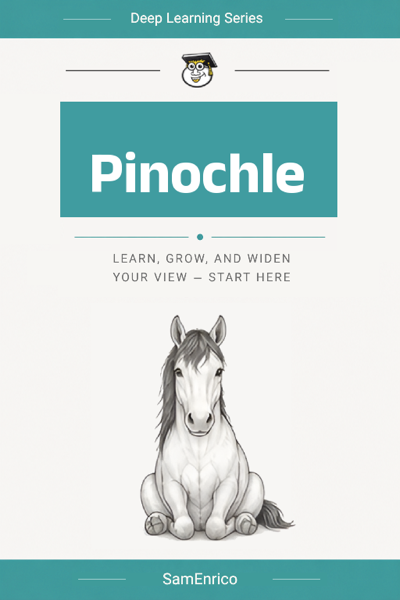
Non-FictionInformativeEducational
Pinochle
A Coursebook on Pinochle
A Coursebook on Pinochle
Formats
About this book
Free sample
Chapter 1: The Lost Deck...--In a smoky VFW hall in South Bend, Indiana, in the winter of 1953, four men sat around a scarred wooden table. They had just finished a hand of Pinochle that would be talked about for forty years. One of them, a one-eyed former Army sergeant named Mickey, had correctly called a double run in hearts, pulled trumps with surgical precision, and set his opponents by eighty-seven points. When asked how he did it, he tapped his temple and said, “The cards talk. You just have to learn the language.”That language is what this chapter teaches.Most card games whisper.
Poker murmurs about probability and bluff. Bridge speaks in the formal cadence of convention. But Pinochle? Pinochle shouts. It announces itself with meld laid boldly on the table, with bids that escalate like auctioneers at a cattle fair, with the slap of cards that says, “I have something you do not.”To understand Pinochle, you must first understand where it came from, what tools it requires, and how to sit at the table like someone who belongs there.
This is not a dry recitation of rules. This is an origin story, an equipment guide, and a code of conduct wrapped in the same package that turned a nineteenth-century French diversion into America’s sharpest card game.The Accidental Aristocrat: From Bezique to Buffalo Pinochle did not spring fully formed from the mind of a single inventor. It evolved, like jazz or barbecue, through the hands of people who took something good and made it better.The story begins with Bezique, a French card game popular among the aristocracy in the 1830s. Bezique used two decks, involved melding sequences, and rewarded players who could remember which cards had already appeared. It was elegant, slow, and played in parlors where servants refilled wine glasses between hands.Then came the Germans.German immigrants knew Bezique as Binokel, a name derived from the German word for “binoculars” – a reference to the two decks being used together, like two lenses focusing on the same hand.
When these immigrants crossed the Atlantic in the mid-nineteenth century, they brought Binokel with them in steamer trunks alongside hymn…
This is the end of the free sample. Get the eBook to keep going. Buy now
Contents
- Chapter 1
- Chapter 2
- Chapter 3
- Chapter 4
- Chapter 5
- Chapter 6
- Chapter 7
- Chapter 8
- Chapter 9
- Chapter 10
- Chapter 11
- Chapter 12
Details
- Author
- Huntley Sheridan
- Publisher
- SamEnrico
- Language
- English
- Genre
- Non-Fiction, Informative, Educational
- Released
- 2026-05-06
- Pages (approx.)
- 117
- Available as
- eBook, Audiobook

Read better in the ZLOADR app
Your eBooks on your phone or tablet. Sign in with your SamEnrico account and start reading.
More by Huntley Sheridan
 Lower Back Stretch ProtocolHuntley Sheridan$11.99
 Resentment Release Meditation GuideHuntley Sheridan$11.99
 TM Peak ExperiencesHuntley Sheridan$11.99
 Plant Based Pregnancy Nutrition GuideHuntley Sheridan$11.99
 Imposter Syndrome and Career TransitionsHuntley Sheridan$11.99
 The First and the Last: The Untold Story of the Titanic's Final Radio OperatorHuntley Sheridan$11.99
 Operation Mockingbird: The CIA’s Media MisfireHuntley Sheridan$11.99
 Understanding Creatine DeficiencyHuntley Sheridan$17.99
 Small Entity Fee DiscountsHuntley Sheridan$12.99
 UN Office in Nairobi GuideHuntley Sheridan$12.99
 How to Start a Case for Flash Lamp Business (Beginners Guide)Huntley Sheridan$11.99
You may also like
 Hong Kong Handover 1997Dunn Johnnie$11.99
 Zumba For Postnatal Recovery CourseNeal Christian$11.99
 Zumba for BeginnersLadner Nikia$11.99
 YouTube Comment Mining GuideHumes Pandora$12.99
 Worry Box MeditationCarlin Rudy$11.99
 Workplace Stress MeditationNguyen Lynn$11.99
 Workplace Stress and Sleep RepairHawley Ivory$11.99
 Workplace Perfectionism CureDelaney Jeffry$11.99
 Workplace Injustice Anger GuideWallen Isabelle$11.99
 Work Addiction and Burnout LinkGreenwood Ester$11.99
 Women in Yoga and WellnessBeattie Galina$11.99
 Women in Stand Up ComedyChun Evangeline$11.99