
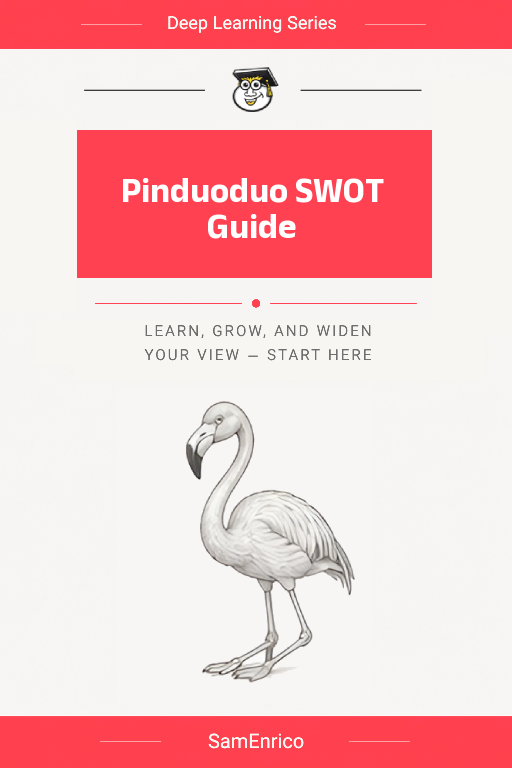
Non-FictionStrategic AtlasEcommerce
Pinduoduo SWOT Guide
Assess social commerce model, agricultural focus,
Assess social commerce model, agricultural focus, Temu international expansion, and competition from other marketplaces.
Formats
About this book
Free sample
Chapter 1: The Billion-Dollar Button--In 2015, a thirty-five-year-old former Google engineer named Colin Huang sat in a coffee shop in Shanghai and watched his mother bargain with a street vendor over a bag of oranges. She pulled out her phone, opened We Chat, and sent a voice message to three friends: “If we buy together, the price drops by half. Who’s in?” Within two minutes, she had her group. Within ten, she had her oranges. The vendor was happy.
His mother was happy. And Huang had his epiphany.What he witnessed was not a transaction. It was a social event. Shopping, in that moment, was not about search bars, shopping carts, or one-click checkout—the holy trinity of Western e-commerce. It was about relationships, shared risk, and the small thrill of unlocking a discount together.
Huang realized that the entire e-commerce industry had been optimizing for the wrong metric. Everyone was competing on speed, selection, and convenience. No one was competing on fun.That realization became Pinduoduo. And within eight years, that coffee-shop insight would transform a startup into a nine-hundred-million-user juggernaut, disrupt the dominance of Alibaba and JD.com, launch a global assault via Temu, and force Amazon to build a clone just to stay relevant. This chapter tells the story of how a button—the “team purchase” button—became a billion-dollar idea, and why understanding its mechanics is essential to understanding everything that follows.The Underserved Billion: How Huang Saw What Everyone Else Missed To understand Pinduoduo’s rise, you must first understand what the incumbents were not seeing.
In 2015, China’s e-commerce market was a two-horse race. Alibaba’s Taobao and Tmall dominated the consumer-to-consumer and business-to-consumer spaces respectively, while JD.com had carved out a reputation for authenticity and lightning-fast delivery. Both companies were competing for the same customer: the urban, relatively affluent, tech-savvy shopper in China’s Tier 1 and Tier 2 cities—Beijing, Shanghai, Shenzhen, Guangzhou.Together, these cities represented roughly two hundred million consumers. That is a massive market by any standard. But China has 1.4 billion people.
Huang was less interested in the two hundred million than in the remaining 1.2 billion—the hundreds of millions of consumers…
This is the end of the free sample. Get the eBook to keep going. Buy now
Contents
- Chapter 1
- Chapter 2
- Chapter 3
- Chapter 4
- Chapter 5
- Chapter 6
- Chapter 7
- Chapter 8
- Chapter 9
- Chapter 10
- Chapter 11
- Chapter 12
Details
- Author
- Dancy Rhiannon
- Publisher
- SamEnrico
- Language
- English
- Genre
- Non-Fiction, Strategic Atlas, Ecommerce
- Released
- 2026-05-30
- Pages (approx.)
- 127
- Available as
- eBook, Audiobook

Read better in the ZLOADR app
Your eBooks on your phone or tablet. Sign in with your SamEnrico account and start reading.
More by Dancy Rhiannon
 Attempt Survivor Sexual AssaultDancy Rhiannon$11.99
 Prank Call KingDancy Rhiannon$11.99
 Retirement Savings by Age GuideDancy Rhiannon$11.99
 Loving Kindness for Emotional NeglectDancy Rhiannon$11.99
 Construction Zone Patience PrimerDancy Rhiannon$11.99
 The Silk and Steel of Burgundy: Isabella of Portugal's Fashion RevolutionDancy Rhiannon$11.99
 IT Build AnalystDancy Rhiannon$11.99
 African Student Abroad Scholarship GuideDancy Rhiannon$12.99
 Understanding Neural Tube Defects X LinkedDancy Rhiannon$17.99
 How to Become a Drip-box TenderDancy Rhiannon$11.99
You may also like
 Hong Kong Handover 1997Dunn Johnnie$11.99
 Zumba For Postnatal Recovery CourseNeal Christian$11.99
 Zumba for BeginnersLadner Nikia$11.99
 YouTube Comment Mining GuideHumes Pandora$12.99
 Worry Box MeditationCarlin Rudy$11.99
 Workplace Stress MeditationNguyen Lynn$11.99
 Workplace Stress and Sleep RepairHawley Ivory$11.99
 Workplace Perfectionism CureDelaney Jeffry$11.99
 Workplace Injustice Anger GuideWallen Isabelle$11.99
 Work Addiction and Burnout LinkGreenwood Ester$11.99
 Women in Yoga and WellnessBeattie Galina$11.99
 Women in Stand Up ComedyChun Evangeline$11.99