
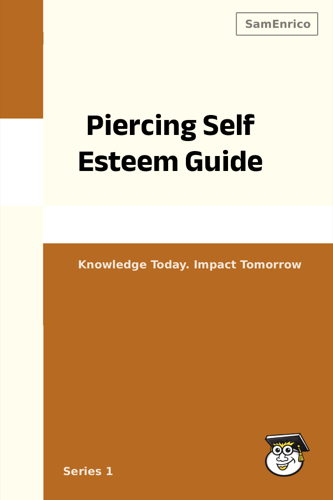
Non-FictionSelf-HelpBody Modification
Piercing Self Esteem Guide
Honors body modification choices without judgment
Honors body modification choices without judgment from conservative circles.
Formats
About this book
Free sample
Chapter 1: The Damage Myth--For as long as you can remember, you have been told, directly or silently, that the desire to modify your body is evidence of something wrong with you. A therapist once asked a client with a septum ring, "What are you trying to cover up?" A father looked at his daughter's new tattoo and said, "I didn't raise you to need that kind of attention." A hiring manager glanced at a candidate's visible forearm ink and thought, impulsive, maybe unstable. You have felt the weight of these assumptions even when no one spoke them aloud. The message is consistent and exhausting: if you want to pierce it, ink it, or stretch it, you must be broken, traumatized, rebellious, or suffering from low self-esteem.This chapter exists to name that assumption and then dismantle it, piece by piece, using historical research, contemporary psychology, and a concept we will call body literacy. By the time you finish these pages, you will understand why the "damaged modifier" stereotype is not only false but also historically recent, culturally specific, and scientifically unsupported.
More importantly, you will have the language and the evidence to stop carrying that assumption inside your own head.The Criminal Body: A Nineteenth-Century Invention The idea that body modification signals a defective character is not ancient wisdom. It is a relatively modern invention, born in the cramped offices of nineteenth-century criminologists who were desperate to find physical markers of moral failure. The most influential of these was Cesare Lombroso, an Italian physician who argued in his 1876 book Criminal Man that criminals could be identified by specific physical traits—sloping foreheads, asymmetrical faces, and, crucially, tattoos. Lombroso called these "atavistic stigmata," meaning biological throwbacks to an earlier, more primitive stage of human evolution. In his view, tattoos were not art or culture or identity.
They were symptoms of a degenerate mind trapped in a body that had failed to evolve properly.Lombroso's theories were popular in their time, but they have been thoroughly discredited by modern criminology, anthropology, and genetics. There is no such thing as a "born criminal" body…
This is the end of the free sample. Get the eBook to keep going. Buy now
Contents
- Chapter 1
- Chapter 2
- Chapter 3
- Chapter 4
- Chapter 5
- Chapter 6
- Chapter 7
- Chapter 8
- Chapter 9
- Chapter 10
- Chapter 11
- Chapter 12
Details
- Author
- Cantwell Santana
- Publisher
- SamEnrico
- Language
- English
- Genre
- Non-Fiction, Self-Help, Body Modification
- Released
- 2026-06-06
- Pages (approx.)
- 126
- Available as
- eBook, Audiobook

Read better in the ZLOADR app
Your eBooks on your phone or tablet. Sign in with your SamEnrico account and start reading.
More by Cantwell Santana
 French Resistance Fake IdentityCantwell Santana$11.99
 Senior Video Calling Self Esteem WorkbookCantwell Santana$11.99
 EQ For Academic AdvisorsCantwell Santana$11.99
 Emotional Intelligence for CaregiversCantwell Santana$11.99
 The Visionary Banker: Abubakar III and the Gold Standard of MaliCantwell Santana$11.99
 Medical DosimetristCantwell Santana$11.99
 How to Become a Seed-potato ArrangerCantwell Santana$11.99
 Procurement Automation ROI CalculatorCantwell Santana$12.99
 Strategy Meeting Action TrackerCantwell Santana$12.99
 Understanding Mandibuloacral DysplasiaCantwell Santana$17.99
You may also like
 Hong Kong Handover 1997Dunn Johnnie$11.99
 Zumba For Postnatal Recovery CourseNeal Christian$11.99
 Zumba for BeginnersLadner Nikia$11.99
 YouTube Comment Mining GuideHumes Pandora$12.99
 Worry Box MeditationCarlin Rudy$11.99
 Workplace Stress MeditationNguyen Lynn$11.99
 Workplace Stress and Sleep RepairHawley Ivory$11.99
 Workplace Perfectionism CureDelaney Jeffry$11.99
 Workplace Injustice Anger GuideWallen Isabelle$11.99
 Work Addiction and Burnout LinkGreenwood Ester$11.99
 Women in Yoga and WellnessBeattie Galina$11.99
 Women in Stand Up ComedyChun Evangeline$11.99