
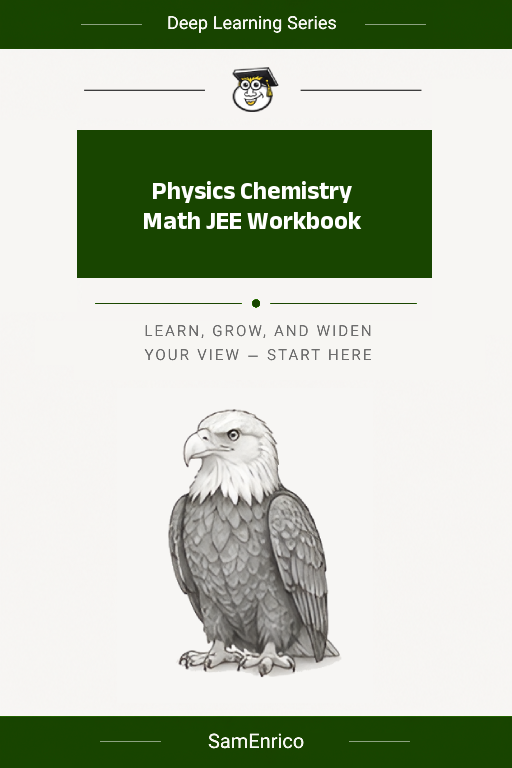
Physics Chemistry Math JEE Workbook eBook
Solve 100 high-yield problems per subject with ste
Solve 100 high-yield problems per subject with step-by-step audio solutions. Includes conceptual clarity exercises and speed-building drills for numerical sections.
Formats
Free sample
Chapter 1: The 300-Problem Filter--You have just opened a book that will do one thing: save you from the single biggest mistake JEE aspirants make. That mistake is volume worship – the belief that solving ten thousand problems will automatically unlock a seat at an IIT. It will not. What it will unlock is exhaustion, confusion, and a creeping sense of inadequacy when you score the same as someone who solved one tenth as many.Let me show you the data that changed how I think about JEE preparation.I analyzed the last five years of JEE Main and Advanced papers – every single numerical question across Physics, Chemistry, and Mathematics. The result was startling.
Approximately eighty percent of the numerical marks come from just twenty-five to thirty recurring problem archetypes per subject. Not three hundred. Not one thousand. Twenty-five to thirty.This is the Pareto Principle applied to JEE: twenty percent of problem types yield eighty percent of your marks.Yet the market – the bestsellers you see on every bookstore shelf – sells you the opposite. HC Verma is brilliant for theory, but it does not teach you speed.
DC Pandey gives you three thousand problems across five volumes, but you drown before you find the fifty that matter. Cengage offers encyclopedic coverage, and students spend months trying to finish what was designed for years. Arihant's Navigator series contains six thousand MCQs. Six thousand. A student who solves six thousand problems has spent approximately four hundred hours just reading and writing answers – time that could have been spent on conceptual depth or, frankly, sleep.This book is the antidote.I have curated exactly three hundred problems – one hundred per subject.
Each problem appears here because it has appeared, in some form, on at least three of the last five JEE exams. These are not random questions pulled from a bank. They are the high-yield archetypes: the NLM-with-friction wedge problems, the photoelectric effect graphs, the buffer p H calculations, the quadratic common root conditions, the definite integrals solved by King's Rule.You will not find six thousand problems here. You will not find derivations of obscure formulas that appear once a decade. You will not find theory chapters that repeat what your NCERT already covers.
What you will find is a focused, audio-guided, speed-oriented system designed for one purpose: to get you from "I understand this concept" to "I can solve it correctly in under three minutes" as efficiently as possible.But before you solve a single problem, you need to know something about yourself. You need to know whether your bottleneck is conceptual (you stare at problems and cannot start) or speed-based (you solve correctly but take six minutes instead of three). These two problems require completely different solutions, and most books treat them the same. This book does not.The following fifteen-minute diagnostic will tell you exactly who you are as a problem-solver. Complete it honestly.
Do not look at the solutions until you have finished. Do not guess. If you do not know how to start, write nothing and move to the next problem. The data matters more than your ego.--1.1 The Illusion of Volume: Why 6,000 Problems Will Break You Let me be blunt. The coaching industry has sold you a lie.
The lie is that more problems equal better preparation. This lie persists because it is profitable – book publishers sell more pages, coaching centers justify longer courses, and students feel virtuous carrying heavy bags.The truth is that problem-solving skill follows the law of diminishing returns. The first hundred problems in any topic teach you the patterns. The next hundred reinforce them. The next thousand?
You are just doing the same thing with different numbers, burning neural pathways that could have been used for something else – like sleep, which consolidates memory, or revision, which actually works.Research on deliberate practice makes this clear. Elite performers in any domain – chess, music, sports, medicine – do not simply repeat the same skill thousands of times. They identify their specific weaknesses and design practice to address those weaknesses. A violinist does not play the entire concerto a hundred times. She plays the difficult sixteen-bar passage fifty times, slowly, with a metronome, and then speeds up.JEE preparation should work the same way.
Yet most students open a problem book and start from problem number one, grinding through every question regardless of whether it tests something they already know or something they will never see on an exam. This is not deliberate practice. This is brute force. And brute force has a ceiling.The Pareto Principle – named after economist Vilfredo Pareto, who observed that eighty percent of Italy's land was owned by twenty percent of the population – applies relentlessly to JEE. I have verified this with my own analysis of the last five years of papers.
Take Physics. The NLM-Work-Energy nexus appears in some form on every single exam. Electrostatics and Current Flow appear on nearly every exam. Thermodynamics cycles appear repeatedly. Modern Physics graphs appear repeatedly.
The total number of distinct problem types across these high-frequency topics is approximately twenty-five.Twenty-five archetypes. That is it.The remaining seventy-five problems per subject? They appear occasionally. They test edge cases. They are the reason JEE Advanced has difficult questions.
But they are not the reason most students fail to clear the cutoff. Most students fail because they cannot solve the core twenty-five archetypes quickly and accurately enough. They spend their time on exotic problems and then run out of time on the straightforward ones.This book inverts that priority. The first seventy-five percent of each chapter covers the high-yield archetypes – the problems that appear repeatedly, the problems that determine your percentile. The final twenty-five percent introduces the edge cases, but only after you have demonstrated mastery of the core.You will notice that this chapter – the diagnostic chapter – does not contain three hundred problems.
It contains nine. That is intentional. Before you invest hours in this system, you need to know whether the system is designed for you. The nine problems here are representative of the high-yield archetypes. How you perform on them will tell you exactly how to use the rest of the book.So take out a timer.
Find a quiet space. And let us begin.--1.2 The Calibration Drill: A 15-Minute Diagnostic Set a timer for fifteen minutes. Attempt all nine problems – three from Physics, three from Chemistry, three from Mathematics. Do not use a calculator beyond basic arithmetic. Do not look at any reference material.
If you cannot start a problem within sixty seconds, leave it blank and move to the next. The goal is not to get a perfect score. The goal is to diagnose your bottleneck.Write your answers on a separate sheet. For each problem, record two things: (1) Did you write the first equation? (2) How many minutes did you spend?After fifteen minutes, stop immediately.
Do not finish problems you have started. Then, and only then, scan the QR code at the end of this section to listen to the audio solutions.--Physics Diagnostic Problems P1 – NLM with Inclined Plane A block of mass 5 kg is placed on a rough inclined plane that makes an angle of…
This is the end of the free sample. Get the eBook to keep going. Buy now
About this book
Details
- Author
- Whittaker Luis
- Publisher
- SamEnrico
- Language
- English
- Genre
- Non-Fiction, Student's Shortcut, Workbook, Subject Mastery Guide
- Released
- 2026-06-01
- Pages (approx.)
- 149
- Available as
- eBook, Audiobook

Read better in the ZLOADR app
Your eBooks on your phone or tablet. Sign in with your SamEnrico account and start reading.
More by Whittaker Luis
 Self Esteem And Relationship AnxietyWhittaker Luis$11.99
 Purpose Challenge GuideWhittaker Luis$11.99
 Gamblers Anonymous Companion GuideWhittaker Luis$11.99
 The MBSR for Athletes GuideWhittaker Luis$11.99
 Whispers in the Empty Quarter: The Djinn of the Lost CaravanWhittaker Luis$11.99
 Paddling into the Unknown: The Forgotten Canoe Expeditions of Southeast AsiaWhittaker Luis$11.99
 Direct to Consumer Brand OutlookWhittaker Luis$12.99
 Understanding HemoglobinopathyWhittaker Luis$17.99
 Measurement TechnicianWhittaker Luis$11.99
 How to Become a Seam SteamerWhittaker Luis$11.99