
Non-FictionHealth & WellnessCommunication
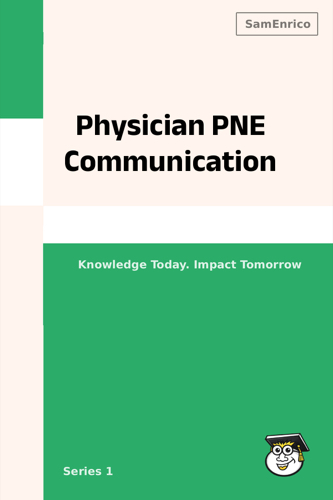
Physician PNE Communication eBook
Use language and metaphors that reduce patient fea
Use language and metaphors that reduce patient fear and catastrophizing.
Formats
Free sample
Chapter 1: The Security System--You have been taught that pain is a damage meter. A warning light on your body’s dashboard. When it glows red, something is broken. When it glows brighter, something is breaking more. When it persists, you must be falling apart.This is wrong.Not just slightly inaccurate.
Not just oversimplified. Fundamentally, dangerously, iatrogenically wrong.The damage meter model of pain has caused more suffering than any disease. It has turned strained backs into lifelong disabilities. It has turned normal age-related MRI findings into surgical catastrophes. It has turned millions of people who hurt into millions of people who believe they are broken.
And the most heartbreaking part? Most of them were told this by well-meaning physicians who thought they were helping.This chapter will dismantle the damage meter. In its place, we will build something truer, more useful, and infinitely more hopeful: the security system. By the time you finish these pages, you will never look at pain the same way again. Neither will your patients.The Most Dangerous Sentence in Medicine Let us begin with a story.A forty-two-year-old construction worker named Marcus lifts a beam the wrong way.
He feels a pop in his lower back. The pain is immediate and sharp. He goes to the emergency room. The physician orders an MRI. The radiologist’s report reads: “L4-L5 disc bulge with annular fissure.
Mild degenerative changes.”The physician reads this report, looks at Marcus, and says: “You have a bulging disc and early arthritis in your spine. You need to be careful. No more heavy lifting. Physical therapy twice a week. And honestly, with a back like this, you might want to think about a different line of work.”Marcus leaves the ER with a prescription for opioids, a referral to PT, and a new identity.
He is no longer a construction worker with a sore back. He is a man with a bad spine. A damaged spine. A spine that could go out at any moment.Six months later, Marcus cannot work. He has gained thirty pounds.
He avoids bending, twisting, lifting anything over ten pounds, and playing catch with his son. His pain is worse than the day of the injury. He believes—truly, deeply believes—that his spine is crumbling.Now consider a second story.A forty-two-year-old accountant named David lifts a box of files the wrong way. He feels a pop in his lower back. The pain is immediate and sharp.
He goes to the emergency room. The physician orders an MRI. The radiologist’s report reads exactly the same: “L4-L5 disc bulge with annular fissure. Mild degenerative changes.”But this physician has read this book. She looks at David and says: “Here is what we found.
About half of people your age without any back pain have exactly this MRI finding. Your body is doing what bodies do—it adapts to life. The question is not what your MRI shows. The question is why your alarm system is ringing when there is no intruder.”She pauses. Then she continues.
“Right now, your nervous system has learned to treat normal movement as dangerous. We are going to teach it otherwise. This will take time. But you are not broken. You have an overprotective alarm.
And alarms can be recalibrated.”David leaves the ER with a prescription for movement, a referral to a physical therapist trained in pain neuroscience, and a new identity. He is a man with a sensitive nervous system. A system that learned to be afraid and can learn to be calm.Six months later, David is back at work. He still has occasional twinges. He notices them, labels them as weather, and keeps moving.
His life is not his injury. His life is his response to his injury.Same MRI. Same age. Same initial injury. Radically different outcomes.The only difference was the language the physician used.This is not an isolated case.
Study after study shows that the words physicians choose directly predict patient outcomes. When patients hear threat-laden language—“degeneration,” “wear and tear,” “bulging,” “tear,” “instability”—they show higher pain intensity, greater disability, more healthcare utilization, and worse psychological outcomes up to two years later. When patients hear neutral or explanatory language—“normal age-related changes,” “overprotective nervous system,” “sensitive alarm,” “recoverable”—they recover faster, move more, and suffer less.The most dangerous sentence in medicine is not “You have cancer” or “We cannot cure this.” The most dangerous sentence in medicine is “Your MRI shows degeneration.”Because degeneration sounds like decay. Decay sounds like decline. And decline sounds like destiny.But it is not destiny.
It is interpretation. And interpretation can be changed.What Pain Actually Is (And What It Is Not)To change how we talk about pain, we must first change how we think about pain. Most physicians and patients share an implicit model: pain is a direct readout of tissue damage. More pain equals more damage. Less pain equals less damage.
Chronic pain equals ongoing damage.This model is intuitive. It matches everyday experience. Stub your toe, it hurts. Break your toe, it hurts more. Heal your toe, it stops hurting.The problem is that this model only works for acute pain from fresh tissue injury.
Once pain persists beyond normal healing time—typically three to six months—the damage meter model breaks down completely. And it breaks down because the underlying assumption is wrong.Pain is not a damage meter.Pain is a prediction of danger constructed by your brain.Let us unpack that sentence carefully.Your body contains a vast network of sensors called nociceptors. These sensors detect potentially threatening stimuli—extreme temperature, intense pressure, chemical irritants, tissue damage. When activated, they send signals up your spinal cord to your brain. This process is called nociception.Nociception is not pain.Nociception is raw data.
Like ones and zeros coming from a security camera. Your brain takes that raw data and combines it with other information: your memories of past injuries, your current emotional state, your beliefs about your body, your stress levels, your sleep quality, your context, your expectations, and a hundred other variables. From all of this, your brain makes a single decision: Is there danger? If the answer is yes, your brain produces pain.Pain is the output of this danger prediction system.This explains phenomena that the damage meter cannot explain. Phantom limb pain: a patient with no limb experiences intense pain because the brain still predicts danger from that missing body part.
The nociception is absent, but the pain is real. Stress-induced back pain: a patient under extreme pressure feels severe back pain despite no new tissue damage because the brain interprets stress as a threat and produces pain to motivate protective behavior. Placebo analgesia: a sugar pill reduces pain because the patient’s expectation of relief changes the brain’s danger calculation. Nocebo hyperalgesia: a warning that a touch “might hurt” increases pain because the expectation of threat activates the danger system.None of this makes sense under the damage meter model. All of it makes perfect sense under the danger prediction model.The Home Security System Here is the metaphor that will carry us through…
This is the end of the free sample. Get the eBook to keep going. Buy now
About this book
Details
- Author
- Addison Ernie
- Publisher
- SamEnrico
- Language
- English
- Genre
- Non-Fiction, Health & Wellness, Communication
- Released
- 2026-06-08
- Pages (approx.)
- 140
- Available as
- eBook, Audiobook

Read better in the ZLOADR app
Your eBooks on your phone or tablet. Sign in with your SamEnrico account and start reading.
More by Addison Ernie
 Financial Stress Forgiveness GuideAddison Ernie$11.99
 Sensory Overload Parent Rescue ManualAddison Ernie$11.99
 Childhood Anger Roots GuideAddison Ernie$11.99
 The Bone Collector: How the Wendigo Stole WinterAddison Ernie$11.99
 The Billion-Dollar Bet: How a Poker Player Bought the NBAAddison Ernie$11.99
 Understanding HyperchylomicronemiaAddison Ernie$17.99
 Rf Interference HuntingAddison Ernie$11.99
 Skills Translation WorkbookAddison Ernie$12.99
 Chronic Care Telehealth OutlookAddison Ernie$12.99
You may also like
 Hong Kong Handover 1997Dunn Johnnie$11.99
 Zumba For Postnatal Recovery CourseNeal Christian$11.99
 Zumba for BeginnersLadner Nikia$11.99
 YouTube Comment Mining GuideHumes Pandora$12.99
 Worry Box MeditationCarlin Rudy$11.99
 Workplace Stress MeditationNguyen Lynn$11.99
 Workplace Stress and Sleep RepairHawley Ivory$11.99
 Workplace Perfectionism CureDelaney Jeffry$11.99
 Workplace Injustice Anger GuideWallen Isabelle$11.99
 Work Addiction and Burnout LinkGreenwood Ester$11.99
 Women in Yoga and WellnessBeattie Galina$11.99
 Women in Stand Up ComedyChun Evangeline$11.99