
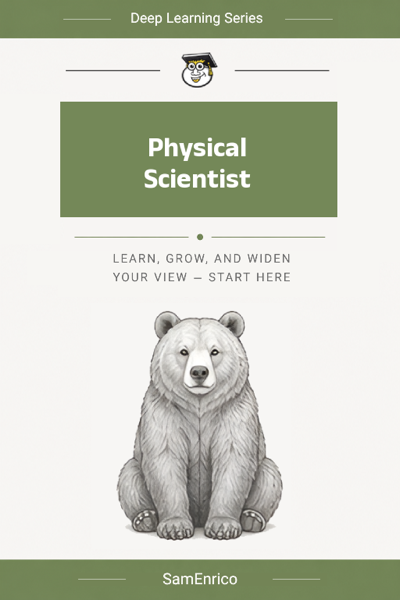
Non-FictionInformativeEducational
Physical Scientist Audiobook
A Coursebook on Physical Scientist
by Hinds Luanne
A Coursebook on Physical Scientist
Formats
Free sample
Chapter 1: The Curiosity Engine--The moment you asked “why” as a child, you became a scientist. The moment you demanded evidence, you became a physical scientist. This book is not a collection of formulas to memorize or procedures to robotically follow. It is an invitation to join a lineage that includes Galileo dropping spheres from the Leaning Tower of Pisa, Marie Curie extracting radium from tons of pitchblende, and the engineers who landed a nuclear-powered rover on Mars using nothing but mathematics and courage. Physical science is the most successful truth-finding enterprise humanity has ever devised.
But success does not come from genius alone. It comes from a disciplined, repeatable, and teachable way of thinking about the material world.This chapter establishes the philosophical, methodological, and epistemological foundations unique to physical science. Unlike biological systems, which evolve, reproduce, and adapt, physical systems—in physics, chemistry, earth science, and astronomy—are governed by universal laws that are typically deterministic, time-reversible at microscopic scales, and amenable to mathematical formulation. This distinction matters because it shapes how you design experiments, interpret data, and trust your conclusions. A physicist measuring the charge of an electron expects the same result tomorrow in Tokyo as today in Toronto.
A chemist synthesizing a crystal expects the same lattice structure regardless of who performs the synthesis. This reproducibility is not a happy accident. It is the direct consequence of a rigorous framework that this chapter will unpack.What Is Physical Science, Exactly?Physical science is the systematic study of non-living systems through observation, experimentation, and mathematical modeling. The term encompasses physics (matter, energy, space, time), chemistry (substances, reactions, bonding), earth science (geology, meteorology, oceanography), and astronomy (celestial bodies, cosmology). Despite their surface differences, these fields share a common core: they seek universal laws that describe how physical entities behave under specified conditions.The power of physical science lies in its ability to predict.
Newton's laws of motion predict where a cannonball will land. The ideal gas law predicts how pressure changes when you heat a sealed container. Quantum mechanics predicts the spectrum of light emitted by a hydrogen atom with twelve decimal places of accuracy. These predictions are not guesses. They are logical consequences of mathematical models that have survived thousands of experimental tests.
When a prediction fails, the scientist does not despair. She celebrates, because a failed prediction reveals a flaw in the model, and a flaw is…
This is the end of the free sample. Get the Audiobook to keep going. Buy now
About this book
Details
- Author
- Hinds Luanne
- Publisher
- SamEnrico
- Language
- English
- Genre
- Non-Fiction, Informative, Educational
- Released
- 2026-05-18
- Pages (approx.)
- 154
- Available as
- eBook, Audiobook

Listen in the VoxFlicks app
Audiobooks and audio dramas wherever you go. Sign in with your SamEnrico account and press play.
More by Hinds Luanne
 Logistics ESG ComparisonsHinds Luanne$11.99
 Cremation Burial Memorial Planning CourseHinds Luanne$11.99
 Stress And Witness AccuracyHinds Luanne$11.99
 Metta for Family ConflictHinds Luanne$11.99
 The Letting Go of Anger GuideHinds Luanne$11.99
 The Terracotta Warriors: How King Zheng Forged an EmpireHinds Luanne$11.99
 Business Email Credit ImpactHinds Luanne$12.99
 Connection Requests That Get AcceptedHinds Luanne$12.99
 Understanding Say–Meyer SyndromeHinds Luanne$17.99
 How to Become a Drying-unit-felting-machine OperatorHinds Luanne$11.99
You may also like
 Hong Kong Handover 1997Dunn Johnnie$11.99
 Zumba For Postnatal Recovery CourseNeal Christian$11.99
 Zumba for BeginnersLadner Nikia$11.99
 YouTube Comment Mining GuideHumes Pandora$12.99
 Worry Box MeditationCarlin Rudy$11.99
 Workplace Stress MeditationNguyen Lynn$11.99
 Workplace Stress and Sleep RepairHawley Ivory$11.99
 Workplace Perfectionism CureDelaney Jeffry$11.99
 Workplace Injustice Anger GuideWallen Isabelle$11.99
 Work Addiction and Burnout LinkGreenwood Ester$11.99
 Women in Yoga and WellnessBeattie Galina$11.99
 Women in Stand Up ComedyChun Evangeline$11.99