
Non-FictionSelf-HelpPhysical Autonomy
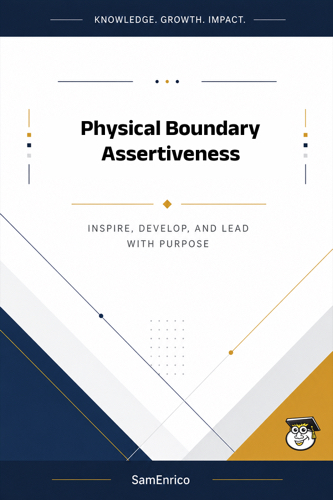
Physical Boundary Assertiveness eBook
Tell people to stop unwanted touching and respect
Tell people to stop unwanted touching and respect your space.
Formats
Free sample
Chapter 1: The Invasion Spectrum...--–- You’re standing at a family gathering, drink in hand, when your aunt spots you from across the room. Her face lights up. She drops her purse on a chair and barrels toward you, arms already outstretched. You have approximately four seconds to decide what to do. Your body knows before your brain does.
Your shoulders rise toward your ears. Your rib cage compresses. Your feet, traitors that they are, do not move. She arrives. The hug happens.
It is not violent. It is not illegal. It is not even, by most standards, remarkable. And yet, as her arms close around you, you feel something you cannot quite name—a shrinking, a swallowing, a small death of your right to say no. Later, in the car, you will rehash the moment.
Why didn’t you step back? Why didn’t you say something? Why is everyone else fine with this? The answer, which this chapter will lay bare, is that you have been trained to tolerate the invasion of your physical self as the price of being good. And that training starts now.The Problem No One Names Every day, millions of adults experience unwanted touch.
Not the kind that makes headlines. Not the kind with bruises or police reports. The kind that lives in the margins—the colleague who touches your shoulder during a meeting, the stranger on the bus who leans into your space because there are no empty seats, the neighbor who grabs your arm to emphasize a point, the friend who pulls you into a goodbye hug after you have already stiffened. These touches are not malicious. Often, the person doing them would be horrified to know they made you uncomfortable.
That is precisely why you say nothing. You tell yourself it’s not a big deal. You tell yourself you’re being too sensitive. You tell yourself that everyone else tolerates it, so you should too.But here is the truth that the rest of this book will teach you to act upon: unwanted touch is unwanted touch, regardless of intent. The person who pats your back meaning well does not make the pat less invasive.
The relative who demands a kiss because “that’s what we do in this family” does not have a right to your face. The boss who places a hand on your shoulder while giving feedback is not entitled to your body as a prop for their communication style. And yet, most of us have no framework for distinguishing between touches that are merely annoying, touches that are socially coerced, and touches that are outright violations. The Invasion Spectrum, introduced in this chapter, provides that framework.By the time you finish reading this chapter, you will have a name for every type of unwanted touch you have ever endured. You will understand why you freeze when you should speak.
You will learn that your personal bubble is not a metaphor—it is a biological reality with measurable dimensions. And you will begin the process of replacing shame with self-compassion. The remaining eleven chapters of this book will give you the scripts, the spatial tactics, the guilt detox, and the daily practices to turn that understanding into action. But first, you have to see the problem clearly. And that requires looking directly at what you have been trained to look away from.The Invasion Spectrum: Three Categories of Boundary Crossings Most people think of unwanted touch as a binary: either it’s assault, or it’s fine.
This binary is the enemy of assertiveness because it leaves an enormous middle ground where most unwanted touch actually lives. The Invasion Spectrum replaces the binary with three distinct categories, each requiring a different response. These categories are not judgments of the toucher’s character. They are assessments of the touch’s impact and context. You are the only person who can place a touch on this spectrum because you are the only person who feels it.Category One: Minor Annoyances Minor annoyances are low-stakes, high-frequency boundary crossings that are usually unintentional and often context-driven.
The bus leaner who settles into your space because the train is packed. The colleague who touches your arm while laughing at a story. The person in line who stands so close you can feel their breath on your neck. These touches are draining not because they are dangerous but because they accumulate. A hundred minor annoyances across a week add up to a constant low-grade erosion of your sense of bodily autonomy.The defining feature of a minor annoyance is that the person doing it would almost certainly stop if you asked—and would likely apologize.
They are not trying to dominate you or test your limits. They are simply oblivious, distracted, or operating under different cultural norms about personal space. This does not make the touch acceptable. It does mean that your response can be proportionate. A minor annoyance does not require a confrontation.
It requires a passive block, a step back, a repositioning of your body that signals “too close” without a word. (You will learn exactly how to do this in Chapter 6, the primary chapter on spatial tactics.)The danger of minor annoyances is not the annoyance itself. The danger is that they train you to tolerate intrusions. Every time you accept a touch you do not want, you strengthen the neural pathway that says “my comfort does not matter.” This is why the Fawn Response, which we will explore later in this chapter, is so insidious. It turns survival adaptations into personality traits.
You are not “easygoing” because you tolerate the bus leaner. You are disconnected from your own physical preferences. And that disconnection bleeds into every other area of your life.Category Two: Social Pressure Violations Social pressure violations are the most psychologically complex category because they are wrapped in the language of love, respect, tradition, or politeness. The relative who demands a kiss at a family gathering. The friend who says “I’m a hugger” as they move toward you, making your refusal a rejection of their identity.
The boss who pats your back repeatedly, framing it as encouragement. The in-law who grabs your arm and says “we don’t stand on ceremony here.” These touches are not accidental. They are intentional but not malicious. They are enforced by social contracts that you never signed.What makes social pressure violations so difficult to resist is that the cost of saying no feels enormous. If you refuse your aunt’s hug, you are not just refusing a hug—you are potentially disrupting the entire family system.
You are “being difficult.” You are “making things weird.” You are “hurting her feelings.” The toucher has weaponized their own comfort as a hostage. Your job, you have been taught, is to keep them comfortable by surrendering your body. This is not love. This is entitlement wearing a sweater.The defining feature of a social pressure violation is that the person doing it expects compliance. They may even feel genuinely confused or hurt when you push back, because they have never been told no.
This does not mean you owe them a yes. It does mean that your response needs to be clear, calm…
This is the end of the free sample. Get the eBook to keep going. Buy now
About this book
Details
- Author
- Meredith Yolando
- Publisher
- SamEnrico
- Language
- English
- Genre
- Non-Fiction, Self-Help, Physical Autonomy
- Released
- 2026-06-06
- Pages (approx.)
- 124
- Available as
- eBook, Audiobook

Read better in the ZLOADR app
Your eBooks on your phone or tablet. Sign in with your SamEnrico account and start reading.
More by Meredith Yolando
 The Family Hope GuideMeredith Yolando$11.99
 Fear of Failure in Social SettingsMeredith Yolando$11.99
 Provocation Reappraisal GuideMeredith Yolando$11.99
 Talking About Political DifferencesMeredith Yolando$11.99
 Gambling Debt Recovery GuideMeredith Yolando$11.99
 Plateau Due To Gut BacteriaMeredith Yolando$11.99
 HIIT for Busy ParentsMeredith Yolando$11.99
 The Wheels of Revolution: How Skateboarding Defied Dictators in 1970s ArgentinaMeredith Yolando$11.99
 The Leaked Love Letters: The Shocking Downfall of a Royal ScandalMeredith Yolando$11.99
 The Essential Guide to Urban CowboyMeredith Yolando$11.99
 Plum: European & JapaneseMeredith Yolando$11.99
 Coffee EU Country GuideMeredith Yolando$12.99
You may also like
 Hong Kong Handover 1997Dunn Johnnie$11.99
 Zumba For Postnatal Recovery CourseNeal Christian$11.99
 Zumba for BeginnersLadner Nikia$11.99
 YouTube Comment Mining GuideHumes Pandora$12.99
 Worry Box MeditationCarlin Rudy$11.99
 Workplace Stress MeditationNguyen Lynn$11.99
 Workplace Stress and Sleep RepairHawley Ivory$11.99
 Workplace Perfectionism CureDelaney Jeffry$11.99
 Workplace Injustice Anger GuideWallen Isabelle$11.99
 Work Addiction and Burnout LinkGreenwood Ester$11.99
 Women in Yoga and WellnessBeattie Galina$11.99
 Women in Stand Up ComedyChun Evangeline$11.99