
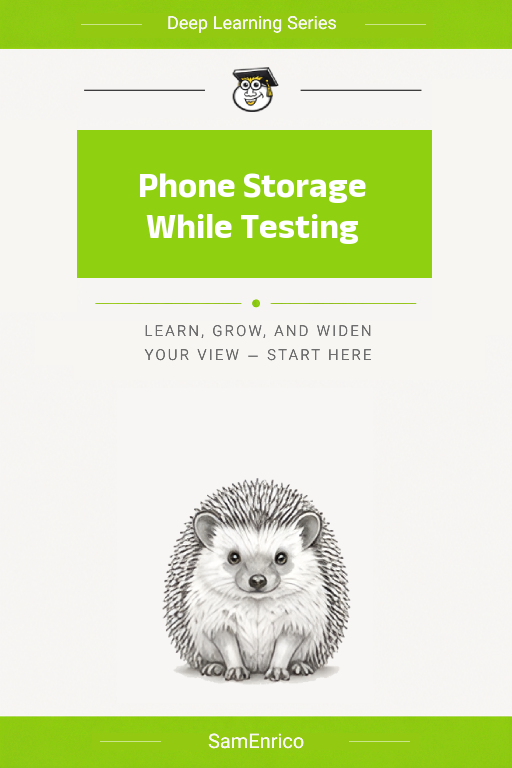
Non-FictionStudent's ShortcutPhone GuideDistraction Free
Phone Storage While Testing eBook
Store your phone away from testing area during pro
Store your phone away from testing area during proctored exams to avoid detection and suspicion of cheating.
Formats
Free sample
Chapter 1: The Pocket Grave...--The first time Maria lost an exam she never touched, she was sitting in row three of a fluorescent-lit lecture hall at a respected state university, her number-two pencil hovering over a Scantron bubble for question forty-seven. Her phone was in her backpack, zipped shut, powered off, and tucked under her chair exactly where the proctor had told everyone to place their bags. She had followed every rule. She had read the syllabus. She had even asked the teaching assistant beforehand whether “silent mode” was acceptable, and the TA had said, “Silent is fine, just don’t let it ring.”At 10:47 AM, twenty-three minutes before the exam ended, Maria’s phone vibrated once.Not a call.
Not a text. A calendar reminder she had set six months earlier for her dentist appointment. The phone was powered off—or so she believed. What she did not know, and what this chapter will teach you, is that modern smartphones do not truly power off the way a lamp turns off. They enter a low-power state where certain functions—alarms, reminders, and even Bluetooth beaconing—can still activate.
Her reminder triggered the vibration motor for exactly 1.2 seconds. The backpack’s fabric muffled the sound, but the vibration transferred through the nylon, into the chair leg, and created a low-frequency hum that the proctor, walking the aisle three rows away, felt through the soles of her shoes.The proctor stopped. She knelt beside Maria’s chair, unzipped the backpack without asking, and pulled out the phone. The screen was dark. The phone was, by every reasonable definition, off.
But the proctor wrote down Maria’s exam ID number and circled “Unauthorized Electronic Device” on a violation form.Maria protested. She explained about the dentist reminder. She showed the proctor the phone’s battery history proving it had not been unlocked in nine hours. None of it mattered. The university’s academic integrity policy stated, in bold letters: “Any electronic device that activates—by sound, vibration, or screen illumination—during a proctored exam will result in an automatic zero and a referral to the Student Conduct Office.”She appealed.
She lost. She retook the class the following semester, paid an additional $1,200 in tuition, and explained the academic misconduct notation on her law school applications for three years. She still got into a decent school, but not her first choice. Not even her second.Maria’s story is not rare. It is not extreme.
It is, by every metric available from academic integrity offices at fifty major universities, a quietly common catastrophe. And it happened because she believed a myth that this book will destroy on every page: the myth that silence equals safety.The Difference Between Policy and Security Before you can understand how to store your phone during a proctored exam, you must understand a distinction that most students never learn until it is too late. That distinction is between policy and security.Policy is the written rule. It is what appears on the syllabus, the exam instructions, or the testing center’s website. Policy says things like “All electronic devices must be turned off and stored out of sight” or “Phones placed in silent mode are permitted in bags.” Policy is designed to be simple, enforceable, and defensible in an academic hearing.
Policy is what the university tells you before the exam.Security is what actually happens during the exam. Security is the set of surveillance methods, detection technologies, and human behaviors that proctors use to catch violations. Security is not bound by the same simple language as policy. Security is opportunistic, aggressive, and often invisible. Security is what happens to you during the exam, regardless of what you read in the syllabus.Here is the critical insight that separates students who pass from students who get dragged into conduct hearings: Proctors do not enforce policy.
Proctors enforce security.When a proctor sees a phone on a desk, they do not stop to ask whether it is in silent mode. When a proctor hears a vibration, they do not check the syllabus to see whether reminders are exempt. When proctoring software detects a Bluetooth handshake between your laptop and your bag, it does not read the fine print about “good faith attempts to comply.” The security system flags you, and the policy system punishes you. The two systems never talk to each other in your defense.This chapter, and every chapter that follows, teaches you how to navigate security—not policy. Because policy is what you hope protects you after the fact.
Security is what actually determines whether you get caught.The Silent Mode Fallacy Let us name the most dangerous belief in proctored testing: the belief that putting your phone on silent or vibrate is sufficient.This belief persists because it is reinforced by casual language. Teaching assistants say “just silence your phones.” Syllabus language often says “phones must be silenced.” Even some testing center websites use the word “silent” as shorthand for “compliant.” But the word “silent” is a trap.Silent mode does three things, and only three things:It prevents the phone from playing ringtones for incoming calls.It prevents the phone from playing notification sounds for texts, emails, and app alerts.It may (depending on the phone model) disable the camera shutter sound.Silent mode does not disable the vibration motor. Silent mode does not prevent alarms or reminders from triggering. Silent mode does not stop Bluetooth or Wi-Fi from broadcasting beacon signals. Silent mode does not prevent screen illumination from notification previews if the phone is lifted or bumped.In other words, silent mode is a sound setting.
It has nothing to do with detection. And proctors are not listening for ringtones—they are watching for movement, feeling for vibration, and scanning for wireless signals.Consider the physics of vibration. A smartphone’s vibration motor is a small eccentric rotating mass (ERM) or a linear resonant actuator (LRA). When it activates, it spins or oscillates at a frequency between 100 and 200 Hertz. That vibration transfers through whatever surface the phone rests on.
If the phone is in a jacket pocket, the vibration transfers to your body—specifically to the muscles of your thigh, which will twitch imperceptibly. If the phone is in a bag on the floor, the vibration transfers to the floor tiles, then to the proctor’s feet if they are walking nearby. If the phone is in a backpack hanging from a chair, the vibration resonates through the chair’s frame, which amplifies the frequency.Proctors are trained to notice these effects. Not because they are physicists, but because they have watched thousands of students take exams. They have seen the subtle leg twitch.
They have felt the floor buzz. They have heard the low hum that is not a chair squeaking. And when they notice these things, they do not conduct an investigation to determine whether the phone was in silent mode. They write the violation.What “Off” Really Means (And Why It’s Complicated)If silent mode is insufficient, then surely powering off your phone is safe. Right?This is where the technical reality of modern smartphones becomes both fascinating and terrifying.…
This is the end of the free sample. Get the eBook to keep going. Buy now
About this book
Details
- Author
- Hutcherson Kym
- Publisher
- SamEnrico
- Language
- English
- Genre
- Non-Fiction, Student's Shortcut, Phone Guide, Distraction Free
- Released
- 2026-05-28
- Pages (approx.)
- 147
- Available as
- eBook, Audiobook

Read better in the ZLOADR app
Your eBooks on your phone or tablet. Sign in with your SamEnrico account and start reading.
More by Hutcherson Kym
 Gaming Addiction and ADHD WorkbookHutcherson Kym$11.99
 Hearing Conservation for MusiciansHutcherson Kym$11.99
 Parental Addiction and TheftHutcherson Kym$11.99
 HIIT for Calisthenics TrainingHutcherson Kym$11.99
 Smoking Cessation Sleep ImprovementHutcherson Kym$11.99
 Pill Poppers & Power Players: The Inside Story of the McKesson Drug EmpireHutcherson Kym$11.99
 The Pacific Pioneers: How Radio Telescopes Unlocked the Secrets of VenusHutcherson Kym$11.99
 Business Credit Card Strategy GuideHutcherson Kym$12.99
 Understanding Carpo Tarsal Osteolysis RecessiveHutcherson Kym$17.99
 How to Become a ButtonerHutcherson Kym$11.99
 Art TherapyHutcherson Kym$11.99
You may also like
 Hong Kong Handover 1997Dunn Johnnie$11.99
 Zumba For Postnatal Recovery CourseNeal Christian$11.99
 Zumba for BeginnersLadner Nikia$11.99
 YouTube Comment Mining GuideHumes Pandora$12.99
 Worry Box MeditationCarlin Rudy$11.99
 Workplace Stress MeditationNguyen Lynn$11.99
 Workplace Stress and Sleep RepairHawley Ivory$11.99
 Workplace Perfectionism CureDelaney Jeffry$11.99
 Workplace Injustice Anger GuideWallen Isabelle$11.99
 Work Addiction and Burnout LinkGreenwood Ester$11.99
 Women in Yoga and WellnessBeattie Galina$11.99
 Women in Stand Up ComedyChun Evangeline$11.99