
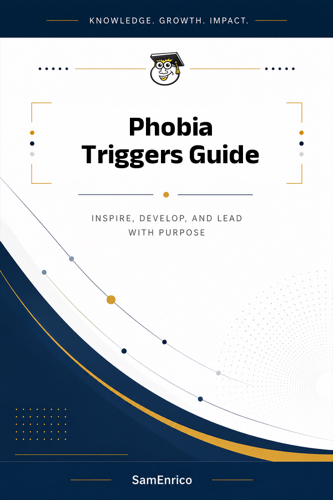
Phobia Triggers Guide eBook
Identify specific cues that set off panic and desi
Identify specific cues that set off panic and design hierarchies.
Formats
Free sample
Chapter 1: The Broken Label--–- The first thing you need to know is that your phobia is not what you think it is.Not the thing you run from. Not the animal, the height, the enclosed space, the needle, the flying tube of metal with wings. Those are just the stage decorations. The real phobia lives somewhere else entirely, and until you find it, every attempt to "face your fear" will feel like trying to kill a weed by cutting off the flower while the roots spread deeper underground.Let me prove it to you with a simple experiment.Think of your phobia right now. Whatever it is.
Spiders. Elevators. Public speaking. Flying. Needles.
The thing that makes your chest tighten just reading the word.Now answer this question honestly: Have you ever been in the presence of your phobic object and felt completely fine?Not once. Not ever. Every single encounter, without exception, has triggered panic.I do not believe you.Because here is the truth that every person with a phobia discovers when they start paying close attention: the fear is not consistent. You can walk past a spider on the sidewalk and feel only a flicker of unease, then later see a photo of a spider in a magazine and feel your throat close up. You can sit in a parked airplane for boarding and feel manageable anxiety, then lose your mind when the seatbelt sign dings.
You can give a presentation to five coworkers and stumble through it okay, then freeze completely when someone asks an unexpected question.The object did not change. The spider did not get bigger. The plane did not start moving. The question was not even hostile. So what changed?Everything.Because your phobia is not a fear of an object.
It is a fear of a specific constellation of cues—sights, sounds, body sensations, thoughts, contexts—that you have learned to treat as dangerous. When those cues are present, you panic. When they are absent, even if the object is right there, you might feel surprisingly calm.This is the single most important insight in this entire book. Read it again:Your phobia is not one thing. It is dozens of tiny triggers hiding under a single broken label.And once you understand that, everything changes.
Because you cannot fight a monster called "flying phobia." But you can absolutely learn to dismantle a list of thirty specific triggers, one by one, starting with the smallest and working your way up.This chapter teaches you to break the broken label. To become a detective of your own fear. To abandon vague, useless diagnoses like "I have a fear of heights" and replace them with forensic precision: "I panic when I see the ground through a glass floor, but I am fine on a solid balcony. I panic when I feel the floor sway, but not when I look at photos of tall buildings. I panic when I am alone near the edge, but not when my partner is holding my hand."That is not one phobia.
That is three completely different problems, each with its own solution. And by the end of this chapter, you will have your own list.The Lie of the Label Let me tell you about someone I will call Marcus.Marcus came to treatment convinced he had a "severe flying phobia." He had not been on a plane in twelve years. He had turned down promotions that required travel. He had driven eighteen hours to a family wedding rather than take a ninety-minute flight. He was certain that the problem was the plane itself—the metal tube, the altitude, the lack of control.I asked him to describe his last attempt to fly.
He had made it to the gate, boarded, sat in his seat, and then fled during the safety demonstration. What specific moment triggered the escape?He thought for a long time. Then he said: "The flight attendant closed the overhead bin."Not takeoff. Not turbulence. Not the plane leaving the gate.
The sound of the bin latching shut.We dug deeper. It turned out Marcus could sit in a stationary plane on the tarmac for hours with tolerable anxiety. He could watch videos of takeoff and landing without panic. He could even drive past the airport without issue. His phobia was not "flying." It was specifically the moment of no return—the sound that meant the door was about to close, the bins were locked, and he was committed.That sound was his trigger.
Not the plane. Not the altitude. Not the lack of control in the abstract. A specific auditory cue that lasted less than one second.Marcus spent twelve years avoiding planes because of one second of sound.We treated that trigger directly. He listened to recordings of bin latches at increasing volume.
He practiced staying in his seat while a therapist simulated the sound. He worked up to sitting on a real plane while the bins were closed around him. Within eight weeks, he flew to Chicago without panic. He still did not love turbulence. He still felt some anxiety during takeoff.
But the overwhelming, escape-driven terror was gone.Because the trigger was gone.This is not a miracle. This is how phobias work. The label "flying phobia" hid the real problem. Once Marcus found the actual cue—the bin latch sound—the solution became obvious.You have your own bin latch. It might be a specific smell, a certain time of day, the way someone looks at you, the feeling of your own heartbeat speeding up.
It is almost certainly not the object you think it is.Let us find it.Fear versus Phobia: The Critical Distinction Before we go any further, we need to understand what a phobia actually is. Because most people use the word "phobia" to mean "anything I really do not like," and that sloppiness has real consequences.Fear is a survival mechanism. It is proportional, specific, and useful. You feel fear when you are actually in danger—when a car swerves toward you, when you look down from a high ledge without a railing, when someone threatening approaches you in a dark parking lot. Fear makes you move faster, think more clearly in the short term, and take protective action.
Fear is your friend. Fear has kept your ancestors alive for millions of years.Phobia is a malfunction of that system. It is a learned, disproportionate dread that persists even when you know, intellectually, that there is no real threat. You know the spider in the sealed terrarium cannot hurt you. You know the elevator has been inspected and rated for twenty people.
You know the plane has a one in eleven million chance of crashing. But knowing does nothing. Your body reacts as if death is imminent.The diagnostic criteria for a phobia, from the clinical manual used by mental health professionals, include:Marked fear or anxiety about a specific object or situation The phobic object almost always provokes immediate fear or anxiety The phobic object is actively avoided or endured with intense fear The fear is out of proportion to the actual danger The fear…
This is the end of the free sample. Get the eBook to keep going. Buy now
About this book
Details
- Author
- Drummond Kaylene
- Publisher
- SamEnrico
- Language
- English
- Genre
- Non-Fiction, Health & Wellness
- Released
- 2026-06-09
- Pages (approx.)
- 134
- Available as
- eBook, Audiobook

Read better in the ZLOADR app
Your eBooks on your phone or tablet. Sign in with your SamEnrico account and start reading.
More by Drummond Kaylene
 Dog Sleeping MeditationDrummond Kaylene$11.99
 Benzo Taper Headache ManagementDrummond Kaylene$11.99
 Boomy Video Soundtrack GuideDrummond Kaylene$11.99
 Building a Sober Social Life ManualDrummond Kaylene$11.99
 The Fire This Time: The Lost Voices of the 1921 Tulsa Race Massacre in Harlem’s EchoesDrummond Kaylene$11.99
 Understanding Infant Epilepsy With Migrant Focal CrisisDrummond Kaylene$17.99
 Travel Tourism Spending OutlookDrummond Kaylene$12.99
 Turnitin Safe Editing ProtocolDrummond Kaylene$12.99
 A Beginners Guide to Bokator (Volume 1)Drummond Kaylene$11.99
 Application Penetration TesterDrummond Kaylene$11.99Application Penetration TesterDrummond Kaylene$11.99
You may also like
 Hong Kong Handover 1997Dunn Johnnie$11.99
 Zumba For Postnatal Recovery CourseNeal Christian$11.99
 Zumba for BeginnersLadner Nikia$11.99
 YouTube Comment Mining GuideHumes Pandora$12.99
 Worry Box MeditationCarlin Rudy$11.99
 Workplace Stress MeditationNguyen Lynn$11.99
 Workplace Stress and Sleep RepairHawley Ivory$11.99
 Workplace Perfectionism CureDelaney Jeffry$11.99
 Workplace Injustice Anger GuideWallen Isabelle$11.99
 Work Addiction and Burnout LinkGreenwood Ester$11.99
 Women in Yoga and WellnessBeattie Galina$11.99
 Women in Stand Up ComedyChun Evangeline$11.99