
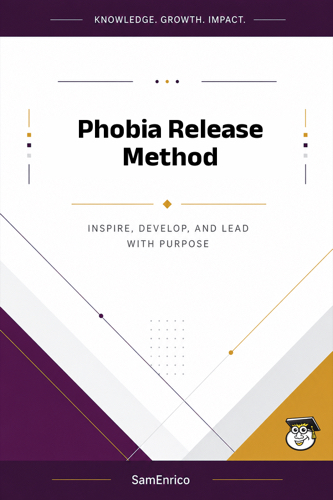
Phobia Release Method eBook
undefined
undefined
Formats
Free sample
Chapter 1: The Smoke Alarm That Never Sleeps--–- Imagine for a moment that a smoke alarm is installed inside your home. It is a perfectly functioning device—sensitive, responsive, and designed to protect you from the genuine threat of fire. One afternoon, you burn toast in the kitchen. A small wisp of smoke rises toward the ceiling. The alarm shrieks.
You wave a towel at it, the shrieking stops, and you go about your day. The alarm did its job, even though the threat was minimal. Now imagine that same smoke alarm, after years of being triggered by burnt toast, steam from the shower, and even dust motes floating through the air, becomes permanently hypersensitive. It shrieks not only when there is actual smoke but also when you simply walk past the toaster. It shrieks when you think about turning on the oven.
It shrieks at 3 a.m. for no reason at all. The alarm is not broken. It is doing exactly what it was designed to do—detect a potential threat and mobilize a response. But its calibration has drifted so far from reality that it has become a source of terror rather than a source of safety.
Your amygdala, a small almond-shaped cluster of nuclei deep within the temporal lobe of your brain, is that smoke alarm. And if you are reading this book, there is a very good chance that your amygdala has been screaming at you for years about threats that do not exist.This is not your fault. It is not a character flaw, a sign of weakness, a moral failing, or evidence that you are somehow "broken" compared to other people. Your brain has simply learned a pattern of fear that has become stuck—like a record player needle caught in a scratched groove, playing the same panicked loop over and over. The good news, and the central promise of this entire book, is that what the brain has learned, the brain can unlearn.
This is not wishful thinking or self-help platitude. It is neuroscience. The scientific concept that makes this possible is called neuroplasticity, and it is the single most important idea you will encounter in your journey from phobia to freedom. Neuroplasticity is the brain's lifelong ability to reorganize itself by forming new neural connections throughout life. It means that the neural circuits that currently scream "DANGER!" every time you see a spider, step into an elevator, or board an airplane can be weakened, pruned, and replaced with circuits that whisper, "This is uncomfortable, but I am safe." The process is not magic.
It is biology. And this book is your step-by-step manual for rewiring that biology.The Amygdala: Your Brain’s Hypervigilant Sentinel To understand why phobias feel so overwhelming, you must first understand the architecture of fear inside your own skull. The human brain is not a single unified organ but a collection of interconnected systems that evolved at different times. The oldest part, sometimes called the "reptilian brain," governs basic survival functions like breathing, heart rate, and the startle response. Wrapped around it is the limbic system, which includes the amygdala, the hippocampus (memory center), and the hypothalamus (which controls hormonal responses).
The newest part, the prefrontal cortex, is responsible for rational thought, planning, and impulse control. In a calm, well-regulated brain, these systems communicate smoothly. The prefrontal cortex can tell the amygdala, "Yes, I see that dark alley, but statistically, we are perfectly safe right now." In the phobic brain, however, the amygdala has learned to bypass the prefrontal cortex entirely. It fires its alarm signal before the rational brain even has a chance to weigh in.The amygdala's job is to detect threats and initiate the body's fight-or-flight response. It does this with astonishing speed.
In fact, research using functional magnetic resonance imaging (f MRI) has shown that the amygdala can detect a potential threat and trigger a physiological response in as little as 50 milliseconds—well before the conscious brain has even registered what it is seeing. This speed is essential for survival when a predator is lunging at you. It is catastrophically unhelpful when you are sitting in a waiting room or walking through a grocery store aisle. The amygdala does not distinguish between a genuine physical threat and a symbolic or anticipated one. It responds to a photograph of a snake the same way it would respond to a real snake.
It responds to the thought of giving a presentation the same way it would respond to being chased by a bear. This is why your heart pounds, your palms sweat, and your legs feel weak even when you know, rationally, that you are in no danger. The amygdala has already pressed the panic button. The rational brain is just along for the ride.The Chemistry of Panic: Adrenaline and Cortisol When your amygdala detects a threat—real or imagined—it sends an emergency signal to the hypothalamus, which acts as the brain's command center for the stress response. The hypothalamus activates the sympathetic nervous system, and within seconds, your body is flooded with two primary stress hormones: adrenaline (epinephrine) and cortisol.
These hormones are exquisitely designed to prepare you for physical action. They increase your heart rate to pump more blood to your muscles. They dilate your airways to take in more oxygen. They redirect blood flow away from non-essential systems like digestion and toward large muscle groups. They sharpen your focus into tunnel vision, blocking out peripheral details so you can concentrate on the threat.
They even trigger the release of glucose and fats into your bloodstream for quick energy. This is a miraculous survival system—when you actually need to run from a predator or fight an attacker.But here is the cruel irony of phobias: you are not running. You are not fighting. You are standing in an elevator, sitting in a dentist's chair, or looking at a photograph of a spider. Your body is flooded with survival hormones for which there is no physical outlet.
You cannot punch your way out of a fear of heights. You cannot outrun a panic attack triggered by a needle. So the energy that was meant for action becomes trapped inside your body, manifesting as trembling, nausea, dizziness, heart palpitations, and the terrifying sensation that you are about to die, go crazy, or lose all control. These sensations are not dangerous. They are uncomfortable.
They are frightening. But they are not harmful. No one has ever died from a panic attack. No one has ever gone insane from a phobic reaction. The body is simply doing what it evolved to do: preparing for a threat that is not actually there.
Learning to tolerate this discomfort without fighting it or fleeing from it is the foundation of recovery. But we are getting ahead of ourselves. First, you must understand that your phobia is a learned neural circuit.Neuroplasticity: The Brain’s Remarkable Ability to Change For much of the twentieth century, neuroscientists believed that the adult brain was fixed and immutable. They thought that after a critical period in childhood, the brain's structure was largely set in stone—you could lose neurons, but you could not grow new…
This is the end of the free sample. Get the eBook to keep going. Buy now
About this book
Details
- Author
- Menard Marleen
- Publisher
- SamEnrico
- Language
- English
- Genre
- Non-Fiction, Self-Help
- Released
- 2026-06-06
- Pages (approx.)
- 156
- Available as
- eBook, Audiobook

Read better in the ZLOADR app
Your eBooks on your phone or tablet. Sign in with your SamEnrico account and start reading.
More by Menard Marleen
 Nonprofit Relationship BuildingMenard Marleen$11.99
 Loneliness Church Small GroupMenard Marleen$11.99
 Text and Email Hard TalksMenard Marleen$11.99
 Senior Divorce RecoveryMenard Marleen$11.99
 Stress Vision Problems GuideMenard Marleen$11.99
 Preventing Entrepreneur BurnoutMenard Marleen$11.99
 The Park Name ErasedMenard Marleen$11.99
 Heist Blueprint RecreationMenard Marleen$11.99
 The Last Flight of the Red Baron: A Skybound GambleMenard Marleen$11.99
 The Last Empress: A Dynasty’s Echo in Modern JapanMenard Marleen$11.99
 Stardust Detectives: The Cosmic Mystery of the Wow! SignalMenard Marleen$11.99
 How to Become a House SitterMenard Marleen$11.99
You may also like
 Hong Kong Handover 1997Dunn Johnnie$11.99
 Zumba For Postnatal Recovery CourseNeal Christian$11.99
 Zumba for BeginnersLadner Nikia$11.99
 YouTube Comment Mining GuideHumes Pandora$12.99
 Worry Box MeditationCarlin Rudy$11.99
 Workplace Stress MeditationNguyen Lynn$11.99
 Workplace Stress and Sleep RepairHawley Ivory$11.99
 Workplace Perfectionism CureDelaney Jeffry$11.99
 Workplace Injustice Anger GuideWallen Isabelle$11.99
 Work Addiction and Burnout LinkGreenwood Ester$11.99
 Women in Yoga and WellnessBeattie Galina$11.99
 Women in Stand Up ComedyChun Evangeline$11.99