
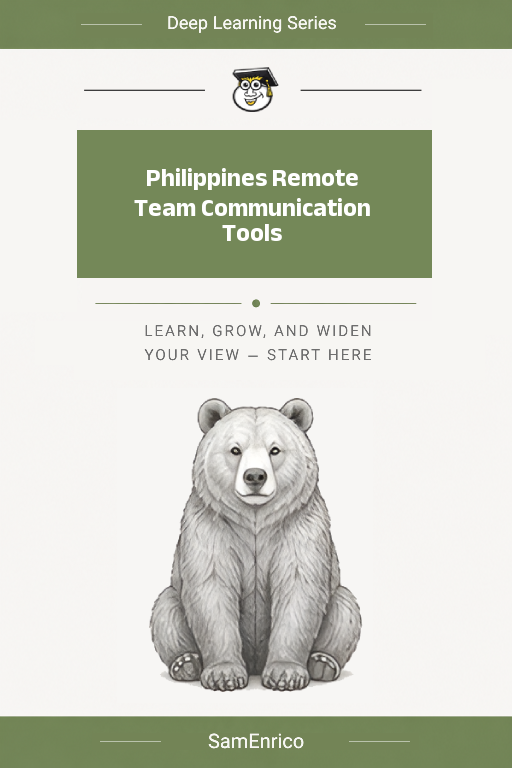
Philippines Remote Team Communication Tools
Adopt Slack, Zoom, and Asana for Filipino teams, u
by Ebert Elicia
Adopt Slack, Zoom, and Asana for Filipino teams, using mobile-first apps as many workers access internet primarily via smartphones.
Formats
About this book
Free sample
Chapter 1: The Mobile Tambayan--–- The first time I lost a Filipino virtual assistant, it wasn’t because of salary, skill, or performance. It was because of a tool. I had built what I believed was the perfect remote workflow: email for formal requests, Trello for task tracking, and Skype for daily check-ins. The system worked beautifully for my US-based team. My Filipino VA, Maria, lasted six weeks.
In her exit interview, she didn’t mention pay or hours. She said, “I felt like I was always guessing what you wanted. I didn’t want to ask and look stupid. And by the time I figured out the email chain, the day was over.”Maria wasn’t lazy. She wasn’t unskilled.
She was operating in a different communication universe—one defined by a small screen, intermittent connectivity, and a cultural instinct to preserve harmony over asking clarifying questions. I had copied and pasted a Western workflow into a Filipino context. It failed. This book exists because that failure is incredibly common, incredibly expensive, and completely avoidable.This chapter dismantles the single biggest mistake Western managers make when building remote teams in the Philippines: assuming that communication tools work the same way everywhere. They don’t.
The gap between a mouse-first, email-centric, desktop-designed workflow and a thumb-first, chat-driven, mobile-native reality is not a small gap. It is a chasm. And until you understand why, every tool you buy will be a waste of money.We begin with three foundational truths that will underpin every subsequent chapter. First, 89 percent of Filipino internet users access the web primarily through smartphones. Not laptops.
Not desktops. Smartphones. Second, Filipino communication culture prioritizes relational harmony over transactional clarity. And third, the tools that dominate Western remote work—email, linear project management, scheduled meetings—were never designed for the way Filipinos actually work. Understanding these truths is not optional.
It is the difference between a team that thrives and a team that turns over every ninety days.The Glass Office vs. The Mobile Tambayan Imagine a traditional American office. There are desks, monitors, keyboards, and a clear…
This is the end of the free sample. Get the eBook to keep going. Buy now
Contents
- Chapter 1
- Chapter 2
- Chapter 3
- Chapter 4
- Chapter 5
- Chapter 6
- Chapter 7
- Chapter 8
- Chapter 9
- Chapter 10
- Chapter 11
- Chapter 12
Details
- Author
- Ebert Elicia
- Publisher
- SamEnrico
- Language
- English
- Genre
- Non-Fiction, Business Brief
- Released
- 2026-06-01
- Pages (approx.)
- 131
- Available as
- eBook, Audiobook

Read better in the ZLOADR app
Your eBooks on your phone or tablet. Sign in with your SamEnrico account and start reading.
More by Ebert Elicia
 Niche Selection for Upwork SuccessEbert Elicia$11.99
 Low Frustration Tolerance CBTEbert Elicia$11.99
 NamUs Presumptive IdentificationsEbert Elicia$11.99
 The Hero Rescript MethodEbert Elicia$11.99
 The Staircase InductionEbert Elicia$11.99
 Technical Presentation SkillsEbert Elicia$11.99
 Night Sweat GuideEbert Elicia$11.99
 Albanian Jewelry Apprentice To DealerEbert Elicia$11.99
 The Last Breath of Cleopatra: A Funeral Fit for a QueenEbert Elicia$11.99
 The Dragon of the Black Forest: A Knight’s Last OathEbert Elicia$11.99
 How to Produce Non-metallic Mineral DepositEbert Elicia$11.99
 A Collector's Handbook to the Singer Nine RoadsterEbert Elicia$11.99
You may also like
 Hong Kong Handover 1997Dunn Johnnie$11.99
 Zumba For Postnatal Recovery CourseNeal Christian$11.99
 Zumba for BeginnersLadner Nikia$11.99
 YouTube Comment Mining GuideHumes Pandora$12.99
 Worry Box MeditationCarlin Rudy$11.99
 Workplace Stress MeditationNguyen Lynn$11.99
 Workplace Stress and Sleep RepairHawley Ivory$11.99
 Workplace Perfectionism CureDelaney Jeffry$11.99
 Workplace Injustice Anger GuideWallen Isabelle$11.99
 Work Addiction and Burnout LinkGreenwood Ester$11.99
 Women in Yoga and WellnessBeattie Galina$11.99
 Women in Stand Up ComedyChun Evangeline$11.99