
Non-FictionStudent's ShortcutPersonal Narrative
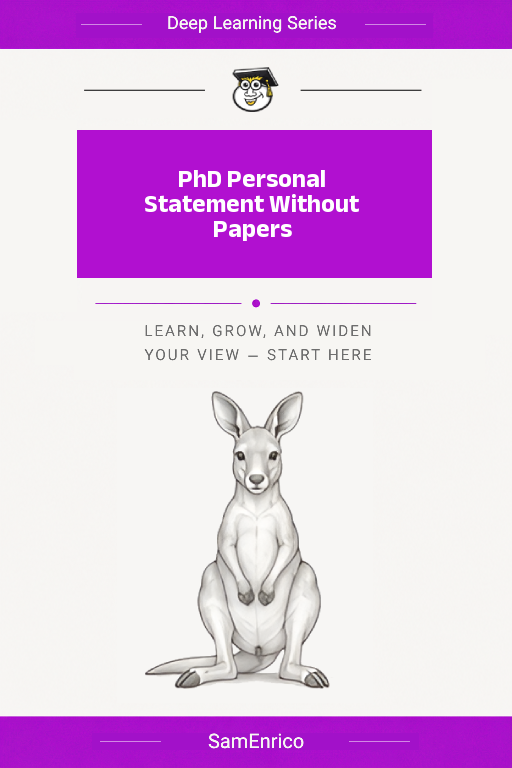
PhD Personal Statement Without Papers eBook
Craft a narrative that connects research interests
Craft a narrative that connects research interests, past projects, and future goals without relying on publication listings.
Formats
Free sample
Chapter 1: The Paper Mirage--–- You are staring at a blank document. The cursor blinks. Somewhere in your email inbox, a rejection letter from a journal sits unopened. Or maybe there is no rejection letter because you never even submitted. Maybe your undergraduate research project ended in a confusing mess of null results, a contaminated cell line, a PI who left for industry halfway through your thesis.
Maybe you have three summers of research experience but nothing to show for it except a poster from a campus symposium that your mother attended.And now you are supposed to convince a Ph D admissions committee—a room full of people who have published hundreds of papers collectively—that you belong in their program. Without a publication list. Without a first-author paper. Without a shiny Nature citation to wave like a flag.You are not alone. You are not behind.
And the absence of papers on your curriculum vitae is not the weakness you think it is.This chapter will dismantle the most damaging myth in graduate admissions: that you cannot compete without publications. It will introduce the core framework that will transform how you see your own research experience. And it will give you the first concrete tool—the Failure-to-Growth framework—that will become the backbone of your personal statement.The Myth That Keeps You Up at Night Let us name the monster. Most undergraduates believe that a first-author publication is the golden ticket to a top Ph D program. This belief festers in dark corners of Reddit forums, in pre-med locker rooms, in hushed conversations at research symposia where students compare CV lines like trading cards.
"Oh, you have a third-author paper? I have a second-author under review." "Wait, you have no papers? You might as well not apply."Here is the truth that admissions committee members have been saying for years, but applicants refuse to hear: the majority of admitted Ph D students do not have first-author publications. At most top programs in the life sciences, physical sciences, and engineering, fewer than 30 percent of incoming students have any peer-reviewed publication at all. At some programs, the number drops below 15 percent.How can this be?
Because correlation is not causation. Successful applicants often have papers, yes. But the causation runs the other way: strong scientists get papers and get admitted. The paper is a result of being a strong scientist. It is not the cause of admission.You can demonstrate that you are a strong scientist without the paper.
You can show the process that generates papers—curiosity, resilience, technical skill, intellectual ownership—without having crossed the finish line of publication. In fact, a well-told story of a failed experiment that taught you something profound is often more compelling than a third-author paper where you just ran gels.A recent analysis of admissions data from a top-ten biomedical program found that students with zero publications were admitted at nearly the same rate as students with one or two publications, provided they had strong letters of recommendation and a personal statement that demonstrated research maturity. The students who were rejected despite having publications? They were the ones whose statements read like lab reports: flat, procedural, devoid of intellectual curiosity.The paper is a mirage. The process is the proof.The Two Readers Who Live Inside Every Professor You have probably heard advice that splits admissions readers into two categories: the C.V.
Reader and the Narrative Seeker. The C.V. Reader, according to this framework, is a junior faculty member or postdoc who skims for checkboxes—GPA, GRE, publications, prestigious REUs. The Narrative Seeker is a senior faculty member who looks for evidence of scientific thinking. The advice usually goes: satisfy the C.V.
Reader with a clean application, then write for the Narrative Seeker.This advice is incomplete. And it creates a dangerous misunderstanding.Here is what actually happens. At almost every Ph D program, the same faculty member performs both roles in a single 2-to-4 minute read. There is no first filter and second filter. There is one exhausted professor, sitting in a windowless conference room in February, who has already read forty statements that day.
That professor has two cognitive modes running simultaneously:Mode One: The Filter (first 30 seconds). In these first thirty seconds, the professor is scanning for disqualifying features. Did this student take the required coursework? Do they have any research experience at all? Is their GPA above the departmental minimum?
Can they write a coherent English sentence? This mode is rapid, ruthless, and entirely about elimination. If you fail Mode One, you are out. Your statement will not receive a careful reading. Your beautiful narrative will never be seen.Mode Two: The Seeker (remaining 90 to 210 seconds).
If you pass Mode One, the professor slows down slightly and begins looking for evidence of scientific thinking. Curiosity. Persistence. The ability to frame a research question. Intellectual ownership of a project.
Resilience in the face of failure. This mode is still fast—ninety seconds for a mediocre statement, maybe three minutes for a compelling one—but it is no longer just checking boxes. It is looking for a person.The critical insight is this: your personal statement must serve both modes simultaneously in the same 2-to-4 minutes. It cannot be structured for one and then the other. Every paragraph, every sentence, every formatting choice must acknowledge that the person reading it is switching between filtering and seeking at lightning speed.How do you do that?You give them clean signals for Mode One.
Clear section breaks. White space. Topic sentences that announce what each paragraph contains. A logical flow that does not require a map. You do not make them hunt for your GPA or your research experience.
You put those things where they expect them—usually in your CV, but also signaled clearly in your statement.And then, within those clean signals, you give them narrative for Mode Two. You replace generic claims with specific details. You replace a list of techniques with a story of troubleshooting. You replace "I am passionate" with "I spent two weeks chasing a contamination problem and found it in the water source."This chapter will teach you the first major tool for satisfying Mode Two: the Failure-to-Growth framework. But first, we must address one more myth.Why "No Papers" Is Actually an Advantage Let me say something that will sound counterintuitive: having no publications can be an advantage if you frame it correctly.Here is why.
Admissions committees have learned to be skeptical of undergraduate publications. They know that a third-author paper on a six-person project might mean you ran two PCR reactions and your name got added out of kindness. They know that some undergraduate "publications" are in predatory journals that accept anything. They know that the signal-to-noise ratio on undergraduate publications is terrible.But a well-told failure? That signal is pure.When you describe a failed experiment with honesty and specificity, you demonstrate:Self-awareness (you know what went wrong)Intellectual honesty (you are not hiding your mistakes)Problem-solving skills (you tried to fix it)Resilience (you did not quit)Maturity (you learned something from the experience)These are the exact traits that predict Ph D completion.…
This is the end of the free sample. Get the eBook to keep going. Buy now
About this book
Details
- Author
- Mcginnis Chin
- Publisher
- SamEnrico
- Language
- English
- Genre
- Non-Fiction, Student's Shortcut, Personal Narrative
- Released
- 2026-05-30
- Pages (approx.)
- 145
- Available as
- eBook, Audiobook

Read better in the ZLOADR app
Your eBooks on your phone or tablet. Sign in with your SamEnrico account and start reading.
More by Mcginnis Chin
 Paralanguage Vocal Nonverbal Cues GuideMcginnis Chin$11.99
 Parenting Eating Disorder RecoveryMcginnis Chin$11.99
 Survey Data Aggregation with AIMcginnis Chin$11.99
 OCD And Tic Disorder OverlapMcginnis Chin$11.99
 The Silent Symphony: How a Deaf Composer Changed HollywoodMcginnis Chin$11.99
 Ash and Obsidian: The Volcanic Secrets of the Atlantic's Lost CivilizationsMcginnis Chin$11.99
 Understanding Campomelia Cumming TypeMcginnis Chin$17.99
 Zero Tuition German Master HandbookMcginnis Chin$12.99
 Azure ArchitectMcginnis Chin$11.99
 How to Start a Construction of Hospitals Business (Beginners Guide)Mcginnis Chin$11.99
You may also like
 Hong Kong Handover 1997Dunn Johnnie$11.99
 Zumba For Postnatal Recovery CourseNeal Christian$11.99
 Zumba for BeginnersLadner Nikia$11.99
 YouTube Comment Mining GuideHumes Pandora$12.99
 Worry Box MeditationCarlin Rudy$11.99
 Workplace Stress MeditationNguyen Lynn$11.99
 Workplace Stress and Sleep RepairHawley Ivory$11.99
 Workplace Perfectionism CureDelaney Jeffry$11.99
 Workplace Injustice Anger GuideWallen Isabelle$11.99
 Work Addiction and Burnout LinkGreenwood Ester$11.99
 Women in Yoga and WellnessBeattie Galina$11.99
 Women in Stand Up ComedyChun Evangeline$11.99