
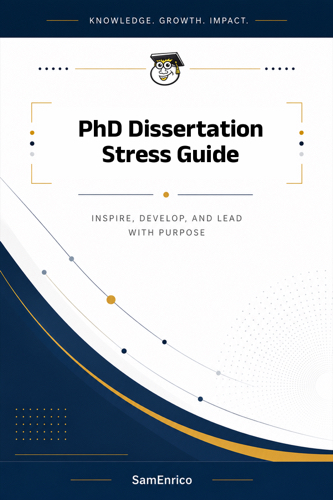
Non-FictionSelf-HelpDoctoral Studies
PhD Dissertation Stress Guide eBook
Break the dissertation into manageable milestones
by Bock Cheryll
Break the dissertation into manageable milestones and combat imposter syndrome.
Formats
Free sample
Chapter 1: The Stress Loop--In the spring of my third year, I spent eleven consecutive days unable to write a single sentence. Not because I didn't know what to say. I had three pages of notes, a clear outline approved by my advisor, and all the data cleaned and ready. I sat down every morning at 8:00 AM with coffee and good intentions. And every morning at 8:07, I found myself checking email.
Then reorganizing my reference manager. Then reading the news. Then cleaning my desk. Then wondering why I couldn't just write the damn sentence.On day eight, I started to believe something was wrong with me. Not academically wrong—existentially wrong.
The kind of wrong that meant I had made a mistake coming to graduate school. The kind of wrong that meant I wasn't cut out for this. The kind of wrong that meant everyone else could do this and I could not.On day eleven, I told my advisor I was struggling. She said something I have never forgotten: "You're not stuck because you're lazy. You're stuck because your brain thinks the dissertation is a predator."She was right.
And she was describing what this book calls the Stress Loop—a neurological trap that turns an open-ended intellectual project into a threat response, and then interprets your avoidance of that threat as evidence of incompetence. The Stress Loop is not a character flaw. It is not a sign that you don't belong. It is a predictable, wired, ancient response to a very specific kind of challenge: the long-haul, ambiguous, high-stakes project with no guardrails and no weekly validation.This chapter is about understanding that loop so you can begin to break it. Because you cannot solve a problem you cannot name.The Dissertation Is Not a Term Paper Before we talk about stress, we need to talk about scale.
Most doctoral students enter their programs as supremely successful undergraduates and master's students. You know how to write a term paper. You know how to study for an exam. You know how to please a professor within a ten-week quarter or a fifteen-week semester. These are important skills.
They are also almost entirely useless for the dissertation.A term paper has guardrails. There is a syllabus with clear deadlines. There is a rubric that tells you exactly what the professor wants. There are weekly lectures that chunk the material into digestible units. There are peers in the same class who are doing the same assignment at the same time.
And most importantly, there is a fixed endpoint: the paper is due on a specific date, after which you receive a grade and the task is finished forever.The dissertation has none of this.There is no syllabus for a dissertation. There are no weekly lectures. There is no cohort of peers doing the exact same chapter at the exact same time. There is no rubric that tells you what "good enough" looks like. There is no fixed endpoint—or rather, there is an endpoint so far in the future that your brain cannot use it to motivate daily action.
And unlike a term paper, which you can pull together in a caffeine-fueled weekend, the dissertation cannot be crammed. It is a multi-year project that requires sustained, self-directed, intrinsically motivated work.This is not a bug in the system. This is the feature. The dissertation is designed to test whether you can manage an open-ended research project without external structure. But the fact that it is designed to be hard does not make it feel less like a predator.The Stress Loop: How Your Brain Turns Ambiguity into Terror Here is what happens inside your skull when you sit down to write a dissertation chapter.You open your laptop.
You look at the blank document. You have a vague sense of what needs to go into this chapter—maybe a literature review, maybe a methodology section, maybe some analysis. But the path from where you are to a finished chapter is not a straight line. It is a branching tree of decisions. Which sources to include?
How much detail to provide? What to foreground and what to summarize? How to transition between paragraphs? How to know when you are done?Your brain, which evolved to detect threats in a savanna, does not know what to do with a branching tree of abstract decisions. It evolved to handle immediate, concrete threats: a lion, a rival tribe, a cliff edge.
When your brain cannot find a clear, immediate, concrete threat, it does not relax. It starts looking for one. And when it cannot find a lion, it starts treating the ambiguity itself as the threat.This is the amygdala—two small almond-shaped clusters of neurons deep in your brain that serve as your threat-detection system. The amygdala does not think. It reacts.
When it perceives a threat, it floods your body with cortisol and adrenaline, shuts down blood flow to your prefrontal cortex (the thinking part of your brain), and prepares you to fight, flee, or freeze. This is an ancient system. It kept your ancestors alive. It is also completely useless for writing a dissertation.When your amygdala activates, your prefrontal cortex—the part of your brain that does planning, reasoning, impulse control, and creative problem-solving—goes offline. You cannot write a sophisticated academic argument when your prefrontal cortex is offline.
You cannot analyze data. You cannot synthesize sources. You can only do simple, repetitive, low-cognitive tasks: checking email, cleaning your desk, reorganizing your files, scrolling social media.This is not laziness. This is neurology.Here is the cruel trick: after you spend an hour checking email and reorganizing your files, your prefrontal cortex comes back online. You look at the blank document.
You have written nothing. Your brain interprets this lack of progress as evidence that you are incompetent. The incompetence feels like a threat. The amygdala activates again. The loop repeats.This is the Stress Loop.Ambiguity triggers threat detection Amygdala activates, prefrontal cortex shuts down You avoid the threatening task (check email, clean desk)You make no progress Your brain interprets no progress as incompetence Incompetence feels like a threat Go to step 2The Stress Loop is why you can spend eight hours in your office and accomplish nothing.
It is why you feel exhausted after a day of "procrastination." It is why you start to believe that something is fundamentally wrong with you. The loop is self-reinforcing, and it is the single greatest barrier to finishing a dissertation.Procrastination Is Mood Management, Not Laziness Let me say this as clearly as I can: procrastination is not a time-management problem. It is a mood-management problem.When you procrastinate, you are not failing to organize your schedule. You are successfully managing your mood in the short term by escaping an aversive feeling. The dissertation feels threatening.
Checking email feels neutral or even pleasant. You choose the pleasant option. This is not laziness; it is a rational response to an aversive stimulus. Every animal on earth avoids aversive stimuli. You are not broken.
You are behaving exactly as your neurology predicts.The problem is that avoiding the aversive stimulus does not make it go…
This is the end of the free sample. Get the eBook to keep going. Buy now
About this book
Details
- Author
- Bock Cheryll
- Publisher
- SamEnrico
- Language
- English
- Genre
- Non-Fiction, Self-Help, Doctoral Studies
- Released
- 2026-06-09
- Pages (approx.)
- 150
- Available as
- eBook, Audiobook

Read better in the ZLOADR app
Your eBooks on your phone or tablet. Sign in with your SamEnrico account and start reading.
More by Bock Cheryll
 Networking Memory StrategiesBock Cheryll$11.99
 Food Addiction in Men WorkbookBock Cheryll$11.99
 Toxic Positivity WarningBock Cheryll$11.99
 Adrenal Fatigue and Thyroid LinkBock Cheryll$11.99
 Echoes of the Coral Sea: The Ancient Mariners of the Great Barrier ReefBock Cheryll$11.99
 Neon Shadows: The Forgotten Rebellion of Tokyo’s UndergroundBock Cheryll$11.99
 DraftspersonBock Cheryll$11.99
 Voiceover Character WorkBock Cheryll$12.99
 Children's Data Breach GuideBock Cheryll$12.99
 Understanding Ectrodactyly Cardiopathy DysmorphismBock Cheryll$17.99
 How to Become a Racing Secretary And HandicapperBock Cheryll$11.99
You may also like
 Hong Kong Handover 1997Dunn Johnnie$11.99
 Zumba For Postnatal Recovery CourseNeal Christian$11.99
 Zumba for BeginnersLadner Nikia$11.99
 YouTube Comment Mining GuideHumes Pandora$12.99
 Worry Box MeditationCarlin Rudy$11.99
 Workplace Stress MeditationNguyen Lynn$11.99
 Workplace Stress and Sleep RepairHawley Ivory$11.99
 Workplace Perfectionism CureDelaney Jeffry$11.99
 Workplace Injustice Anger GuideWallen Isabelle$11.99
 Work Addiction and Burnout LinkGreenwood Ester$11.99
 Women in Yoga and WellnessBeattie Galina$11.99
 Women in Stand Up ComedyChun Evangeline$11.99