
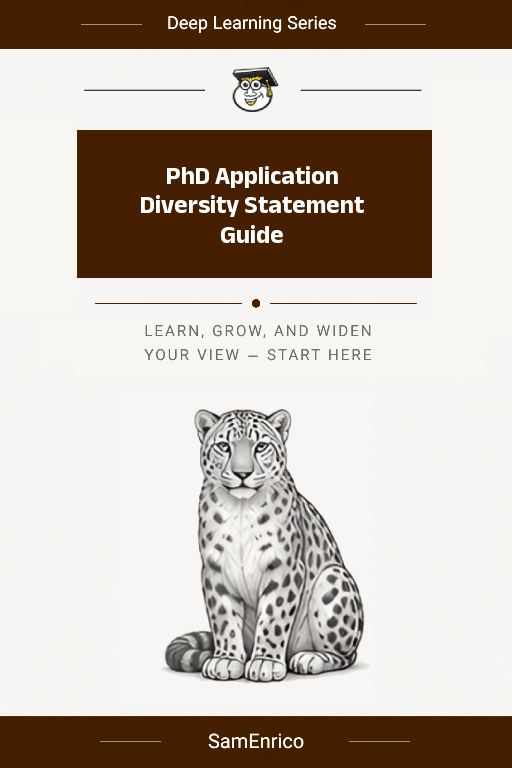
Non-FictionStudent's ShortcutDiversity
PhD Application Diversity Statement Guide eBook
Use diversity statements to explain non-traditiona
by Ezell Reagan
Use diversity statements to explain non-traditional paths that delayed publication opportunities.
Formats
Free sample
Chapter 1: The Productivity Myth--The first thing you need to understand is that the timeline you think is normal—high school at eighteen, bachelor’s degree at twenty-two, master’s at twenty-four, Ph D by twenty-six, first-author publication by twenty-seven—is not a law of nature. It is not even the historical norm. It is a relatively recent invention, and it is built on a set of assumptions that exclude most of the world’s population, most of history’s great thinkers, and probably you.If you are reading this book, you have likely internalized the belief that you are “behind.” You look at the CVs of your peers—or worse, the idealized profiles you find on grad school admission forums, Linked In, or faculty lab websites—and you see a clean, linear path. Undergraduate research assistant in year two. Poster presentation at a regional conference in year three.
A co-authorship in an undergraduate journal. Graduation. A post-baccalaureate research position. Two more publications. Then, finally, the Ph D application.
You, by contrast, have gaps. You have years where nothing appears on your CV because you were not in a lab; you were in a hospital room, a factory floor, a restaurant kitchen, a military base, or a therapist’s office. You have semesters that stretch into question marks. You have a publication record that ranges from “sparse” to “nonexistent.” And you have arrived at this book because somewhere, in a quiet moment of panic, you asked yourself: Am I already too late?The answer is no. But to understand why, you must first unlearn something.
You must dismantle what this chapter calls the productivity myth.The Productivity Myth Defined The productivity myth is the false belief that any deviation from a standardized, linear academic timeline indicates lower potential, lesser ability, or diminished worth as a future scholar. It is a myth because it confuses chronology with capability. It assumes that the eighteen-year-old who lands a research assistantship is necessarily more talented than the twenty-six-year-old who spent those years working as a paramedic. It assumes that the twenty-two-year-old with two conference posters is necessarily more prepared for a Ph D than the thirty-year-old who spent eight years in the military. It assumes that the absence of early output is evidence of an absence of ability—when in fact, decades of research suggest the opposite.The productivity myth thrives on a specific cultural narrative: the genius child, the prodigy, the young gun who publishes before finishing undergrad.
We celebrate these stories because they are exceptional. But we make a catastrophic error when we treat the exception as the expectation. Most Ph D applicants—including most successful ones—do not follow a linear path. Data from the Council of Graduate Schools indicates that the average age of a new doctoral student in the United States is thirty-one. Not twenty-two.
Not twenty-four. Thirty-one. The median time between bachelor’s degree and Ph D enrollment is nearly six years. That means half of all doctoral students took six or more years off between finishing college and starting graduate school. They worked.
They cared for family members. They served in the military. They recovered from illness. They paid off debt. They tried other careers and found them unsatisfying.
They took the scenic route. And then they applied—and were admitted—to Ph D programs.You are not behind. You are statistically normal.But statistics alone will not quiet the voice in your head that says, Yes, but those other people probably had publications anyway. This chapter has two additional tasks. First, it will show you how systemic barriers—not individual failings—produce the very publication gaps that make you feel inadequate.
Second, it will reframe your so-called “lost years” as evidence of precisely the skills that predict Ph D completion better than early publication counts. By the end of this chapter, you will not merely feel better about your timeline. You will understand why your timeline may be your greatest asset.The Data on Systemic Barriers: Why Early Publication Is Not a Meritocracy Let us begin with a hard truth. Academic publishing is not a pure meritocracy. It never has been.
Peer review is a human process, and humans carry biases—often unconsciously—that systematically disadvantage certain groups. These biases do not just affect who gets published. They affect who gets cited, who gets funded, who gets hired, and ultimately, who gets admitted to Ph D programs. If you have fewer publications than your traditional-path peers, it is worth asking: did they have access to opportunities that you did not? And were those opportunities distributed fairly?Consider the following data, which this chapter presents not to discourage you but to free you from the illusion that your publication count is a pure measure of your potential.Grant review bias.
A landmark study published in Nature found that when identical grant proposals are submitted with different names, those attributed to white male applicants receive significantly higher scores than those attributed to women and underrepresented minorities. Specifically, the study found that Black applicants were nearly 40 percent less likely to receive research funding than white applicants with identical qualifications. The reviewers did not believe they were being biased. They simply perceived the white male applicants as more “competent” and “productive” based on no evidence other than the name at the top of the page. If you are a woman, a person of color, or both, your proposals have statistically faced a higher bar from the very beginning.Editorial and peer review delays.
A comprehensive analysis of peer review times across dozens of journals found that papers authored by scholars from non-Western countries or from underrepresented racial and ethnic groups within Western countries take significantly longer to review than papers authored by white Western scholars. The gap averages between three and six weeks per review round. Over multiple rounds, that can delay publication by six months or more. For early-career researchers, six months can mean the difference between having a paper “in press” before application deadlines versus having nothing to show.Citation inequality. Even after publication, the playing field is uneven.
A large-scale study of citation patterns across neuroscience, sociology, and economics found that papers with women as first authors are cited significantly less often than papers with men as first authors, even when the papers are of comparable quality and published in the same journals. Similarly, papers from authors with non-Anglicized names receive fewer citations. Since citation counts are often used as a proxy for “impact” in Ph D applications and fellowship reviews, this bias compounds over time.The mentorship gap. Perhaps most relevant to your situation: undergraduate research opportunities are not distributed equally. A study published in the Journal of Higher Education found that first-generation college students are significantly less likely to be invited into faculty research labs than continuing-generation students, even when they have identical grades and expressed interest.
Why? Faculty mentors tend to recruit students they already know through informal networks, honors programs, and “research methods” courses that first-generation students often cannot fit into their schedules because they are working. The result is a self-perpetuating cycle: students without family connections to academia never get the mentorship that…
This is the end of the free sample. Get the eBook to keep going. Buy now
About this book
Details
- Author
- Ezell Reagan
- Publisher
- SamEnrico
- Language
- English
- Genre
- Non-Fiction, Student's Shortcut, Diversity
- Released
- 2026-05-30
- Pages (approx.)
- 149
- Available as
- eBook, Audiobook

Read better in the ZLOADR app
Your eBooks on your phone or tablet. Sign in with your SamEnrico account and start reading.
More by Ezell Reagan
 The 30 Day Metta ChallengeEzell Reagan$11.99
 Fermi's Atomic Pile PioneerEzell Reagan$11.99
 Drug Dependency and Healthcare ProfessionalsEzell Reagan$11.99
 Lying Eyes Spotting GuideEzell Reagan$11.99
 Self Talk for ConfidenceEzell Reagan$11.99
 Rodney Dangerfield NoEzell Reagan$11.99
 Anapanasati for Long LinesEzell Reagan$11.99
 David Tepper CarvanaEzell Reagan$11.99
 When the Sky Split Open: The First Words of the WorldEzell Reagan$11.99
 The Ghosts of Monte Cassino: Blood and Prayer in the Abruzzi MountainsEzell Reagan$11.99
 UI/UX Design Foundations and User-Centered DesignEzell Reagan$11.99
 How to Produce Blocks and Roll BagsEzell Reagan$11.99
You may also like
 Hong Kong Handover 1997Dunn Johnnie$11.99
 Zumba For Postnatal Recovery CourseNeal Christian$11.99
 Zumba for BeginnersLadner Nikia$11.99
 YouTube Comment Mining GuideHumes Pandora$12.99
 Worry Box MeditationCarlin Rudy$11.99
 Workplace Stress MeditationNguyen Lynn$11.99
 Workplace Stress and Sleep RepairHawley Ivory$11.99
 Workplace Perfectionism CureDelaney Jeffry$11.99
 Workplace Injustice Anger GuideWallen Isabelle$11.99
 Work Addiction and Burnout LinkGreenwood Ester$11.99
 Women in Yoga and WellnessBeattie Galina$11.99
 Women in Stand Up ComedyChun Evangeline$11.99