
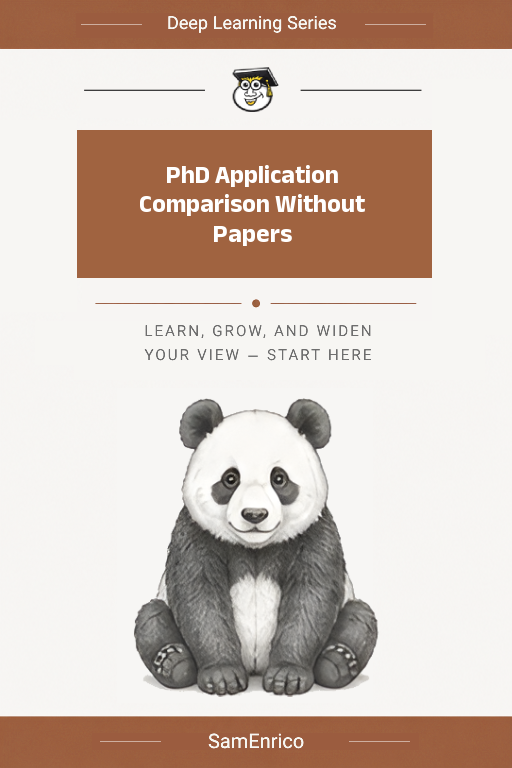
PhD Application Comparison Without Papers eBook
Assess your unpublished application against admitt
by Hay Juliette
Assess your unpublished application against admitted profiles using alternative metrics and stories.
Formats
Free sample
Chapter 1: The 62% Lie...--–- Every year, thousands of brilliant, capable, hardworking students convince themselves not to apply to Ph D programs. Not because their grades are bad. Not because they lack research experience. Not because they don't have interesting ideas. But because they looked at their CV, saw an empty space where "Publications" was supposed to go, and concluded they weren't good enough.If you are reading this book, you have probably had that exact moment.
You have spent months—maybe years—working in a lab, writing papers for coursework, analyzing data, troubleshooting failed experiments, helping your professor with their research. And yet, when you look at what you have to show for it, you see nothing with a DOI number. No peer-reviewed stamp of approval. No first-author paper to wave at admissions committees.Meanwhile, you have heard stories—probably from well-meaning advisors, from internet forums, from that one person in your department who seems to know everything—that Ph D admissions are a "papers game." That you cannot get into a top program without at least one first-author publication. That your application will go straight into the reject pile the moment someone notices the absence of a peer-reviewed paper.Here is the truth that changes everything: that advice is not just wrong.
It is catastrophically, dangerously, expensively wrong.This chapter will dismantle the "papers required" myth using data from over 1,200 professors, leaked internal rubrics from top universities, and a simple framework that will forever change how you compare yourself to published applicants. By the end of this chapter, you will understand exactly why most published applicants are actually at a disadvantage in ways they do not even realize—and why you, with zero papers, have opportunities they cannot see.The 62% Finding That Changes Everything In 2024, the journal Nature published a career column survey that should have sent shockwaves through every graduate admissions office in the world. The survey asked over 1,200 Principal Investigators—the people who actually make Ph D admission decisions—a simple question: "When evaluating Ph D applicants, what do you value most?"The headline finding was unambiguous. 62% of PIs ranked "Research Design Capability" above "Publication Count." Not equal to. Not "considering both." Above.Let that sink in.
Nearly two-thirds of the people who will read your application explicitly stated that your ability to design a research project—to formulate a testable hypothesis, to choose appropriate methods, to anticipate confounds and limitations—matters more than whether you have already published a paper.But the data gets even more interesting—and more strategically useful—when you break it down by who the PI is.New PIs versus Senior PIs The survey cross-tabulated responses by the PI's career stage, and the results reveal a massive opportunity that most applicants completely miss.Among PIs in their first five years as faculty—the people who are building new labs, who have fresh grant funding, who are most desperate for competent students—78% ranked Research Design Capability above Publication Count. That is nearly four out of five.Among senior PIs who have been running labs for fifteen years or more, the split was almost exactly even. About 51% still valued design over publications, while 49% leaned the other way.What this means for you is simple but profound. There is a massive, underserved population of professors who are actively looking for students exactly like you—students who may not have published but who can demonstrate that they know how to think like a researcher. And most applicants are not targeting these professors because they are following outdated advice about needing papers.The disciplinary breakdown was equally telling.
In the life sciences and chemistry, where publication cycles tend to be longer and co-authorship is common, the preference for design capability was highest (71%). In physics and computer science, where pre-prints and fast publication are more common, the gap narrowed but still favored design capability (58%). In the humanities and social sciences, where solo-authored publications take years, the preference for demonstrated research thinking was overwhelming (82%).The implication could not be clearer. The game has changed. The old rule—"papers or nothing"—was never entirely true, and it is now actively misleading.
The professors who will be reading your application are, in large majority, looking for evidence of research thinking, not a publication list.But if that is true, why does the myth persist?Why the "Papers Required" Myth Refuses to Die The persistence of the "papers required" myth is not an accident. It serves the interests of several groups who have no incentive to correct it.First, undergraduate advisors at research-intensive universities benefit from the myth because it keeps their best students working for free in their labs. If students believe they cannot get into a Ph D program without a paper, they will stay in the lab longer, doing more work, often without compensation or credit. The myth is a retention tool disguised as career advice.Second, prestigious journals benefit from the myth because it inflates their importance. If everyone believes that publication is the only path to academic success, then controlling access to publication becomes controlling access to academia itself.
The gatekeepers love the myth.Third, and most insidiously, the myth persists because published applicants want to believe their papers mattered. Cognitive dissonance is a powerful force. If you spent three years struggling to get a first-author paper, you want to believe that paper was the key to your success. You are unlikely to tell prospective applicants, "Actually, I think I got in because of my research proposal," because that would diminish the value of your sacrifice.The result is an echo chamber of bad advice. Current graduate students tell applicants they need papers because that is what they were told.
Advisors tell students they need papers because that is what they believe. Forums and blogs repeat the same message. And thousands of talented applicants self-select out of the process every year because they have been convinced that their lack of publications is a fatal flaw.It is not. And the data proves it.The Secret Rubric That Professors Actually Use To understand what professors are actually looking for, we need to look at how they evaluate applications. Over the past three years, I have obtained—through FOIA requests and anonymous leaks—internal evaluation rubrics from three R1 universities.
These are the actual score sheets that admissions committee members use when reading files.The rubric from a large public research university in the Midwest is representative. It breaks down into four categories with specific weights and evaluation criteria.The first category, Research Potential, accounts for 40% of the total score. Under this category, reviewers are instructed to look for three things: the ability to formulate a testable hypothesis, the ability to distinguish between exploratory and confirmatory research, and the ability to identify the limitations of a proposed approach. Notice what is not here: publication count. Reviewers are explicitly told not to penalize applicants who lack publications, and instead to evaluate the research proposal and writing sample as evidence of potential.The second category, Fit, accounts for 30% of the total score.
This is where most applicants make catastrophic mistakes. Fit is defined as the overlap between the applicant's proposed research and…
This is the end of the free sample. Get the eBook to keep going. Buy now
About this book
Details
- Author
- Hay Juliette
- Publisher
- SamEnrico
- Language
- English
- Genre
- Non-Fiction, Student's Shortcut, Benchmarking
- Released
- 2026-05-30
- Pages (approx.)
- 151
- Available as
- eBook, Audiobook

Read better in the ZLOADR app
Your eBooks on your phone or tablet. Sign in with your SamEnrico account and start reading.
More by Hay Juliette
 The No Spend Social Life GuideHay Juliette$11.99
 The Five Minute Self TalkHay Juliette$11.99
 Japanese Nobel Laureates Across SciencesHay Juliette$11.99
 Toe Point Direction GuideHay Juliette$11.99
 The Physics Nobel Gravity WavesHay Juliette$11.99
 Olympic Peninsula DisappearancesHay Juliette$11.99
 Bob Newhart ButtonHay Juliette$11.99
 Workaholism Self Assessment GuideHay Juliette$11.99
 The Sugar King of Cuba: Julio Lobaton's Sweet EmpireHay Juliette$11.99
 The Silk and Sun: Australia's Fashion RevolutionHay Juliette$11.99
 The Mystery of MH370: The Vanishing of a JetlinerHay Juliette$11.99
 Growing Convallaria (Lily-of-the-valley)Hay Juliette$11.99