
Non-FictionBusiness Brief / Pharma
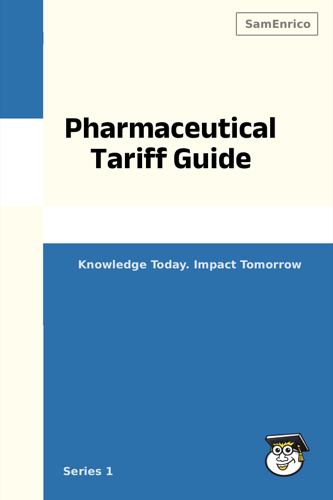
Pharmaceutical Tariff Guide eBook
Covers drug import duties, API classifications, an
by Clem Shandi
Covers drug import duties, API classifications, and medical device tariff codes.
Formats
Free sample
Chapter 1: The Classification Mirror--Tariffs do not care about your FDA approval. They do not care about your clinical trial results, your patent portfolio, or the number of lives your drug will save. At the border, a pharmaceutical product is stripped of its life-saving narrative and reduced to a single question: what are you? The answer determines whether your shipment clears customs in hours or weeks, whether your duty bill adds three percent or fifteen percent to your landed cost, and whether your supply chain thrives or merely survives.This is the Classification Mirror. And most pharmaceutical professionals have never truly looked into it.The Harmonized System—that sprawling, six-digit code structure used by over two hundred countries and territories—is the lens through which customs authorities see every product crossing their borders.
For the uninitiated, the HS is a bureaucratic maze of headings and subheadings, legal notes and interpretative rules. For the informed, it is a strategic tool. The difference between the two perspectives can mean millions of dollars in duty savings, months of avoided supply chain delays, and the difference between a compliant import program and one that invites audits, penalties, and reputational damage.This chapter builds the foundation upon which the entire book rests. It explains what the Harmonized System is, how it classifies pharmaceutical products, and where the critical battle lines are drawn—particularly the boundary between Chapter 29 (chemical intermediates) and Chapter 30 (finished medicaments). By the end of this chapter, you will understand the architecture of pharmaceutical tariffs and be equipped to navigate the classification decisions that determine your company's duty exposure.The Architecture of Global Trade Before diving into specific codes and chapters, it is essential to understand what the Harmonized System actually is.
The HS is not a random collection of numbers. It is a structured, hierarchical nomenclature developed and maintained by the World Customs Organization (WCO), an independent intergovernmental body based in Brussels. First implemented in 1988, the HS has been adopted by more than two hundred countries and customs territories, covering approximately ninety-eight percent of global trade.The system is organized into twenty-one sections, which are further divided into ninety-seven chapters. Chapters are numbered sequentially, with Chapter 1 covering live animals and Chapter 97 covering works of art. Each chapter contains headings (four-digit codes) and subheadings (six-digit codes).
For example, a six-digit HS code of 3004.90 might break down as: 30 (Chapter 30 – Pharmaceutical Products), 04 (Heading 3004 – Medicaments put up for retail sale), and 90 (Subheading – Other). Countries may add additional digits beyond six for national tariff purposes—the United States uses ten digits (HTSUS), the European Union uses eight or more (TARIC)—but the first six digits are harmonized globally.This harmonization is the genius of the system. A product classified under HS 3004 in Shanghai receives the same six-digit code in Chicago, London, and Tokyo. That common language allows customs authorities to apply consistent duty rates, collect trade statistics, and enforce regulatory requirements. But harmonization does not mean uniformity.
Countries can impose different duty rates on the same six-digit subheading, and they can add national notes that modify classification rules. Understanding both the global framework and national variations is essential for accurate classification.The General Interpretative Rules: The Constitution of Classification No discussion of the HS is complete without the General Interpretative Rules (GIRs). These six rules function as the constitution of classification. They dictate how to assign a code when a product could arguably fit into multiple headings, when the product is a mixture or combination, and when the product is incomplete or unassembled. Pharmaceutical professionals ignore the GIRs at their peril.Rule 1 is the starting point.
It states that classification is determined by the terms of the headings and any relative section or chapter notes. In plain English: read the actual words of the heading and the legal notes before doing anything else. If a product is described precisely in a heading, and no exclusionary note applies, the classification is settled. The problem, of course, is that most pharmaceutical products are not described precisely. They are blends, mixtures, intermediates, or novel formulations that stretch the boundaries of existing headings.When Rule 1 cannot resolve the classification, Rule 2(a) comes into play.
It addresses incomplete or unfinished articles that have the essential character of the complete article. For pharmaceuticals, this rarely applies. Rule 2(b) is more relevant: it covers mixtures and combinations of materials. This rule is the gateway to Rule 3.Rule 3 is where many pharmaceutical classification battles are fought. It has three parts, applied in sequence.
Rule 3(a) says that the most specific heading prevails over a more general heading. If one heading describes a product exactly and another describes it only generally, the specific heading wins. Rule 3(b) addresses mixtures, composite goods, and sets. It says that classification is determined by the component that gives the product its essential character. This is critical for combination products like drug-eluting stents, pre-filled syringes, and diagnostic kits that contain both reagents and devices.
Rule 3(c) is the fallback: if Rules 3(a) and 3(b) do not resolve the issue, the product is classified under the heading that occurs last in numerical order among those equally meriting consideration.Rules 4 through 6 provide additional guidance, but Rules 1, 2, and 3 handle the vast majority of pharmaceutical classification disputes. The key takeaway is this: classification is not a matter of intuition or convenience. It is a disciplined, rule-based analysis. Customs authorities apply these rules strictly, and importers who cannot articulate their reasoning under the GIRs will find their classifications rejected and their shipments delayed.Chapter 29: The World of Chemical Intermediates Chapter 29 of the Harmonized System covers "Organic Chemicals." This chapter is vast, containing forty-three headings and hundreds of subheadings. It includes everything from acyclic hydrocarbons (heading 2901) to heterocyclic compounds (heading 2933) to provitamins and vitamins (heading 2936).
For pharmaceutical professionals, Chapter 29 is where most active pharmaceutical ingredients (APIs) begin their journey.A pure, unformulated API—a single chemical entity with no excipients, no binders, no fillers—belongs in Chapter 29. It does not matter that the chemical has potent therapeutic effects. It does not matter that it is destined for a pharmaceutical factory where it will be compressed into tablets. For customs purposes, a chemical is a chemical until it is compounded with other ingredients or packaged for retail sale.Consider metformin hydrochloride. In its pure powder form, shipped in twenty-five kilogram fiber drums, metformin HCl is classified under HS 2933.59 (heterocyclic compounds containing a triazine ring).
The duty rate varies by country, but it is generally low—often zero to four percent in developed markets under most-favored-nation (MFN) treatment. This is because Chapter 29 chemicals are viewed as industrial inputs, not finished consumer goods. The tariff policy assumption is that these chemicals will undergo further manufacturing before reaching patients.But the line between a Chapter 29 chemical and a Chapter 30 medicament is not always clear. The WCO has issued hundreds of binding classification opinions on precisely this boundary. One recurring principle is that the addition of any excipient—even a trace amount of magnesium stearate or lactose—can move a product from Chapter 29 to Chapter 30.
Another principle is that the therapeutic intent of the product is irrelevant to classification. A poison intended only for laboratory use is still a chemical under Chapter 29.…
This is the end of the free sample. Get the eBook to keep going. Buy now
About this book
Details
- Author
- Clem Shandi
- Publisher
- SamEnrico
- Language
- English
- Genre
- Non-Fiction, Business Brief / Pharma
- Released
- 2026-06-09
- Pages (approx.)
- 152
- Available as
- eBook, Audiobook

Read better in the ZLOADR app
Your eBooks on your phone or tablet. Sign in with your SamEnrico account and start reading.
More by Clem Shandi
 Tobacco Cessation Apps And ToolsClem Shandi$11.99
 IBS Toilet Emergency KitClem Shandi$11.99
 Shopping Addiction and MinimalismClem Shandi$11.99
 Harald Hardrada: The Last Viking KingClem Shandi$11.99
 How to Produce ApartmentsClem Shandi$11.99
 Sponsorship While Studying WorkbookClem Shandi$12.99
 How to Start a Fertilisers (wholesale) Business (Beginners Guide)Clem Shandi$11.99
 Use of Force Continuum TrainingClem Shandi$11.99
You may also like
 Hong Kong Handover 1997Dunn Johnnie$11.99
 Zumba For Postnatal Recovery CourseNeal Christian$11.99
 Zumba for BeginnersLadner Nikia$11.99
 YouTube Comment Mining GuideHumes Pandora$12.99
 Worry Box MeditationCarlin Rudy$11.99
 Workplace Stress MeditationNguyen Lynn$11.99
 Workplace Stress and Sleep RepairHawley Ivory$11.99
 Workplace Perfectionism CureDelaney Jeffry$11.99
 Workplace Injustice Anger GuideWallen Isabelle$11.99
 Work Addiction and Burnout LinkGreenwood Ester$11.99
 Women in Yoga and WellnessBeattie Galina$11.99
 Women in Stand Up ComedyChun Evangeline$11.99