
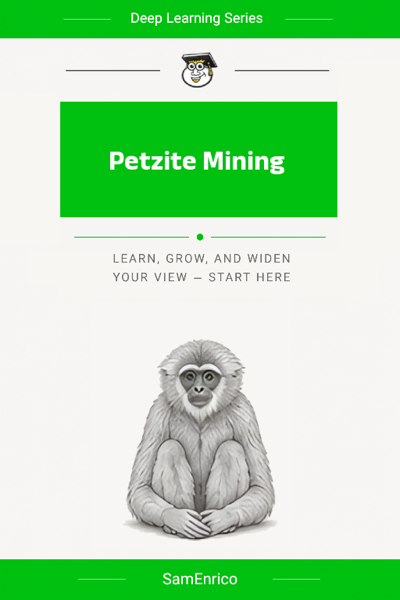
Petzite Mining eBook
A Coursebook on Petzite Mining
A Coursebook on Petzite Mining
Formats
Free sample
Chapter 1: The Devil‘s Gold--–- The air in the Romanian tunnel smelled of wet stone and something else—something sharp, metallic, and wrong. It was the summer of 1782, and the miners of Zlatna, high in the Transylvanian Alps, had spent three weeks chasing a dark vein that gleamed like aged silver but cut like cold butter under their picks. They called it “the devil’s gold” because it made men sick in ways they did not understand. Within days of breaking the ore, their breath turned foul—a sweet, garlicky stench that no amount of washing or chewing of herbs could mask. Their skin took on a grey pallor.
Their hands trembled. Some grew confused, forgetting the way back to the shaft entrance. A few, the oldest miners whispered, simply lay down in the darkness and never rose again.The mine foreman, a practical man named Iacob Măcelaru, had seen lung disease before. He had seen men crushed by falls of rock and men drowned in sudden floods from underground springs. But he had never seen a mineral that poisoned from the inside out, that turned a man into a ghost while he still breathed.
He ordered the vein sealed with timber and clay, and he wrote to the imperial mining office in Vienna: “We have encountered a black ore that kills by smell. I cannot recommend its extraction.”That letter, buried for decades in the Habsburg archives, marked the first recorded encounter with what would later be named Petzite. And it contained, in the foreman’s simple warning, the essential truth of this remarkable mineral: it has always been valuable, and it has always been dangerous. The same chemical property that makes Petzite a rich source of gold, silver, and tellurium—the element that gives the mineral its lethal character—also demands respect, knowledge, and careful engineering.This book is about that mineral. It is about the science of finding it, the art of mining it, and the ingenuity required to extract its wealth without sacrificing the health of workers or the integrity of the environment.
But before we descend into the technical details of comminution circuits, flotation chemistry, and pressure oxidation autoclaves, we must first understand what Petzite is, where it came from, and why a mineral that killed men in the 18th century is suddenly, urgently important in the 21st.The Discovery of a Forgotten Treasure The story of Petzite’s formal identification begins not in a mine but in a laboratory, half a century after Iacob Măcelaru sealed that fatal vein. Franz Joseph Petz was a Hungarian chemist of considerable skill and modest fame, working in Vienna during the great flowering of mineralogy that marked the mid-19th century. European science was obsessed with classification—with naming and ordering the natural world. New minerals were being discovered at a rate that had not been seen since the Renaissance, and Petz, like many of his contemporaries, was racing to claim his place in the scientific firmament.In 1845, Petz received samples from several Transylvanian mines, including the sealed vein at Zlatna. The ore was unlike anything described in the standard mineralogy texts.
It had a metallic luster, a dark grey to black color, and a curious property: it could be cut with a knife. This sectility, as mineralogists call it, was unusual for a gold-bearing mineral. Gold itself is malleable, but gold ores are typically hard, brittle, and resistant to the blade. This ore was not. It was soft, almost greasy to the touch, and when Petz scraped it across an unglazed porcelain plate, it left a grey-black streak—not the yellow or brown streak of common gold ores.Petz subjected the samples to a series of chemical analyses, dissolving them in acids, precipitating their components, weighing the residues.
The results surprised him. The mineral contained silver—a great deal of silver, nearly forty percent by weight. It contained gold—more than twenty percent in the purest samples. And it contained a third element that Petz had to test repeatedly to believe: tellurium, a rare, silvery-white metalloid that had been discovered only sixty years earlier, in 1782, by the Austrian mineralogist Franz-Joseph Müller von Reichenstein.Müller had found tellurium in the same Transylvanian mines that produced Petzite—a coincidence that speaks to the unique geochemistry of the region. Tellurium is one of the rarest stable elements in the Earth’s crust, less abundant than platinum, less abundant than gold itself.
It is so scarce that its very name derives from the Latin tellus, meaning “earth,” because its discoverer believed it to be a new form of antimony and wanted to honor the planet that produced such a curiosity.Petz combined his analytical results into a chemical formula: Ag₃Au Te₂. Three atoms of silver, one of gold, two of tellurium. He published his findings and, as was the custom, gave his name to the new mineral. Petzite entered the scientific literature in 1845, a footnote in the great catalog of Earth’s treasures.For nearly a century, that footnote remained obscure. Petzite was a collector’s curiosity, a specimen for museum cabinets and university teaching collections.
A few mining operations in Transylvania, Colorado, and Western Australia recognized its value—they could see the gold and silver shining in the dark matrix—but extracting those metals proved difficult. Conventional processing methods, the stamp mills and amalgamation tables that had served gold miners since Roman times, failed to capture the values locked in Petzite. The mineral seemed to resist every attempt to break it open. It was, in the language of metallurgists, refractory.The Refractory Riddle To understand why Petzite is refractory, we must look at its atomic structure. The gold and silver in Petzite are not present as free metals, nor are they merely trapped as microscopic grains within a surrounding gangue.
They are chemically bonded to tellurium in a crystal lattice—a repeating three-dimensional arrangement of atoms that holds the elements in a tight embrace.When a conventional gold ore is treated with cyanide, the cyanide ions attack the surface of native gold particles, forming a soluble complex that dissolves into solution. The process is elegant and efficient, recovering ninety percent or more of the gold from most ores. But cyanide cannot easily attack Petzite because the gold atoms are not exposed on the surface; they are shielded by tellurium and silver, locked in the crystal structure. The cyanide solution washes over the mineral particle and finds nothing to dissolve.Early miners, lacking this understanding, tried everything. They ground the ore to fine powders, hoping to expose more surface area.
They boiled it in mercury, hoping to form an amalgam. They heated it in furnaces, driving off sulfur and other volatiles. And sometimes, by accident, they discovered partial success. The roasting furnaces of Kalgoorlie, in Western Australia, produced acceptable recoveries not because the miners understood the chemistry but because the high heat broke the telluride bonds, oxidizing the tellurium and leaving behind porous gold and silver particles that cyanide could finally attack.But roasting, as we shall see in Chapter 7, creates its own problems. It releases toxic gases.
It consumes enormous energy. And it tells us nothing about the fundamental identity of Petzite—the question of what this mineral…
This is the end of the free sample. Get the eBook to keep going. Buy now
About this book
Details
- Author
- Guajardo Dalia
- Publisher
- SamEnrico
- Language
- English
- Genre
- Non-Fiction, Informative, Educational
- Released
- 2026-06-02
- Pages (approx.)
- 142
- Available as
- eBook, Audiobook

Read better in the ZLOADR app
Your eBooks on your phone or tablet. Sign in with your SamEnrico account and start reading.
More by Guajardo Dalia
 Outdoor HIIT WorkoutsGuajardo Dalia$11.99
 TikTok Perfection Illusion HandbookGuajardo Dalia$11.99
 Consumer Surplus Business UseGuajardo Dalia$11.99
 Night Eating Syndrome RecoveryGuajardo Dalia$11.99
 The King Street Escape: Canada's First Notorious Prison BreakGuajardo Dalia$11.99
 Learn to Play the ZhuihuGuajardo Dalia$11.99
 10 Ways to Use Green Cabbage (Recipe Book)Guajardo Dalia$11.99
 French Job Interview GuideGuajardo Dalia$12.99