
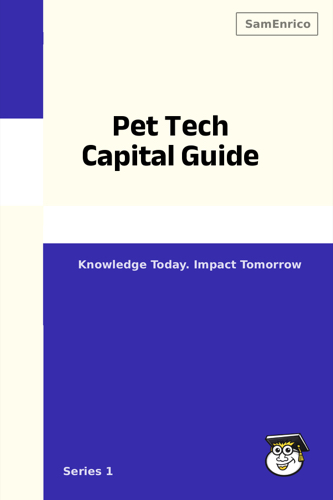
Non-FictionForecast & OutlookPet Technology
Pet Tech Capital Guide eBook
Deploy resources for pet wearables, tele vet, and
Deploy resources for pet wearables, tele vet, and pet care platforms.
Formats
Free sample
Chapter 1: The $3,000 Collar...--–- It arrived in a brushed aluminum box, lined with foam that mimicked the interior of a jewelry case. The GPS collar cost $3,000. It promised real-time health monitoring, escape alerts, and a direct line to a veterinary professional if the dog's heart rate strayed outside normal parameters. I bought it for a seven-year-old rescue mutt named Gus, who, within forty-eight hours, had chewed through the nylon strap, buried the aluminum housing in the backyard, and, as far as I could tell, never exhibited a single health anomaly beyond a deep and justified distrust of expensive consumer electronics.That was my introduction to pet tech investing, and it was a $3,000 tuition payment in the hardest school there is: the school of what actually happens when pets meet products.Gus did not care about the FDA clearance I had researched. He did not care about the subscription fee I had prepaid for twelve months.
He cared that the collar was slightly heavier than his old one, that it made a faint clicking sound when he shook his head, and that I kept staring at my phone instead of throwing the ball. In the calculus of pet technology, his vote mattered more than mine. And he voted no.This chapter is not about Gus, although we will return to him. This chapter is about the chasm between what pet owners believe they want, what investors believe will scale, and what pets will actually tolerate. If you do not understand that chasm, you will lose money.
Not slowly, not gracefully, but in the way I lost $3,000: quickly, with a pile of chewed nylon at your feet.Before we talk about market sizing, before we discuss CAGR or geographic arbitrage or any of the other tools in the capital allocator's toolkit, we have to talk about the fundamental asymmetry of pet tech. The person who pays is not the user. The user cannot speak. And the user has teeth.The Silent Third Stakeholder Most technology investing operates on a simple, linear model. A human identifies a pain point.
A human purchases a solution. A human uses the solution. Feedback loops are direct, verbal, and relatively fast. If the app crashes, the user writes a review. If the battery dies too quickly, the user returns the product.
The signals are noisy but legible.Pet tech breaks this model in three profound ways.First, the purchaser and the user are different species. This creates a signal problem of extraordinary magnitude. The pet owner observes behavior—pacing, lethargy, scratching—and attempts to infer the user's experience. But inference is not data. When a dog refuses to wear a collar, is it because the collar is uncomfortable, because the dog is stubborn, or because the dog has detected a high-frequency sound from the electronics that humans cannot hear?
The owner does not know. The dog cannot say. And the investor, sitting in a boardroom three thousand miles away, certainly does not know.Second, the user has no ability to provide explicit feedback and no ability to opt out with words. The dog opts out with behavior: chewing, hiding, refusing to move. This behavioral feedback is slower, messier, and更容易被误读 than a one-star app review.
A startup may raise a Series A based on glowing survey data from pet owners, only to discover six months later that 40% of the collars shipped are no longer on the dogs. The owners did not complain. They just stopped using the product. And because they stopped using it quietly, the startup continued to believe, right up until the moment of collapse, that everything was fine.Third, the user has agency that no software user possesses. A dog can destroy a product in ways that violate every assumption in your financial model.
Your unit economics assume a collar lasts eighteen months. The dog assumes the collar is a chew toy. These assumptions are not compatible.I have watched this asymmetry kill more pet tech startups than any other single factor. Founders build for the person with the credit card. They forget that the person with the teeth gets the final vote.The Guilt Economy Why do pet owners spend so much money on technology that often does not work?The answer is not rational.
It is emotional. And it is the single most important driver of revenue in the pet tech sector.Pet owners, particularly in the post-pandemic era, carry a specific and powerful form of guilt. They work long hours. They leave their pets alone. They travel.
They stare at screens instead of throwing balls. This guilt is not abstract; it is visceral, constant, and monetizable.Pet tech sells guilt relief. Every product is, at its core, a promise to alleviate the owner's anxiety. The GPS collar promises that you will never lose your dog because you were looking at your phone instead of watching the gate. The treat-dispensing camera promises that your dog will not starve for affection while you are at the office.
The activity monitor promises that if your dog is sick, you will know before it is too late, even though you missed the early signs because you were busy.This is not a criticism. I have bought all of these products. I will probably buy more. The guilt is real, and the relief, even temporary, feels valuable.But as an investor or founder, you must understand that guilt relief has a different demand curve than utility. When a product provides genuine utility, demand is elastic; when the price rises, some customers leave, but many stay because the product actually helps.
When a product provides guilt relief, demand is paradoxically inelastic at the point of purchase and hyper-elastic after purchase. The customer will pay almost anything to feel like a better pet owner in the moment of buying. But the moment the product fails to deliver relief—the moment the collar falls off, the camera disconnects, the app crashes—the customer feels not neutral but betrayed. They paid to feel less guilty, and instead they feel more guilty, plus poorer.This is why pet tech churn is so brutal. It is not just that the product failed.
It is that the product failed at its emotional job.I have seen data from a mid-sized pet wearable company that I cannot name publicly but can describe directionally. Their customer acquisition cost was $62. Their average order value was $89. Their first-month churn was 18%. The math did not work, obviously.
But here is what their retention surveys found: customers who churned did not report that the product malfunctioned. They reported that the product "did not make me feel better." That is a different problem. You can fix a malfunction. You cannot fix a feeling, except by delivering a different feeling.The Trifecta Framework This book organizes the pet tech opportunity into three categories: wearables, telemedicine, and smart platforms. These are not arbitrary buckets.
They represent three distinct ways of intervening in the pet owner's anxiety, three distinct capital requirements, and three distinct paths to exit.Wearables are the most visible and the most dangerous. They include GPS collars, activity monitors, health trackers, and any other device that attaches to the pet's body.…
This is the end of the free sample. Get the eBook to keep going. Buy now
About this book
Details
- Author
- Vang Anderson
- Publisher
- SamEnrico
- Language
- English
- Genre
- Non-Fiction, Forecast & Outlook, Pet Technology
- Released
- 2026-06-09
- Pages (approx.)
- 121
- Available as
- eBook, Audiobook

Read better in the ZLOADR app
Your eBooks on your phone or tablet. Sign in with your SamEnrico account and start reading.
More by Vang Anderson
 Audio Guided Self HypnosisVang Anderson$11.99
 The Candle Flame FocusVang Anderson$11.99
 OCD JournalVang Anderson$11.99
 MBSR for PregnancyVang Anderson$11.99
 Anchoring Scripts for HypnosisVang Anderson$11.99
 Menino BostonVang Anderson$11.99
 Intensive Care Nurse ResilienceVang Anderson$11.99
 Anger Role ReversalVang Anderson$11.99
 The Deep Dive: Africa's Underwater RevolutionVang Anderson$11.99
 The Architect's Gambit: Designing the City of GoldVang Anderson$11.99
 Echoes of the Apollo: The Lost Tapes of the Moon LandingVang Anderson$11.99
 Professional Ethics and Compliance AdvancedVang Anderson$11.99
You may also like
 Hong Kong Handover 1997Dunn Johnnie$11.99
 Zumba For Postnatal Recovery CourseNeal Christian$11.99
 Zumba for BeginnersLadner Nikia$11.99
 YouTube Comment Mining GuideHumes Pandora$12.99
 Worry Box MeditationCarlin Rudy$11.99
 Workplace Stress MeditationNguyen Lynn$11.99
 Workplace Stress and Sleep RepairHawley Ivory$11.99
 Workplace Perfectionism CureDelaney Jeffry$11.99
 Workplace Injustice Anger GuideWallen Isabelle$11.99
 Work Addiction and Burnout LinkGreenwood Ester$11.99
 Women in Yoga and WellnessBeattie Galina$11.99
 Women in Stand Up ComedyChun Evangeline$11.99