
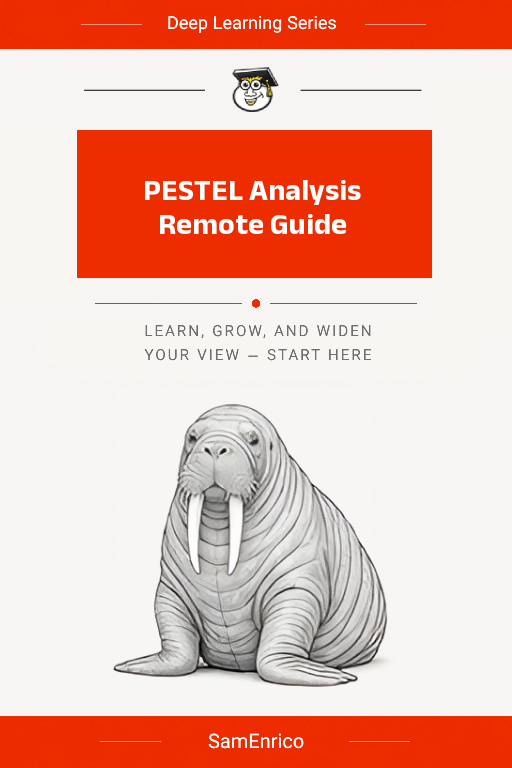
Non-FictionStartup GuidePESTEL AnalysisEnvironment
PESTEL Analysis Remote Guide eBook
Analyze macro environment factors using free onlin
Analyze macro environment factors using free online research tools from any coffee shop with Wi-Fi.
Formats
Free sample
Chapter 1: The End of Boardroom Supremacy--–- The first lie you were told about strategy is that you need a corner office to see the future. The second lie is that you need expensive databases. The third lie—the most dangerous one—is that macro-environmental analysis is something only large corporations with dedicated intelligence teams can afford to do properly. This book exists to demolish all three lies in a single, caffeine-fueled sitting.You are about to learn how to conduct professional-grade PESTEL analysis from any coffee shop with Wi-Fi, using only free online tools. No Bloomberg terminal.
No Statista subscription. No corporate library. Just your laptop, an internet connection, and a fundamentally different mindset about where strategic insights actually come from.Welcome to the era of the Laptop Strategist.The Myth of the Boardroom Advantage For decades, business schools and corporate training programs have perpetuated a seductive myth: that serious strategic analysis requires serious infrastructure. The myth goes something like this: to understand the macro-environment—Political, Economic, Social, Technological, Environmental, and Legal factors affecting your business—you need access to proprietary databases, expensive market research reports, and a team of dedicated analysts working from a centralized headquarters.This myth serves the interests of the institutions that profit from it. Database companies like Bloomberg and Reuters charge thousands of dollars per terminal annually.
Consulting firms sell six-figure reports that are often obsolete by the time they are printed. Business schools teach case studies that assume unlimited research budgets.But here is the truth that changes everything: the vast majority of information required for PESTEL analysis is already public. It is sitting on government websites, social media platforms, academic repositories, and open data portals—accessible to anyone with an internet connection and the knowledge of where to look.The only thing separating you from a "corporate strategist" is not access to information. It is access to training. This book provides that training.Why PESTEL Matters More Than Ever Before we dive into the "how," we must understand the "why." The external environment is changing faster today than at any point in modern history.
Consider what has happened in just the past five years: a global pandemic that reshaped work, consumption, and supply chains; inflation rates not seen in four decades; the rapid rise of generative artificial intelligence; a cascade of new regulations around data privacy and environmental reporting; shifting social attitudes toward remote work, sustainability, and corporate responsibility; and geopolitical instability that has redrawn trade routes and tariff schedules.In this environment, static strategic plans are obsolete before they are approved. The organizations that survive and thrive are not necessarily the ones with the most resources, but the ones with the fastest and most accurate environmental scanning capabilities. They see the shift coming—the political risk, the economic downturn, the social movement, the technological disruption, the environmental regulation, the legal deadline—and they adapt before the competition even notices the signal.PESTEL analysis is the framework for seeing these shifts. It forces you to look beyond your industry, your customers, and your competitors to the broader forces that shape the context in which all businesses operate. A PESTEL factor is not a direct threat or opportunity in itself; it is a change in the rules of the game.
Your job as a strategist is to see the rule change before it penalizes you—or to exploit it before your competitors realize the rules have changed.The Failed Giants Who Didn't See It Coming The graveyard of failed corporations is filled with companies that ignored PESTEL factors. Their stories are not tragedies of bad execution but of failed environmental scanning. They saw what was directly in front of them—quarterly earnings, competitor moves, customer feedback—but missed the tectonic shifts beneath their feet.Consider Kodak. The company invented the digital camera in 1975. The engineers showed management a device that captured images without film.
Management's response? They shelved the invention because it threatened their core business of selling film. Kodak's failure was not technological ignorance; it was a failure to recognize that a Technological factor (digital imaging) would combine with a Social factor (consumers' desire for instant sharing) to render their entire business model obsolete. By the time Kodak tried to catch up, the window had closed. They filed for bankruptcy in 2012.Consider Blockbuster.
In 2000, a small startup called Netflix offered to sell itself to Blockbuster for $50 million. Blockbuster declined. At the time, Blockbuster had 9,000 stores and billions in revenue. Why would they need a mail-order DVD service? They failed to see that a Technological factor (the internet) would combine with an Economic factor (the falling cost of bandwidth) and a Social factor (consumers' desire for convenience over selection) to destroy video rental as a category.
Netflix, by contrast, saw the macro trends early and pivoted from DVDs to streaming before anyone else. Blockbuster filed for bankruptcy in 2010.Consider Nokia. In 2007, Apple released the i Phone. Nokia's engineers tested it and concluded that the battery life was poor, the camera was mediocre, and the device was fragile. They saw the product features but missed the shift: the i Phone was not a phone.
It was a computer that happened to make calls. Nokia failed to recognize that a Technological factor (touchscreen computing) combined with a Social factor (the app economy) and an Economic factor (subsidized smartphone plans) had fundamentally redefined the mobile phone industry. Nokia's market share collapsed within five years.These stories share a common thread: each company had access to the same public information as their disruptors. Kodak's engineers told them about digital cameras. Blockbuster's executives read about the internet.
Nokia's engineers saw the i Phone. The failure was not access to information—it was the framework for interpreting that information. PESTEL provides that framework.The Coffee Shop Strategist Defined Now let us define the protagonist of this book: the Coffee Shop Strategist. This is not a job title; it is a mindset. The Coffee Shop Strategist is a professional—whether an entrepreneur, a freelancer, a consultant, a small business owner, or an analyst within a larger organization—who recognizes that serious strategic work no longer requires a corporate environment.The Coffee Shop Strategist works from anywhere: a café, a library, a co-working space, a kitchen table, or a park bench with Wi-Fi.
They use open-source intelligence (OSINT) techniques to gather macro-environmental data. They rely on free digital tools rather than expensive subscriptions. They value speed and adaptability over exhaustive perfection. They understand that a good decision made today with 70 percent of the information is better than a perfect decision made next month with 100 percent of the information—because by next month, the environment will have changed again.This does not mean that the Coffee Shop Strategist is sloppy or uninformed. On the contrary, they are often more informed than their corporate counterparts because they are scanning continuously rather than waiting for quarterly reports.
They are not constrained by corporate firewalls or approved vendor lists. They can follow a political crisis in real-time on X (formerly Twitter), track economic indicators on Trading View, analyze social sentiment on Reddit, monitor technological trends on Git Hub, assess environmental risks via satellite imagery on…
This is the end of the free sample. Get the eBook to keep going. Buy now
About this book
Details
- Author
- Benjamin Kortney
- Publisher
- SamEnrico
- Language
- English
- Genre
- Non-Fiction, Startup Guide, PESTEL Analysis, Environment
- Released
- 2026-05-30
- Pages (approx.)
- 127
- Available as
- eBook, Audiobook

Read better in the ZLOADR app
Your eBooks on your phone or tablet. Sign in with your SamEnrico account and start reading.
More by Benjamin Kortney
 Burnout Prevention SupervisionBenjamin Kortney$11.99
 Data Leak SMS Alert TemplatesBenjamin Kortney$11.99
 The Low Ticket Funnel GuideBenjamin Kortney$11.99
 The Governor's Climate BetrayalBenjamin Kortney$11.99
 IBS Travel Survival GuideBenjamin Kortney$11.99
 The Unseen Hand: How a Secretive Lobbyist Shaped Modern PoliticsBenjamin Kortney$11.99
 The Jungle's Hidden Cure: How a 17th-Century Explorer Unlocked the Secrets of AntibioticsBenjamin Kortney$11.99
 How to Start a Construction Site Huts Made of Metal Business (Beginners Guide)Benjamin Kortney$11.99
 Hard Maple HarvestingBenjamin Kortney$11.99
 Understanding Chudley–rozdilsky SyndromeBenjamin Kortney$17.99
 Recurring Product SubscriptionBenjamin Kortney$12.99
You may also like
 Hong Kong Handover 1997Dunn Johnnie$11.99
 Zumba For Postnatal Recovery CourseNeal Christian$11.99
 Zumba for BeginnersLadner Nikia$11.99
 YouTube Comment Mining GuideHumes Pandora$12.99
 Worry Box MeditationCarlin Rudy$11.99
 Workplace Stress MeditationNguyen Lynn$11.99
 Workplace Stress and Sleep RepairHawley Ivory$11.99
 Workplace Perfectionism CureDelaney Jeffry$11.99
 Workplace Injustice Anger GuideWallen Isabelle$11.99
 Work Addiction and Burnout LinkGreenwood Ester$11.99
 Women in Yoga and WellnessBeattie Galina$11.99
 Women in Stand Up ComedyChun Evangeline$11.99