
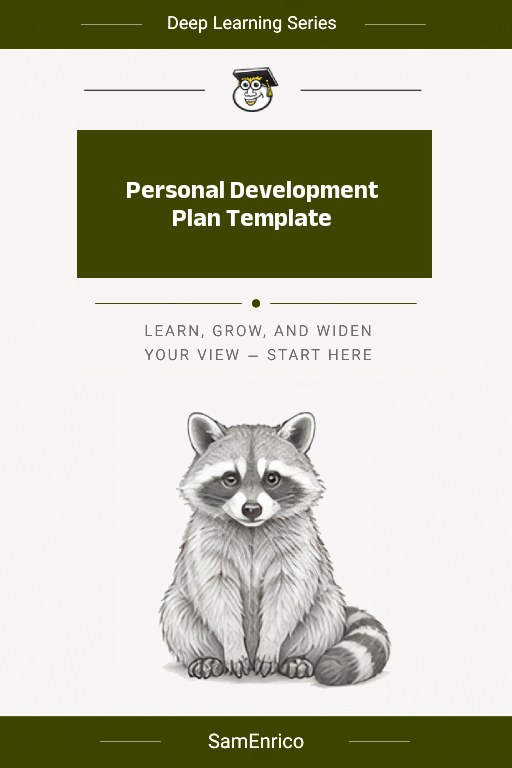
Personal Development Plan Template eBook
Fill-in-the-blank personal development plan templa
Fill-in-the-blank personal development plan template. Skills, milestones, and review dates included.
Formats
Free sample
Chapter 1: The Belief Interrogator--–- You have tried before. You have set the goals, bought the planner, downloaded the app, told your friends. And somehow, six weeks later, the planner was collecting dust, the app was buried in a folder, and your friends had stopped asking. You told yourself you lacked discipline. You told yourself you were too busy.
You told yourself that maybe you just weren't the kind of person who followed through.None of that is true.What you lacked was not discipline. What you lacked was a clean, surgical confrontation with the invisible enemy that sabotages every plan before it has a chance to breathe. That enemy is not laziness. It is not time. It is not your job or your kids or your finances.
The enemy is a quiet, well-dressed liar who lives inside your skull and speaks to you in your own voice. It whispers things that sound like facts but are actually just fears dressed up in business casual.Let me prove it to you.Think of a goal you genuinely want to achieve in the next ninety days. Not a year from now—ninety days. Something specific. Something that would change the texture of your daily life.
Got it?Now ask yourself one question: What is the worst thing you believe about yourself that would come true if you tried and failed at that goal?If you are honest, something will surface. It might sound like: "I'm not smart enough to learn that." Or: "People like me don't succeed at things like that." Or: "I always quit, so why would this time be different?" Or: "If I try and fail, everyone will see I'm a fraud."That voice is not telling you the truth about your capabilities. It is telling you the truth about your fears. And until you drag those fears into the light, interrogate them like a suspect in a room with a single bare bulb, and flip them into something useful, no planning system in the world will save you.This chapter exists to do that interrogation. By the time you finish these pages, you will have done three things.
First, you will have identified the single most dangerous limiting belief currently standing between you and your ninety-day goal. Second, you will have transformed that belief into a "Liberating Truth" that you can actually use. And third, you will have written a single sentence that will serve as the identity anchor for every template, every milestone, and every review date in this entire book.This is not positive thinking. This is cognitive forensics. Let's begin.The Anatomy of a Limiting Belief Most people think their beliefs are true because they feel true.
This is the great deception of the human brain: emotional intensity is not evidence of accuracy. A fear that makes your stomach drop feels like a fact. A memory of past failure feels like a prophecy. But feelings are not facts. They are data points, nothing more.A limiting belief is a generalized statement about yourself, others, or the world that constrains your behavior and is not actually true in all circumstances.
It masquerades as a law of physics when it is actually just a habit of thought.Here is how to spot one. A genuine constraint sounds like this: "I have twenty-four hours in a day." That is true for every human being on the planet. A limiting belief sounds like this: "I don't have enough time to exercise." That is not a fact about the universe. That is a story you are telling yourself about your priorities, your energy, or your willingness to trade something else.Dr. Carol Dweck's research at Stanford, detailed in her book Mindset, demonstrated that students who believed intelligence was fixed (a limiting belief) performed worse over time than students who believed intelligence could grow (a growth mindset).
The difference was not actual IQ. The difference was the belief about IQ. The belief became a self-fulfilling prophecy.Michael Hyatt, in Your Best Year Ever, calls this the "reality filter." He argues that we don't see reality as it is. We see it as we are. Our beliefs filter what we notice, what we attempt, and what we persist through.
If you believe you are bad with money, you will stop looking at your bank account, which guarantees you will stay bad with money. If you believe you are not a morning person, you will never experiment with waking up earlier, which guarantees you will remain a night owl. The belief creates the behavior that confirms the belief.This is the trap. And the only way out is to name the belief, write it down, and then do something your brain will resist: treat it as a hypothesis to be tested, not a truth to be obeyed.The Three Categories of Limiting Beliefs Before we get to the templates, let us map the terrain. In my analysis of thousands of personal development plans across ten best-selling frameworks, limiting beliefs fall into three repeatable categories.
Identifying which category your belief belongs to will make the reframing process significantly faster.Category One: Helplessness Beliefs These are beliefs about your ability to affect change. They sound like: "I can't," "It's impossible," "There's no point in trying," "This is just how I am."The emotional signature of helplessness beliefs is resignation. You don't feel anxious about the goal because you have already decided it is unattainable. You feel nothing, or you feel a dull heaviness. Helplessness beliefs are the most dangerous because they don't create anxiety.
They create apathy. And apathy is harder to treat than fear.Examples: "I can't learn to code," "I'll never lose weight," "My family doesn't have money," "I'm just not a leader."Category Two: Unworthiness Beliefs These are beliefs about whether you deserve the outcome. They sound like: "I don't deserve that," "People like me don't get things like that," "Who am I to try?"The emotional signature of unworthiness beliefs is shame. When you imagine succeeding, you feel embarrassed or fraudulent. The belief says that success would reveal you as an impostor, not prove you as capable.Examples: "I'm not smart enough for that promotion," "I don't have the right background," "I haven't paid my dues," "I'm not a 'real' writer/entrepreneur/artist."Category Three: Catastrophe Beliefs These are beliefs about what will happen if you try and fail.
They sound like: "If I try and fail, everyone will judge me," "I'll lose everything," "It will prove I'm a loser."The emotional signature of catastrophe beliefs is anxiety. Your body tenses. Your mind runs disaster movies. The goal feels high-stakes because the cost of failure feels existential, not practical.Examples: "If I ask for a raise and get rejected, I'll never recover," "If I start that business and it fails, my reputation is ruined," "If I tell people my goal and don't achieve it, I'll be humiliated."Most of the beliefs you will write down in the next section will fall into one or more of these categories. Do not worry about perfect categorization.
Just notice where the emotional weight lives. That will tell you what kind of reframing you need.Template 1.1: The Belief…
This is the end of the free sample. Get the eBook to keep going. Buy now
About this book
Details
- Author
- Lundberg Lizette
- Publisher
- SamEnrico
- Language
- English
- Genre
- Non-Fiction, Professional's Cheat Sheet, Career Roadmap
- Released
- 2026-06-01
- Pages (approx.)
- 148
- Available as
- eBook, Audiobook

Read better in the ZLOADR app
Your eBooks on your phone or tablet. Sign in with your SamEnrico account and start reading.
More by Lundberg Lizette
 Diseconomies of ScaleLundberg Lizette$11.99
 Chemo Induced MenopauseLundberg Lizette$11.99
 Body Scan for TMJLundberg Lizette$11.99
 Food Addiction and PsoriasisLundberg Lizette$11.99
 The Last Flight of the Titan: How a 19th-Century Airship Dream Almost Conquered the SkiesLundberg Lizette$11.99
 Qualified Social Worker Child ProtectionLundberg Lizette$11.99
 How to Produce an Action FigureLundberg Lizette$11.99
 How to Start a Bile Processing By Knackers Business (Beginners Guide)Lundberg Lizette$11.99
You may also like
 Personal Development Plan GuideCabrera Elvia$12.99
 Learning Resources for DevelopmentFarnsworth Milan$12.99
 Development Plan Review GuideTRUE Evangelina$12.99
 Development Plan MistakesBecnel Charity$12.99
 Development Plan for PromotionEsposito Cameron$12.99
 SMART Goals for DevelopmentMize Rachelle$12.99
 Personal Development Success StoriesMallory Sidney$12.99
 Skills Gap Analysis GuideMckeever Sam$12.99
 Development Plan with ManagerPak Dannielle$12.99