
Non-FictionSelf-HelpChemistry Mnemonics
Periodic Table Peg System eBook
Memorizes element symbols, numbers, and groups usi
Memorizes element symbols, numbers, and groups using rhyming pegs.
Formats
Free sample
Chapter 1: The Memory Lie--–- You have been told a lie about your memory. It is a comfortable lie, repeated by parents, teachers, and even well-meaning friends. The lie sounds like this: "I was never good at memorizing things." Or its close cousin: "I have a bad memory for names, numbers, and facts." Perhaps you have said these words yourself, usually after struggling to recall something you knew you had studied. Here is the truth that will change everything: your memory is not bad. It is untrained.
And the difference between a "bad memory" and a world-class memory is not IQ, genetics, or hours of tedious repetition. It is a set of simple, learnable techniques that your brain was designed to use.This book exists to prove that claim in the most dramatic way possible. Over the next twelve chapters, you will memorize the entire periodic table—all 118 elements, every symbol, every atomic number, every group. You will do this not because you are special, not because you have a photographic memory, and not because you will spend hundreds of hours drilling flashcards. You will do it because you will finally stop fighting your brain and start working with it.
The periodic table is merely the training ground. The real prize is discovering that your memory is a sleeping giant, and you hold the alarm clock.The Anatomy of a Forgotten Fact Let us begin with a simple experiment. Without looking anywhere, answer this question: What is the seventh element on the periodic table? Most people cannot answer this. They have seen the periodic table hundreds of times—on classroom walls, in textbook appendices, in You Tube videos—but they cannot retrieve the answer from memory.
Now try a different question: What element has the symbol N? That one feels easier. Nitrogen, you say. But here is the trap: recognition is not recall. Recognizing Nitrogen when you see it written on a chart is a passive process.
Your brain simply says, "Yes, I have seen that before." Recalling that element number seven is Nitrogen requires active retrieval, a completely different neural pathway. Most students never build that pathway. They study by rereading, by highlighting, by staring at the same chart for hours. They mistake familiarity for knowledge. Then, on test day, they discover the brutal difference.Consider what you are trying to memorize: 118 numbers paired with 118 foreign-sounding names, each with one or two letters attached.
That is 354 discrete pieces of information. Rote repetition—the method most students use—creates fragile neural connections that decay rapidly. Research from the late nineteenth century, confirmed by modern neuroscience, shows that without active recall or mnemonic encoding, humans forget approximately fifty percent of rote-learned information within one hour. Within twenty-four hours, seventy percent is gone. By the end of a week, you are left with a ghost of what you studied, a vague sense that you once knew something now lost to the fog.This is not a character flaw.
It is how the brain evolved. Your ancestors did not survive by memorizing disconnected facts. They survived by remembering where the tiger was hiding, which berries were poisonous, and which path led to water. Those memories were visual, spatial, and emotional. They were stories, not spreadsheets.
When you try to memorize "57 equals Lanthanum" by writing it fifty times, you are asking your brain to do something it was never designed to do. When you turn that fact into an image—a log floating in a lake with a glowing lanthanum lantern—you are speaking your brain's native language. The difference is not subtle. It is the difference between pushing a boulder uphill and riding it down.The Science of Vivid Imagery Why do images work so much better than words? The answer lies in how your brain encodes information.
When you hear a word like "hydrogen," your brain processes it as an abstract symbol. It has no color, no sound, no smell, no motion, no emotional weight. It is a ghost. But when you imagine a hydrogen balloon exploding from the barrel of a gun, your brain activates the visual cortex, the auditory cortex (the bang), the motor cortex (the recoil), and the amygdala (the surprise). A single vivid image can engage more neural territory than an hour of rote repetition.
Memory champions have known this for centuries. They call it the principle of vividness, and it is the engine that powers every mnemonic technique in existence.Let me give you a concrete example. Try to memorize this number: 7291438506. Read it ten times. Say it out loud.
Now close your eyes and try to recall it. Difficult, is it not? Now try this instead. Imagine a knight in shining armor riding a horse made of a single rolled cigarette. The knight holds a glowing microphone in one hand and a raindrop in the other.
Behind him, a giant sun made of shag carpet rises over the horizon. You have just converted the number 7291438506 into an image using the Major System, which you will learn in Chapter 3. The knight represents 72 (K+N). The cigarette horse represents 91 (P+T). The microphone represents 43 (R+M).
The raindrop represents 85 (F+L). The shag-carpet sun represents 06 (S+Z). The image is absurd, unforgettable, and completely retrievable. That is the power you are about to harness.The Two Weapons in Your Memory Arsenal Before we build your periodic table memory, you need to understand the two primary weapons you will use throughout this book. They are different tools for different jobs, and knowing when to use each is the mark of a skilled memorizer.The first weapon is the Peg Method.
This is what you will use most often in this book. The Peg Method works by creating permanent "hooks" for numbers, then hanging images onto those hooks. Imagine a coat rack with numbered pegs. Peg number one is shaped like a gun. Peg number two is shaped like a shoe.
Peg number three is shaped like a tree. These pegs never change. When you want to memorize that element number one is Hydrogen, you simply imagine your gun shooting a hydrogen balloon. When you want to recall what element number one is, you look at your mental peg—the gun—and ask yourself, "What is the gun doing?" It is shooting a hydrogen balloon. Hydrogen.
The retrieval is automatic, almost effortless. The Peg Method excels at answering questions like "What element is number 79?" or "What is the atomic number of Gold?"The second weapon is the Story Method. This is what you will use for remembering sequences—the order of elements within a group, for example. In the Story Method, you link images together in a chain, each one triggering the next. Imagine you need to remember the first five elements in order: Hydrogen, Helium, Lithium, Beryllium, Boron.
You could create a story: A hydrogen balloon explodes (Hydrogen). The explosion fills a giant shoe that floats to heaven (Helium). In heaven, a lion climbs a tree (Lithium). The lion crashes through a door, where a bear smashes it open (Beryllium). The bear runs into a hive, where bees bore a hole (Boron).
The story is ridiculous, but that is precisely why it works. Your brain is wired to remember narratives, especially absurd…
This is the end of the free sample. Get the eBook to keep going. Buy now
About this book
Details
- Author
- Steele Jonathon
- Publisher
- SamEnrico
- Language
- English
- Genre
- Non-Fiction, Self-Help, Chemistry Mnemonics
- Released
- 2026-06-06
- Pages (approx.)
- 137
- Available as
- eBook, Audiobook

Read better in the ZLOADR app
Your eBooks on your phone or tablet. Sign in with your SamEnrico account and start reading.
More by Steele Jonathon
 Stepfamily Stress ManagementSteele Jonathon$11.99
 EQ For Low Income Resilience GuideSteele Jonathon$11.99
 Drug Dependency and SpiritualitySteele Jonathon$11.99
 The PQRST Peg ExtensionSteele Jonathon$11.99
 The Microbiome Report DecoderSteele Jonathon$11.99
 Bipolar Children Diagnosis GuideSteele Jonathon$11.99
 Nutrition NeuropathySteele Jonathon$11.99
 Germany Remote Tax GuideSteele Jonathon$11.99
 The Bubble That Broke the Game: The 2022 NBA Draft Lottery ScandalSteele Jonathon$11.99
 The Last Ronin's Oath: A Samurai's Vow to the Dragon KingSteele Jonathon$11.99
 Fenrir's Bite: The Wolf Who Swallowed the MoonSteele Jonathon$11.99
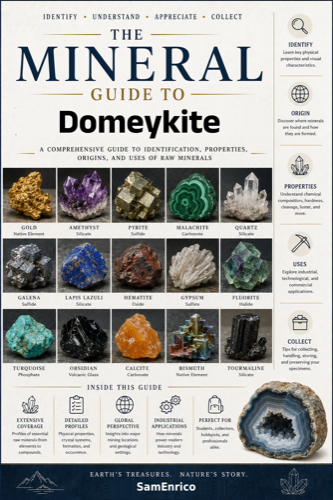 The Mineral Guide to DomeykiteSteele Jonathon$11.99
You may also like
 Hong Kong Handover 1997Dunn Johnnie$11.99
 Zumba For Postnatal Recovery CourseNeal Christian$11.99
 Zumba for BeginnersLadner Nikia$11.99
 YouTube Comment Mining GuideHumes Pandora$12.99
 Worry Box MeditationCarlin Rudy$11.99
 Workplace Stress MeditationNguyen Lynn$11.99
 Workplace Stress and Sleep RepairHawley Ivory$11.99
 Workplace Perfectionism CureDelaney Jeffry$11.99
 Workplace Injustice Anger GuideWallen Isabelle$11.99
 Work Addiction and Burnout LinkGreenwood Ester$11.99
 Women in Yoga and WellnessBeattie Galina$11.99
 Women in Stand Up ComedyChun Evangeline$11.99