
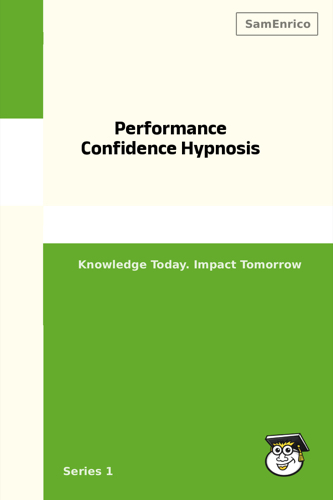
Performance Confidence Hypnosis eBook
Builds stage and audition assurance.
by Aiello Carin
Builds stage and audition assurance.
Formats
Free sample
Chapter 1: The Hidden Audience--–- Every performer knows the moment. You are standing in the wings, or sitting in the green room, or waiting backstage in the darkness. Your costume fits. Your lines are memorized. Your opening note is ready.
You have rehearsed this moment hundreds of times. And then something strange happens. Your heart begins to pound not with excitement but with something that feels closer to terror. Your mouth goes dry. Your palms sweat.
Your thoughts, which were clear and organized just moments ago, scatter like startled birds. A voice inside your head—a voice you did not invite and cannot seem to silence—whispers: You are not ready. They will know. You will fail.If you have felt this, you are not weak. You are not broken.
You are not "not cut out for performance." You are experiencing one of the most ancient, hardwired, and predictable responses of the human nervous system. And that response, as you will learn in this chapter, is not your enemy. It is, in fact, a source of tremendous power—once you understand how to work with it rather than against it.The Evolutionary Ghost To understand why a silent audience can feel like a life-threatening predator, we must travel backward. Way backward. Approximately two hundred thousand years, give or take a few millennia.
Our ancestors lived in small tribal groups where social standing was not a matter of ego but of survival. To be rejected by the tribe meant exposure, starvation, and death. The brain developed a sophisticated threat-detection system calibrated to one paramount rule: Do not be rejected by the group. A stare from a tribal elder was not rude; it was a potential death sentence. A silent crowd was not waiting to be entertained; it was judging whether you would be allowed to eat tomorrow.Now fast forward to today.
You walk onto a stage at a community theater, an audition room in Manhattan, or a conference hall in London. Two hundred faces turn toward you. They are silent. They are watching. Your amygdala—the brain's ancient alarm system—cannot tell the difference between a tribal council deciding your fate and an audience waiting for your monologue.
It interprets those two hundred silent faces as two hundred potential threats. It floods your body with cortisol and adrenaline. Your heart races to pump blood to your large muscle groups so you can fight or flee. Your mouth goes dry because digestion is not a priority when you are about to be attacked. Your vision narrows to tunnel focus because the brain is searching for the nearest exit.This is not a flaw in your design.
This is your nervous system working exactly as evolution intended. The problem is not that you have stage fright. The problem is that your brain is using an outdated map for a modern territory. And the first step to solving any problem is understanding its true nature.The Three Faces of Fear Performance anxiety is not a single experience. It is a cluster of three distinct categories of response, and most performers are dominated by one of them.
Identifying which category drives your anxiety is the single most important diagnostic step you will take in this book.The first category is physical. This is the body's direct response to the threat signal. Sweating palms, racing heart, shaky knees, dry mouth, shallow breathing, a feeling of butterflies or churning in the stomach, and in extreme cases, nausea or the urge to use the bathroom. These symptoms are produced by the sympathetic nervous system—the same system that would help you run from a predator. They are not imagination.
They are measurable physiological events. Many performers mistake these physical symptoms for evidence that they are "too nervous to perform," not realizing that many of these same symptoms are also present during excitement, joy, and peak arousal.The second category is cognitive. This is the mind's interpretation of the physical event. Mind blanks where you cannot remember lines you have said a thousand times. Racing negative thoughts that seem to have a mind of their own.
Catastrophic predictions: I will forget everything. They will laugh. This will ruin my career. Time distortion where minutes feel like seconds or seconds feel like hours. The inner critic speaking in full sentences, often in the second person: You are going to mess this up.
You always do. These cognitive symptoms are not random. They are the brain's attempt to make sense of the physical alarm—to find a story that explains why the body is in emergency mode.The third category is behavioral. This is what you do in response to the physical and cognitive symptoms. Avoiding auditions you are qualified for.
Arriving late so you have less time to wait. Leaving early before your name is called. Refusing eye contact with the audience or the panel. Over-rehearsing to the point of exhaustion or injury, using practice as a form of procrastination. Accepting smaller roles or easier material than you are capable of performing.
In extreme cases, quitting performance altogether while telling yourself you "lost interest." These behavioral responses are logical attempts to reduce anxiety in the short term. But they come at a devastating long-term cost: they shrink your life, your career, and your identity.Here is what most performers do not realize. These three categories are not equally responsive to the same interventions. Physical symptoms respond best to breathing techniques and physical anchors. Cognitive symptoms respond best to cognitive defusion and reframing.
Behavioral symptoms respond best to exposure and ritual. This is why generic advice like "just breathe" or "just think positive" so often fails. If your primary challenge is cognitive—a relentless inner critic—telling you to breathe will not silence that voice. If your primary challenge is behavioral—you keep avoiding auditions—telling you to visualize success will not get you into the room. The first step is accurate diagnosis.
The second step is matched intervention.The Arousal Curve and the Butterfly Problem Now we arrive at a concept that will reshape everything you think you know about performance anxiety. The Yerkes-Dodson law, first described by psychologists Robert Yerkes and John Dodson in 1908, describes the relationship between arousal (the general state of alertness and activation) and performance. The curve looks like an upside-down U. On the left side, low arousal produces low performance. You are bored, lethargic, disengaged.
Your performance is flat, lifeless, and forgettable. On the right side, high arousal produces low performance. You are panicked, scattered, overwhelmed. Your performance is erratic, forced, and prone to catastrophic errors. But in the middle, optimal arousal produces peak performance.
You are alert but not frantic, energized but not shaky, focused but not tunneled.The optimal zone for most performers is between six and seven on a ten-point scale. At six, you feel the butterflies. You are aware of the stakes. Your heart is beating faster than at rest. You feel slightly "on edge." This is good.
This is the zone where great performances happen. At seven, you are fully activated. Your senses are sharp. Time may feel slightly slowed. You are completely present.
This is also good. The problem begins at eight, nine, and ten. At eight, the butterflies turn into bats. Your…
This is the end of the free sample. Get the eBook to keep going. Buy now
About this book
Details
- Author
- Aiello Carin
- Publisher
- SamEnrico
- Language
- English
- Genre
- Non-Fiction, Self-Help, Performance
- Released
- 2026-06-08
- Pages (approx.)
- 132
- Available as
- eBook, Audiobook

Read better in the ZLOADR app
Your eBooks on your phone or tablet. Sign in with your SamEnrico account and start reading.
More by Aiello Carin
 Peter Higgs Boson DiscoveryAiello Carin$11.99
 Stress and Globus SensationAiello Carin$11.99
 Mismatched Libido ManagementAiello Carin$11.99
 Menopause Autoimmune ConnectionAiello Carin$11.99
 Gratitude Daily Review GuideAiello Carin$11.99
 ABCDE for ChefsAiello Carin$11.99
 The Shadow of the Sun King: Napoleon's Hidden War in EgyptAiello Carin$11.99
 The Alchemist’s Canvas: How a 17th-Century Painter Secretly Invented Modern ChemistryAiello Carin$11.99
 How to Produce an Automatic DishwasherAiello Carin$11.99
 African Export Payment Fees WorkbookAiello Carin$12.99
 Mastering Income Tax: Brackets & DeductionsAiello Carin$11.99
 Exploring Assemblage Art: Found Objects ReimaginedAiello Carin$11.99
You may also like
 TM Actor PresenceBoudreau Foster$11.99
 Performance Review AssertiveFarley Carmel$11.99
 The Self Hypnosis for PerformanceThomson Kala$11.99
 Stage Fright SuggestionGavin Vada$11.99
 The High Pressure Job GuideLevy Mason$11.99
 The Annual Review Confidence GuideKohl Jacquelin$11.99
 Performance Anxiety MeditationSchroeder Oswaldo$11.99
 Breath for PerformanceJacobsen Emery$11.99
 Scripting for Peak PerformanceLilley Reatha$11.99
 Breath Awareness For PerformersLord Shante$11.99
 Breath Awareness for Performance AnxietyWay Vena$11.99
 The Loving Kindness for Performance AnxietyMccurdy Hershel$11.99