
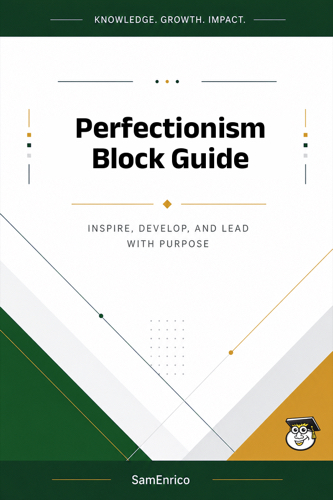
Non-FictionSelf-HelpPerfectionism
Perfectionism Block Guide eBook
Release the need for flawless first drafts and emb
Release the need for flawless first drafts and embrace messy creation.
Formats
Free sample
Chapter 1: The Overnight Lie--–- You have been told a lie. Not a small, harmless fib, but a corrosive, creativity-killing falsehood that has likely stolen years of your productive life. The lie is this: great work springs forth fully formed, like Athena from the head of Zeus—brilliant, armored, and complete. You have absorbed this lie from every direction. You see it in the polished final drafts of bestselling authors who never show you the eighteen abandoned openings.
You see it in the effortless grace of Olympic athletes whose ten thousand hours of invisible failure are edited into highlight reels. You see it on social media, where peers post their triumphs as if they woke up that morning with a finished masterpiece already downloaded into their brains.But here is the truth that will set you free, and it is the foundation upon which this entire book is built: masterpieces are never born. They are built, brick by ugly brick, through thousands of messy, awkward, often embarrassing iterations. The painting hanging in the museum is the two hundredth version, not the first. The novel on the bestseller list went through eleven complete rewrites.
The startup that changed the world began as a napkin sketch so crude it would make a kindergartner blush.This chapter exists to dismantle the Overnight Masterpiece Myth once and for all. We will trace its origins, expose its psychological damage, and replace it with a functional, liberating model of creation that will allow you to finally, blessedly, begin.The Cultural Conspiracy of Perfection The lie of the overnight masterpiece is not accidental. It is a cultural conspiracy supported by three powerful forces, each of which benefits from your belief that flawless work should emerge effortlessly.Force One: Survivorship Bias in Media. For every successful creator, there are thousands who failed quietly. But we do not interview the failures.
We do not put their abandoned drafts on magazine covers. Consequently, the only stories we hear are the ones that ended well—and those stories are inevitably smoothed over, edited for drama, and stripped of their messy middles. The publicist does not want you to know that the author cried for three weeks over chapter four. The gallery does not advertise that the sculptor smashed twelve versions before finding the form. You are shown the destination, never the disorienting, muddy path that led there.Force Two: The Productivity Industrial Complex.
A multi-billion dollar industry sells you the promise of faster, better, easier creation. Five-minute morning routines. Life hacks. Secret formulas used by geniuses. This industry profits when you believe that your inability to produce a perfect first draft is a personal failing rather than a normal part of the creative process.
If you accepted that creation is inherently slow, messy, and non-linear, you would stop buying their shortcuts. So they perpetuate the myth that something is wrong with you—and that their product can fix it.Force Three: Your Own Ego's Defense Mechanisms. This is the most insidious force of all. The perfectionist's ego secretly prefers the myth of the overnight masterpiece because it provides a perfect excuse for never starting. If great work must emerge flawless, then the only safe option is to wait until you feel ready, inspired, or talented enough.
And since that magical state never arrives, you never have to risk failure. The myth becomes a shield. As the writer and activist Hillary Rettig has observed, perfectionism is not a high standard but a "twenty-ton shield" that keeps you small, safe, and invisible. Your ego would rather you believe you could have written a masterpiece if only you had tried than actually try and discover that your first draft reads like a confused second-grader's book report.The Three Thinking Errors of the Perfectionist The Overnight Masterpiece Myth does not simply float in the cultural air. It takes up residence inside your head, warping your thinking in three specific, diagnosable ways.
Cognitive psychologists have studied these patterns extensively, and they are remarkably consistent across perfectionists of all domains—writers, painters, coders, entrepreneurs, students.Error One: Incremental Blindness. The perfectionist cannot see small steps as meaningful progress. If a project requires five hundred small actions, the perfectionist's brain registers only the gap between zero and five hundred. One sentence written? Meaningless.
One sketch? Insufficient. One line of code? Pathetic. This all-or-nothing thinking means that the perfectionist receives zero reinforcement for the vast majority of the work, making it nearly impossible to sustain motivation.
The non-perfectionist, by contrast, celebrates the single sentence. They understand that five hundred sentences is simply one sentence, repeated five hundred times. But the perfectionist sees only the chasm between where they are and where they imagine they should be.Error Two: The Planning Fallacy on Steroids. The planning fallacy is a well-documented cognitive bias in which people underestimate the time, difficulty, and resources required to complete a project. For perfectionists, this bias is amplified to a pathological degree.
You do not simply underestimate difficulty—you refuse to acknowledge that difficulty exists at all. You believe that because the final vision is clear in your mind, the path to it should be straight and short. When obstacles appear (as they always do), you interpret them as evidence of your personal inadequacy rather than as normal features of any creative endeavor.Error Three: The Impossible Goal Trap. Here is the cruelest irony of perfectionist thinking: you set goals so impossibly high that failure is mathematically guaranteed, then use that inevitable failure as proof that you are not good enough to continue. This is a closed loop of self-destruction.
"I will write fifty pages this weekend," you announce. When you write twelve (a perfectly respectable output), you feel like a failure. The shame of "failure" then paralyzes you for the following week. You set the same impossible goal again. You fail again.
Eventually, you stop trying altogether, concluding that you lack the discipline or talent—when in truth, you lacked only a realistic understanding of human creative capacity.The Neuroscience of Starting To understand why the Overnight Masterpiece Myth is so damaging, we must look briefly at what happens inside your brain when you face a blank page or an empty canvas. The neuroscientific picture is clear, and it is not what the productivity gurus want you to believe.The Role of the Anterior Cingulate Cortex. When you contemplate beginning a creative project, a region of your brain called the anterior cingulate cortex (ACC) activates. The ACC is responsible for detecting errors, conflicts, and potential threats. It is, in essence, your brain's quality control department.
In perfectionists, the ACC is hyperactive. It screams "ERROR!" at the slightest deviation from the imagined ideal. But here is the critical insight: the ACC cannot distinguish between a real error and a potential error. It will sound the alarm even when you have not yet written a single word, simply because the possibility of writing a bad word exists. Your brain punishes you for a crime you have not yet committed.The Dopamine Problem.
Dopamine, the neurotransmitter associated with reward and motivation, is released in response to progress, not completion. Every small step forward should trigger a small dopamine…
This is the end of the free sample. Get the eBook to keep going. Buy now
About this book
Details
- Author
- Barker Archie
- Publisher
- SamEnrico
- Language
- English
- Genre
- Non-Fiction, Self-Help, Perfectionism
- Released
- 2026-06-09
- Pages (approx.)
- 146
- Available as
- eBook, Audiobook

Read better in the ZLOADR app
Your eBooks on your phone or tablet. Sign in with your SamEnrico account and start reading.
More by Barker Archie
 Dynamic Warm Up Injury PreventionBarker Archie$11.99
 Mindful Morning Routine GuideBarker Archie$11.99
 Mentorship in Nonprofit LeadershipBarker Archie$11.99
 Reflective Listening Techniques CourseBarker Archie$11.99
 CPRA Enforcement Actions LogBarker Archie$11.99
 Baldwin Dynasty - Alec BaldwinBarker Archie$11.99
 The Punishment FitBarker Archie$11.99
 Assertiveness For CoachesBarker Archie$11.99
 Shadows in the Congo: The Battle of Tabora and the Clash of African EmpiresBarker Archie$11.99
 Echoes of the Deep: The Lost City of Atlantis RediscoveredBarker Archie$11.99
 The Last River: The Epic Quest to Find the Amazon's True SourceBarker Archie$11.99
 Risk Management FundamentalsBarker Archie$11.99
You may also like
 Hong Kong Handover 1997Dunn Johnnie$11.99
 Zumba For Postnatal Recovery CourseNeal Christian$11.99
 Zumba for BeginnersLadner Nikia$11.99
 YouTube Comment Mining GuideHumes Pandora$12.99
 Worry Box MeditationCarlin Rudy$11.99
 Workplace Stress MeditationNguyen Lynn$11.99
 Workplace Stress and Sleep RepairHawley Ivory$11.99
 Workplace Perfectionism CureDelaney Jeffry$11.99
 Workplace Injustice Anger GuideWallen Isabelle$11.99
 Work Addiction and Burnout LinkGreenwood Ester$11.99
 Women in Yoga and WellnessBeattie Galina$11.99
 Women in Stand Up ComedyChun Evangeline$11.99