
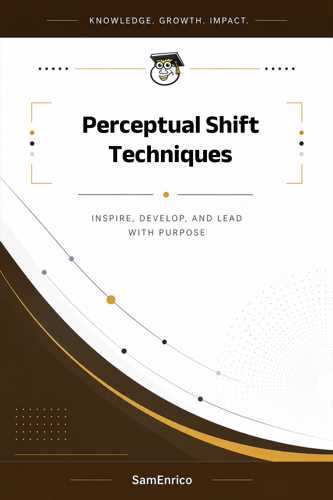
Perceptual Shift Techniques eBook
View problem from customer, competitor, or regulat
View problem from customer, competitor, or regulator perspective.
Formats
Free sample
Chapter 1: The $47 Million Blind Spot...–- On a Tuesday morning in March 2016, the CEO of a medical device company called an all-hands meeting. The room was packed with engineers, product managers, and marketing executives who had worked eighteen months on the Harmony Heart monitor—a wearable device designed to detect early signs of congestive heart failure. They had done everything right. They had conducted twelve focus groups. They had run three clinical trials.
They had received FDA breakthrough device designation. And they had just lost $47 million.The reason was not a technical failure. The device worked perfectly. The reason was not a safety issue. No patients were harmed.
The reason was something far more humbling: the company had assumed that everyone saw the world the way they did.Two weeks earlier, a routine FDA audit had flagged their patient instructions as “misleading to an elderly user.” The company’s internal review had concluded “user error.” The patients themselves, when interviewed, said they felt “betrayed.” Three different conclusions. One device. One set of facts. Three completely different ladders of inference.This book is about what happened in that room—and how you can prevent it from happening in yours.The Problem That Most Leaders Never See Every day, smart people make expensive mistakes because they assume that other people see reality the same way they do. A product manager launches a feature that customers ignore.
A negotiator walks away from a deal that the other side was desperate to close. A regulator rejects an application that the applicant believed was flawless. In each case, the failure is not one of effort or intelligence. It is a failure of perspective.I have spent the last decade studying how successful leaders, negotiators, and strategists avoid this trap. What I have found is surprisingly simple: they have learned to sit on the other side of the table before they make a decision.
Not after. Not during. Before.This chapter introduces the foundational framework that will guide the entire book: the Ladder of Inference, the principle of intent versus impact, and the three critical perspectives that produce 80 percent of business surprises. By the end of this chapter, you will understand why two intelligent people looking at the same data can reach opposite conclusions—and what to do about it.The Ladder of Inference: How Your Brain Builds Reality Let us start with a simple question. Look at the following sequence of events: A customer calls your support line.
They are angry. They say your product “doesn’t work.” They hang up after two minutes. What just happened?Most people will immediately answer with some version of “the customer is irrational,” “our product has a bug,” or “the customer didn’t read the instructions.” But notice what you just did. You took seven raw facts (a call occurred, the caller was angry, specific words were spoken, the call lasted two minutes, a hang-up occurred) and you instantly built a story about what those facts mean.This is the Ladder of Inference. First described by organizational psychologist Chris Argyris and later popularized by Peter Senge in The Fifth Discipline, the Ladder explains how human beings move from observable data to beliefs and actions in a fraction of a second.Let me walk you up the rungs.At the bottom of the ladder is observable data and experiences—the raw, unfiltered reality of what happened.
In our example: a phone call, a raised voice, specific words, a two-minute duration, a disconnection.The second rung is selected data. Your brain cannot process all available data, so it selects what seems relevant. You might focus on the words “doesn’t work” while ignoring that the customer called at 4:55 PM on a Friday.The third rung is meaning. You assign interpretation to the selected data. “Doesn’t work” becomes “the product is defective.”The fourth rung is assumptions.
You connect the meaning to your existing beliefs. “The product is defective” connects to “our testing process should have caught this.”The fifth rung is conclusions. You draw a definitive judgment. “The customer is right, and our quality control failed.”The sixth rung is beliefs. You adopt the conclusion as a working truth.
“We have a quality control problem.”The seventh rung is actions. You act on your belief. You escalate the issue to engineering, initiate a recall, or fire the quality control manager.Here is the crucial insight: The entire climb happens in milliseconds, and you are almost never aware of it.Now here is where this becomes dangerous. Two people looking at the exact same bottom-rung data will select different facts, assign different meanings, make different assumptions, draw different conclusions, form different beliefs, and take different actions. Neither person is stupid.
Neither is malicious. They simply climbed different ladders.Case Study: The Product Recall That Never Needed to Happen In 2013, a major automobile manufacturer recalled 1.2 million vehicles due to a reported “sudden acceleration” issue. The internal investigation concluded that a software bug was causing the throttle to stick. The company spent $300 million on repairs, legal settlements, and brand damage control.Eighteen months later, an independent analysis revealed something astonishing. The “software bug” did not exist.
The sudden acceleration events were almost entirely caused by drivers pressing the wrong pedal—specifically, older drivers with limited familiarity with the vehicle’s pedal layout. The company had climbed its ladder so quickly that it never stopped to verify the bottom rung.The customers climbed a different ladder. When a driver experiences sudden acceleration, they do not think “I might have pressed the wrong pedal.” They think “the car is trying to kill me.” That is not irrational. That is a rational conclusion given their data selection (the car is moving unexpectedly) and their assumptions (cars should not move unless I tell them to).The regulator climbed a third ladder. When the National Highway Traffic Safety Administration received 2,000 complaints, they did not think “these are probably user errors.” They thought “if even one of these is a real defect, and we do nothing, people will die and we will be held responsible.” Their ladder was shaped by risk aversion and precedent anxiety—concepts we will explore in depth in Chapter 10.Three ladders.
One set of bottom-rung events. Three different realities. And a $300 million mistake that could have been prevented by spending one hour sitting on the other side of the table.Intent Versus Impact: The Most Expensive Confusion in Business There is a second foundational distinction that you must internalize before we go any further. It is the distinction between intent (what you meant to do) and impact (how the other party experienced it).Most professionals operate under a dangerous assumption: if my intent is good, the impact will be good. This is false.
Not occasionally false. Regularly false. Fundamentally false.Consider a simple example. You are a manager. You give an employee critical feedback because you want them to grow and succeed.
Your intent is development. The employee experiences the feedback as a public humiliation because you delivered it in front of their peers. The impact is shame. Which matters more for the employee’s future performance? The impact.
Which will you remember tomorrow? Your intent.This pattern repeats across every domain. A product team adds a new feature because…
This is the end of the free sample. Get the eBook to keep going. Buy now
About this book
Details
- Author
- Turley Lauran
- Publisher
- SamEnrico
- Language
- English
- Genre
- Non-Fiction, Self-Help, Perspective Taking
- Released
- 2026-06-07
- Pages (approx.)
- 148
- Available as
- eBook, Audiobook

Read better in the ZLOADR app
Your eBooks on your phone or tablet. Sign in with your SamEnrico account and start reading.
More by Turley Lauran
 Construction Site Supervisor GuideTurley Lauran$11.99
 Russian Phishing KingpinsTurley Lauran$11.99
 Senior Music Therapy GuideTurley Lauran$11.99
 PTSD Workplace Anger GuideTurley Lauran$11.99
 TM for Chronic PainTurley Lauran$11.99
 Reverse Dieting ProtocolTurley Lauran$11.99
 Choking Rescue HandbookTurley Lauran$11.99
 The Abduction of Natascha Kampusch: 8 Years in CaptivityTurley Lauran$11.99
 The Raven's Quest: Odin's Fabled Falcons of the NorthTurley Lauran$11.99
 Mace: Nutmeg ArilTurley Lauran$11.99
 How to Produce EarplugsTurley Lauran$11.99
 Freemium User Feedback LoopsTurley Lauran$12.99
You may also like
 Respecting Different OpinionsPotts Lorine$11.99
 Role Play Creativity WorkshopRead Tamie$11.99
 The Stress Role SwapFrench Karen$11.99
 Figure Storming TechniqueHendrix Marianela$11.99
 Cognitive Empathy TrainingDuffy Renay$11.99
 The Empathy Cognitive Empathy GuideChurchill Sherlene$11.99
 The Cognitive Empathy GuideMelendez Willodean$11.99