
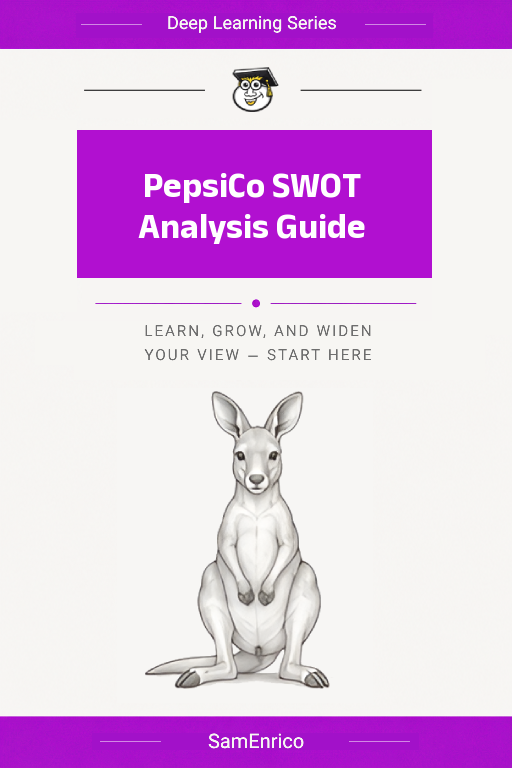
Non-FictionStrategic AtlasFood & Bev
PepsiCo SWOT Analysis Guide
Assess snack division strength, beverage portfolio
Assess snack division strength, beverage portfolio, health trends, and emerging market exposure.
Formats
About this book
Free sample
Chapter 1: The 9% Lever--–- The first thing you need to understand about Pepsi Co is that it does not compete in the snack business. It competes in the shelf-space business. And the difference between those two statements is the difference between analyzing this company like a casual observer and analyzing it like a portfolio strategist who can see around corners.Walk into any supermarket in America. Not a fancy one, not a boutique organic grocer, but a middle-class, fluorescent-lit, linoleum-floored Walmart, Kroger, or Albertsons. Find the snack aisle.
Actually, you cannot miss it. It is usually the longest aisle in the store, often running the entire back wall or an entire center gondola from produce to dairy. Now walk to the beverage aisle. It is shorter, less trafficked, and increasingly filled with sparkling waters, kombuchas, and energy drinks that did not exist ten years ago. The Coca-Cola and Pepsi sections are shrinking.
The Frito-Lay section is not.That visual reality is the starting point for any honest assessment of Pepsi Co’s strategic position. The company that once defined itself by its rivalry with Coca-Cola has, over the past two decades, quietly become something else entirely: a snack company that also happens to sell beverages. This transformation is not accidental. It is the result of a deliberate, decades-long strategy that leverages Pepsi Co’s most underappreciated asset—not a brand, not a recipe, but a distribution empire so dense and so profitable that retailers have no choice but to cooperate. That empire is the subject of this chapter.
Understanding it is the prerequisite for understanding every other chapter in this book.The 9% vs. 2% Mathematics of Power Let us begin with a number: nine. That is roughly the percentage profit margin that a typical American supermarket earns on salty snacks. Not on Frito-Lay specifically, but on the entire salty snack category—chips, pretzels, popcorn, puffs, and everything in between. Now consider another number: two.
That is roughly the percentage profit margin that a supermarket earns on carbonated soft drinks. Not on Pepsi, not on Coke, but on the entire soda category…
This is the end of the free sample. Get the eBook to keep going. Buy now
Contents
- Chapter 1
- Chapter 2
- Chapter 3
- Chapter 4
- Chapter 5
- Chapter 6
- Chapter 7
- Chapter 8
- Chapter 9
- Chapter 10
- Chapter 11
- Chapter 12
Details
- Author
- Murillo Stacie
- Publisher
- SamEnrico
- Language
- English
- Genre
- Non-Fiction, Strategic Atlas, Food & Bev
- Released
- 2026-05-28
- Pages (approx.)
- 135
- Available as
- eBook, Audiobook

Read better in the ZLOADR app
Your eBooks on your phone or tablet. Sign in with your SamEnrico account and start reading.
More by Murillo Stacie
 Child Affirmation Guide ParentsMurillo Stacie$11.99
 TM Siddhi Program Introduction GuideMurillo Stacie$11.99
 The Breakup Self Esteem Recovery PlanMurillo Stacie$11.99
 Kite Flying FreedomMurillo Stacie$11.99
 Vaccine Development HistoryMurillo Stacie$11.99
 The Ghosts of Berlin: Stasi Spies and the Silent War (1961-1989)Murillo Stacie$11.99
 Virtual StylistMurillo Stacie$11.99
 Understanding Muscular Dystrophy Limb Girdle Type 2a, Erb TypeMurillo Stacie$17.99
 AI Financial Data Ethics GuideMurillo Stacie$12.99
 How to Start a Centrifugal Compressor Business (Beginners Guide)Murillo Stacie$11.99
You may also like
 Hong Kong Handover 1997Dunn Johnnie$11.99
 Zumba For Postnatal Recovery CourseNeal Christian$11.99
 Zumba for BeginnersLadner Nikia$11.99
 YouTube Comment Mining GuideHumes Pandora$12.99
 Worry Box MeditationCarlin Rudy$11.99
 Workplace Stress MeditationNguyen Lynn$11.99
 Workplace Stress and Sleep RepairHawley Ivory$11.99
 Workplace Perfectionism CureDelaney Jeffry$11.99
 Workplace Injustice Anger GuideWallen Isabelle$11.99
 Work Addiction and Burnout LinkGreenwood Ester$11.99
 Women in Yoga and WellnessBeattie Galina$11.99
 Women in Stand Up ComedyChun Evangeline$11.99