
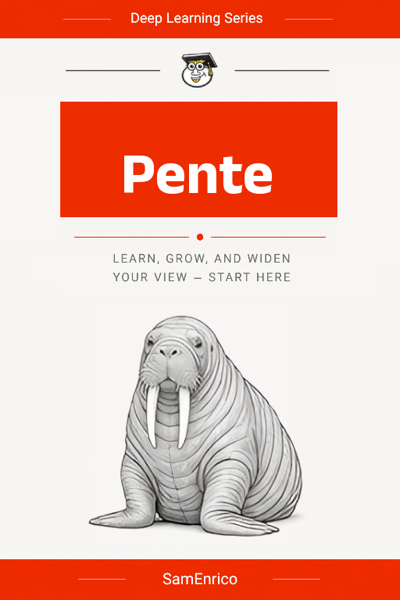
Non-FictionInformativeEducational
Pente eBook
A Coursebook on Pente
by Mcfadden Ok
A Coursebook on Pente
Formats
Free sample
Chapter 1: The Tube on the Shelf--–- In the autumn of 1978, a man named Gary Gabrel sat alone in a small workshop in Seattle, Washington, hand-filling plastic tubes with glass stones. He had no publisher, no distributor, no marketing budget, and no reason to believe that his creation would outlive the holiday season. He had a board, two colors of stones, and a single sheet of mimeographed instructions. That was all. Forty years later, that tube would sit on the shelves of collectors, competitive players, and casual gamers across thirty countries.
The game would outlast Parker Brothers, survive the collapse of the mainstream board game industry in the 1990s, and find new life on the internet. It would inspire world championships, computational analysis, and a small but ferociously dedicated community of players who insist that Pente is the most underrated abstract strategy game ever devised. But in 1978, it was just a tube on a shelf, waiting for someone to open it.This chapter is not a rulebook. It is not a strategy guide. It is an origin story and a map.
Before you can win at Pente, you must understand what Pente actually is—not as a set of mechanisms, but as a game with a history, a personality, and a unique place in the pantheon of abstract strategy. You will learn why Pente is neither Go nor Gomoku, why the center of the board matters more than anywhere else, why the edges are not the dead zones that earlier literature claimed, and why the unwritten rules of competitive etiquette matter as much as the written ones. By the end of this chapter, you will see the grid not as a blank slate but as a living geography of opportunity, threat, and human psychology.The Invention of an Accident Gary Gabrel did not set out to invent a classic. He was a graphic designer and a game enthusiast who enjoyed the elegant simplicity of Go but found its learning curve too steep for casual play. He admired Gomoku—the ancient game of five-in-a-row—but found it too linear, too predictable, too easily solved by defensive play.
In his workshop, he began experimenting. What if you added capture? What if you changed the win condition from one to three? What if you kept the board small enough to fit on a coffee table but large enough to reward spatial thinking? The result was a hybrid: a game that borrowed the stone-placement tension of Go, the row-building clarity of Gomoku, and the capture mechanic of no game in particular because Gabrel invented it himself.The name "Pente" came from the Greek word for five, a nod to the primary win condition.
But the Greek root also carried a second meaning: "to go" or "to proceed." Gabrel liked the double resonance. Pente was about moving forward, about progression through threat and response. He printed a small run of boards, sourced glass stones from a manufacturer that usually supplied Chinese Checkers sets, and began selling the game at craft fairs and hobby shops. The packaging was modest: a long cardboard tube containing a rolled-up vinyl board, a bag of stones, and the mimeographed rule sheet. It looked less like a game and more like a poster.
But it sold.By 1980, Pente had developed a cult following in the Pacific Northwest. Local tournaments sprang up in Seattle and Portland. Players began to notice something strange: the first player (Black) seemed to win almost every time. This was not unusual for abstract strategy games—chess has a first-move advantage, Go has a first-move advantage, even tic-tac-toe has a first-move advantage. But in Pente, the advantage was grotesque.
Early informal statistics suggested that Black won nearly eighty percent of games between players of equal skill. The capture mechanic, which Gabrel had intended as a balancing force, actually amplified the advantage because Black could dictate the geometry of early threats.The Pente community did what communities of competitive players have always done: they fixed the game themselves. In 1979, a group of Seattle players proposed the Opening Restriction, a rule that would later become known as the Tournament Rule. Black could not play on the center intersection on either the second or third move. This small constraint, barely noticeable to a casual player, fundamentally rebalanced the game.
White now had room to breathe, space to counterthreat, and a genuine chance to win. The rule spread through word of mouth, then through tournament rulebooks, and by 1985, it was universal in serious play. Parker Brothers, which acquired the rights to Pente in 1983, included the Tournament Rule as an optional variant in their mass-market edition. Most casual players ignored it, which is why most casual players still believe Black has an unfair advantage. They are playing a different game.Why Pente Is Not Go and Not Gomoku The most common confusion among new players is mistaking Pente for something they already know.
"It's like Go," they say, looking at the grid and the stones. Or, "It's just Gomoku with extra steps." Both statements are wrong, and the difference matters.Go, invented in China over two thousand years ago, is a game of territorial enclosure. Stones do not move, but they also do not capture directly through adjacency. Capture in Go happens when a stone or group of stones runs out of liberties—empty adjacent intersections. The goal is not to form a line but to surround more empty space than your opponent.
The board is large (19x19 is standard), games last for hours, and the strategic depth is legendary. Pente shares the stone-placement mechanic and the grid, but nothing else. Pente has no concept of territory. Liberties exist in Pente (we will borrow the term in Chapter 5), but they function differently because capture in Pente requires a specific geometric sandwich, not the exhaustion of empty spaces. A Pente stone with one liberty is not necessarily doomed; it may be bait.Gomoku, also known as Five in a Row, is the closer cousin.
The goal—five consecutive stones of your color—is identical to Pente's primary win condition. The board is often the same size. But Gomoku has no capture mechanic. In Gomoku, stones accumulate forever. Once placed, they never leave the board.
This changes everything. Without capture, Gomoku becomes a pure race: whoever builds a line of five first wins, and the only defense is blocking. There is no way to remove an opponent's stones, no way to reset a losing local battle, no way to pivot from a failed attack to a different win condition. Gomoku is elegant but shallow. Experienced players can force a win from the opening with memorized sequences.
Pente, by contrast, is deep because capture introduces a third dimension. You can win by building a row, or you can win by capturing five pairs, or you can threaten both simultaneously and force your opponent into impossible choices. The board state is never static. Stones disappear. Formations collapse.
The game breathes.This hybrid nature is Pente's genius and its curse. Genius because it rewards multiple styles of play—aggressive capture hunters, patient row builders, and everything in between. Curse because it confuses newcomers who expect a single path to victory.…
This is the end of the free sample. Get the eBook to keep going. Buy now
About this book
Details
- Author
- Mcfadden Ok
- Publisher
- SamEnrico
- Language
- English
- Genre
- Non-Fiction, Informative, Educational
- Released
- 2026-06-02
- Pages (approx.)
- 148
- Available as
- eBook, Audiobook

Read better in the ZLOADR app
Your eBooks on your phone or tablet. Sign in with your SamEnrico account and start reading.
More by Mcfadden Ok
 The Social Media and Sleep GuideMcfadden Ok$11.99
 WFH Cable Management GuideMcfadden Ok$11.99
 The South Africa Vendor GuideMcfadden Ok$11.99
 Financial Stress Foreclosure PreventionMcfadden Ok$11.99
 The Lion and the Fox: Scipio Africanus and the Art of DeceptionMcfadden Ok$11.99
 How to Start a Biscuits Business (Beginners Guide)Mcfadden Ok$11.99
 Learn to Play the ViolottaMcfadden Ok$11.99
 Board Meeting Etiquette GuideMcfadden Ok$12.99
You may also like
 Hong Kong Handover 1997Dunn Johnnie$11.99
 Zumba For Postnatal Recovery CourseNeal Christian$11.99
 Zumba for BeginnersLadner Nikia$11.99
 YouTube Comment Mining GuideHumes Pandora$12.99
 Worry Box MeditationCarlin Rudy$11.99
 Workplace Stress MeditationNguyen Lynn$11.99
 Workplace Stress and Sleep RepairHawley Ivory$11.99
 Workplace Perfectionism CureDelaney Jeffry$11.99
 Workplace Injustice Anger GuideWallen Isabelle$11.99
 Work Addiction and Burnout LinkGreenwood Ester$11.99
 Women in Yoga and WellnessBeattie Galina$11.99
 Women in Stand Up ComedyChun Evangeline$11.99