
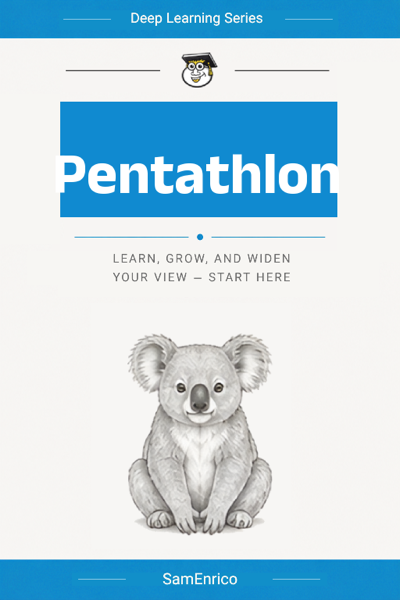
Non-FictionInformativeEducational
Pentathlon eBook
A Coursebook on Pentathlon
A Coursebook on Pentathlon
Formats
Free sample
Chapter 1: The Strangest Sport You Have Never Seen...--The first time I watched a Modern Pentathlon competition, I had no idea what I was looking at. One moment, athletes were lunging at each other with swords in a sterile indoor hall. Twenty minutes later, the same athletes were diving into a swimming pool in full-body suits. Then they were galloping around an arena on horses they had never met before. Finally, they were sprinting across a field while firing laser pistols at targets the size of a credit card.
I remember turning to the person next to me and asking, “Is this a sport or a fever dream?”That question has haunted me ever since. And after a decade of coaching, competing, and obsessively studying the Modern Pentathlon, I have arrived at an answer that surprises most people: it is both. The Pentathlon is a sport of seemingly irreconcilable contradictions. It demands explosive power and meditative calm, aggressive dominance and empathetic partnership, meticulous planning and split-second chaos. It is, quite simply, the strangest, most beautiful, and most brutal athletic challenge that most people have never seen.But here is the secret that the Pentathlon’s obscurity hides from the world: you already live a pentathlon every single day.Think about your most demanding workday.
You start with an aggressive negotiation or a high-stakes presentation—that is your fencing. Then you sink into four hours of deep, uninterrupted focus—that is your swimming. A crisis erupts that you could not have predicted, forcing you to adapt to an unfamiliar situation with grace—that is your equestrian. Then you grind through the mindless, exhausting tasks that simply must get done—that is your running. And finally, you make a precise, high-consequence decision when your brain is already fried—that is your shooting.
The Modern Pentathlon is not a niche sport for eccentric aristocrats. It is a mirror held up to the modern condition of high-performance living. And the athletes who master it know something that most of us never learn: how to switch between five different modes of being without breaking.This book is not a dry technical manual, though you will find plenty of technical instruction within these pages. It is not a collection of inspirational athlete biographies, though you will meet remarkable competitors along the way. It is, instead, a coursebook for the art of the pentathlon—both the formal sport governed by the Union Internationale de Pentathlon Moderne (UIPM) and the informal pentathlon of your own high-stakes life.
By the time you finish this chapter, you will understand why this strange sport exists, why it has survived for more than a century by constantly reinventing itself, and why its core lesson—the mastery of the transition—is more relevant today than ever before.Let us begin at the beginning, not with rules or techniques, but with a question that most sport histories ignore: why would anyone combine five completely different disciplines into a single competition in the first place? The answer takes us back three thousand years, to the battlefields of ancient Greece, where the Pentathlon was born not as entertainment but as a matter of survival.The Warrior’s Examination In 708 BCE, the ancient Olympic Games added a new event that would become the most prestigious on the program. It was called the Pentathlon, from the Greek words pente (five) and athlon (contest). The original five disciplines were the discus throw, the javelin throw, the long jump, running, and wrestling. To the modern eye, this seems like a random assortment of track and field events.
But to the ancient Greek military mind, these five skills represented the complete toolkit of the soldier.The discus throw trained rotational power and full-body coordination—the ability to generate force from the ground up, essential for throwing a spear or swinging a sword. The javelin throw, obviously, was direct weapons training. The long jump was not just a measure of leaping distance but of controlled explosive power, often performed with handheld weights called halteres that simulated the weight of a shield or weapon. The running event—likely a sprint of approximately 200 meters—trained battlefield mobility and the ability to close distance with an enemy. And wrestling, the final event, trained hand-to-hand combat, joint locks, and the brutal art of defeating an opponent without weapons.Here is what made the ancient Pentathlon unique, and what separates it from any modern track combination event like the decathlon: the ancient Pentathlon was not scored by adding points across five separate competitions.
Instead, athletes competed in the first four events to qualify for the final event, wrestling. And the wrestling match was not a separate contest—it was the culmination. The athlete who won the wrestling bout won the entire Pentathlon. This meant that an athlete could lead after the discus, javelin, long jump, and running, but if he lost the final wrestling match, he went home with nothing. The Pentathlon was, in its original form, a sport of elimination under pressure.
It rewarded the athlete who could manage the accumulated fatigue of four events and still perform a completely different physical skill—grappling—at the highest level.The philosopher Aristotle, writing in the 4th century BCE, famously declared that Pentathletes were the most beautiful athletes because they possessed the ideal balance of strength, speed, and skill. Unlike the specialized wrestler (too bulky) or the specialized runner (too lean), the Pentathlete was proportioned for everything. This was not merely aesthetic commentary. It was a military doctrine. The Greek army did not need specialists.
It needed soldiers who could throw, run, jump, and fight—sometimes all in the same hour. The Pentathlon was the ancient world’s original cross-training certification.But after the fall of the Olympic Games in 393 CE (decreed by the Christian emperor Theodosius I, who considered the Games a pagan ritual), the Pentathlon vanished for more than fifteen centuries. It survived only as a word in history books, a curiosity of a lost civilization. Then, in the late 19th century, a French aristocrat with an obsessive vision for the modern world became fascinated by this ancient ideal. His name was Baron Pierre de Coubertin.The Baron’s Gambit Pierre de Coubertin is famous as the founder of the modern Olympic Games in 1896.
But his lesser-known obsession was the Pentathlon. In 1909, de Coubertin wrote a letter to his colleagues proposing a new event for the Olympic program. He argued that the ancient Pentathlon had captured something essential about athletic excellence that the modern Games were missing. The problem, he wrote, was specialization. Modern sport was creating “muscular monstrosities” who could do one thing brilliantly and nothing else.
De Coubertin wanted an event that would produce the “complete athlete.”But de Coubertin was not a slave to tradition. He was a pragmatist. The ancient Pentathlon’s events—discus, javelin, long jump, running, wrestling—were, by 1900, already individual sports in the Olympic program. He could have simply resurrected the ancient format. Instead, he made a radical decision.
He replaced the ancient disciplines with modern ones that he believed better reflected the skills required of a 20th-century military officer. The new Pentathlon would consist of: fencing (sword dueling)…
This is the end of the free sample. Get the eBook to keep going. Buy now
About this book
Details
- Author
- Hadden Donovan
- Publisher
- SamEnrico
- Language
- English
- Genre
- Non-Fiction, Informative, Educational
- Released
- 2026-05-11
- Pages (approx.)
- 160
- Available as
- eBook, Audiobook

Read better in the ZLOADR app
Your eBooks on your phone or tablet. Sign in with your SamEnrico account and start reading.
More by Hadden Donovan
 Teen Public Speaking GuideHadden Donovan$11.99
 MDD And Anxiety GuideHadden Donovan$11.99
 The Bedwetter StoriesHadden Donovan$11.99
 Foster Care And The HolidaysHadden Donovan$11.99
 The Bipolar I Mania Diagnosis GuideHadden Donovan$11.99
 Dragon and the Jade Phoenix: A Forgotten Arthurian Romance in the EastHadden Donovan$11.99
 Minority Firm Past Performance DatabaseHadden Donovan$12.99
 CTO for Mobile App StartupsHadden Donovan$12.99
 The Breeder's Guide to San Clemente GoatHadden Donovan$11.99
 10 Ways to Use Fromage Frais (Recipe Book)Hadden Donovan$11.99
You may also like
 Hong Kong Handover 1997Dunn Johnnie$11.99
 Zumba For Postnatal Recovery CourseNeal Christian$11.99
 Zumba for BeginnersLadner Nikia$11.99
 YouTube Comment Mining GuideHumes Pandora$12.99
 Worry Box MeditationCarlin Rudy$11.99
 Workplace Stress MeditationNguyen Lynn$11.99
 Workplace Stress and Sleep RepairHawley Ivory$11.99
 Workplace Perfectionism CureDelaney Jeffry$11.99
 Workplace Injustice Anger GuideWallen Isabelle$11.99
 Work Addiction and Burnout LinkGreenwood Ester$11.99
 Women in Yoga and WellnessBeattie Galina$11.99
 Women in Stand Up ComedyChun Evangeline$11.99