
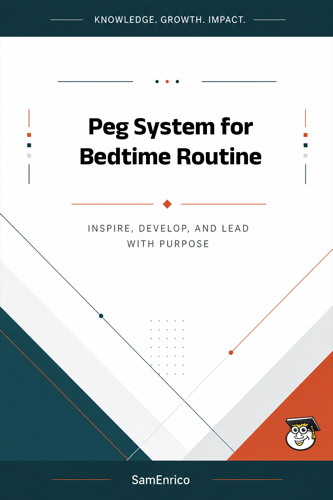
Peg System for Bedtime Routine eBook
Wind down consistently using pegs for evening prep
by Windham Jona
Wind down consistently using pegs for evening preparation tasks.
Formats
Free sample
Chapter 1: The Ceiling Stares Back--–- The ceiling stares back at you. White. Cracked. Slightly yellowed from years of breathing and forgetting. Your phone says 10:47 PM, then 10:48, then 10:49.
You have been lying here for eleven minutes, maybe fourteen, and your brain will not shut up. Did I lock the front door? Did I take my pill? Did I turn off the curling iron? Did I brush my teeth, or do I just remember brushing my teeth from last night?
The questions arrive like unwanted guests, each one pushing open a door you thought you had closed. You sigh. You swing your legs over the side of the bed. The floor is cold. You shuffle back down the hallway, check the lock (it was locked), check the bathroom (toothpaste dried on the counter, so yes, you brushed), check the kitchen (the curling iron is unplugged, it has been unplugged for hours).
You crawl back into bed. Your heart is beating faster now. Your mind is wide awake. Congratulations. You just turned a perfectly good bedtime into a second shift of invisible labor.This is the moment this book exists to destroy.
Not the ceiling. Not the cracked paint. The moment. That specific, grinding, 10:45 PM spiral where your tired brain convinces you that you have failed at the simple act of ending your day. You have not failed.
Your brain has simply been asked to do something it was never designed to do: remember a sequence of boring, identical tasks at the exact moment when its memory systems are shutting down for the night.This chapter is about why that happens, why it is not your fault, and why the solution has nothing to do with trying harder.The Hidden Tax You Did Not Know You Were Paying Let us begin with a question that sounds simple but is actually profound: How many decisions have you made today?Not the big ones. Not "should I quit my job" or "is this relationship working." The small ones. What to wear. Whether to hit snooze. What to eat for breakfast.
Which mug to use. Whether to reply to that email now or later. Whether to say "good morning" to the neighbor or pretend you did not see them. Whether to take the stairs or the elevator. Whether to listen to a podcast or music or silence on the way to work.
What to eat for lunch. Where to sit. Whether to speak up in the meeting or stay quiet. Whether to text back immediately or wait. Whether to stop for gas now or in the morning.
What to make for dinner. Whether to watch one episode or two. Whether to call your mother back tonight or tomorrow.By the time you reach 10:00 PM, you have made literally hundreds of decisions. Some estimates suggest the average adult makes about 35,000 remotely conscious decisions every day. Most of them are trivial.
Each one costs a tiny amount of mental energy. And here is the problem: mental energy is not infinite.Psychologists call this decision fatigue. It is the deteriorating quality of decisions made by an individual after a long session of decision-making. It is why judges are more likely to deny parole in the afternoon than in the morning. It is why shoppers buy more junk food at the end of a long trip to the grocery store.
It is why you make terrible choices about what to watch on Netflix at 10:30 PM but feel fine about it until the next morning.Decision fatigue does not just affect the quality of your decisions. It affects your memory. A fatigued prefrontal cortex—the part of your brain that manages planning, impulse control, and working memory—cannot reliably encode new information. You can look directly at your phone on the charger and think "I will remember that I plugged it in," but your fatigued brain never actually saves that file. It creates a memory placeholder instead.
A note that says "file pending." And then, at 10:47 PM, when you try to retrieve that file, you find nothing but empty space.This is not forgetfulness. This is neurology. And no amount of scolding yourself will fix it.The Three Thieves of Bedtime Memory The Scatterbrain Effect, as we will call it throughout this book, is not one problem but three problems arriving at the same time. Think of them as three thieves who sneak into your bedroom every night, each one stealing a different kind of memory.Thief Number One: Source Monitoring Failure Source monitoring is your brain's ability to track where a memory came from. Did you actually lock the door, or did you imagine locking it?
Did you actually take your pill, or did you think about taking it while you were in the bathroom? Did you actually brush your teeth, or did you remember brushing them yesterday and confuse that memory with tonight?Your brain distinguishes between real memories and imagined memories using contextual clues: the feeling of the doorknob in your hand, the sound of the lock clicking, the temperature of the water on your toothbrush. But when you are tired, your brain stops paying attention to those clues. Everything flattens. Real and imagined feel the same.
And suddenly, you are lying in bed, absolutely certain that you remember doing the thing, but also absolutely certain that you do not trust that memory.Source monitoring failure is responsible for at least seventy percent of the 10:45 PM Panic. You are not forgetting. You are misremembering. And misremembering feels exactly like forgetting.Thief Number Two: Prospective Memory Paralysis Prospective memory is your brain's ability to remember to do something in the future. "I need to take my pill at 9:00 PM." "I need to lock the door before I get into bed." "I need to plug in my phone before the battery dies."Prospective memory relies on two things: a cue (a trigger that reminds you to do the thing) and a retrieval (the actual memory of the thing you need to do).
During the day, cues are everywhere. The sun goes down. Your stomach growls. Your phone buzzes. Your coworker says "lunch?" Each cue triggers a smooth retrieval.But at night, the cues get weird.
You are not hungry. Your phone is not buzzing. The sun has been down for hours. Your brain has to generate its own cues from scratch, using nothing but internal monitoring. And internal monitoring is exactly what decision fatigue destroys.
You cannot cue yourself because the part of your brain that would generate the cue is the same part that is too tired to work.This is why you can walk past the front door, look directly at the lock, think "I should lock that," and then walk away without locking it. You generated the intention. You never generated the retrieval. The cue appeared and vanished without attaching itself to an action.Thief Number Three: Cortisol Confusion Cortisol is your body's primary stress hormone. It rises in the morning to wake you up and falls at night to let you sleep.
That is the ideal pattern. But modern life disrupts this pattern constantly. Late-night emails. Stressful conversations before bed. Worrying about money.
Worrying about work. Worrying about the thing you said three years ago that still keeps you awake at 2:00 AM.When…
This is the end of the free sample. Get the eBook to keep going. Buy now
About this book
Details
- Author
- Windham Jona
- Publisher
- SamEnrico
- Language
- English
- Genre
- Non-Fiction, Self-Help
- Released
- 2026-06-09
- Pages (approx.)
- 136
- Available as
- eBook, Audiobook

Read better in the ZLOADR app
Your eBooks on your phone or tablet. Sign in with your SamEnrico account and start reading.
More by Windham Jona
 Gender Differences Nonverbal GuideWindham Jona$11.99
 Remote Review AI Tool AssistanceWindham Jona$11.99
 Battery Storage Capital GuideWindham Jona$11.99
 Peterson Home Forensics Deep DiveWindham Jona$11.99
 The Banshee's Lament: Ireland's Wailing SpiritWindham Jona$11.99
 How to Start a Hunting and Trapping BusinessWindham Jona$11.99
 ESG Shareholder Proposal AnalysisWindham Jona$12.99
 Dot Africa Domain Registration GuideWindham Jona$12.99
 Understanding Partial Agenesis of Corpus CallosumWindham Jona$17.99
 In Home Sales RepresentativeWindham Jona$11.99
You may also like
 Hong Kong Handover 1997Dunn Johnnie$11.99
 Zumba For Postnatal Recovery CourseNeal Christian$11.99
 Zumba for BeginnersLadner Nikia$11.99
 YouTube Comment Mining GuideHumes Pandora$12.99
 Worry Box MeditationCarlin Rudy$11.99
 Workplace Stress MeditationNguyen Lynn$11.99
 Workplace Stress and Sleep RepairHawley Ivory$11.99
 Workplace Perfectionism CureDelaney Jeffry$11.99
 Workplace Injustice Anger GuideWallen Isabelle$11.99
 Work Addiction and Burnout LinkGreenwood Ester$11.99
 Women in Yoga and WellnessBeattie Galina$11.99
 Women in Stand Up ComedyChun Evangeline$11.99