
Non-FictionSelf-HelpGuided Imagery
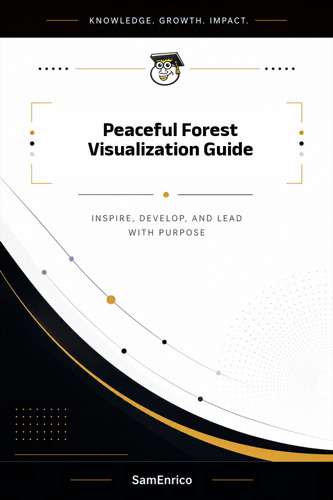
Peaceful Forest Visualization Guide eBook
Leads listeners through a calming woodland journey
Leads listeners through a calming woodland journey with sunlight and birdsong.
Formats
Free sample
Chapter 1: The Forest Already Inside You...--–- You are about to discover something surprising: the most peaceful forest you will ever walk through is not one you drive to, pack for, or find on a map. It is the one you carry behind your closed eyes. And you have been building it your entire life without knowing.Every time you have recalled a sunny afternoon, remembered the sound of rain on leaves, or felt a sudden sense of calm when you thought of a tree you once sat beneath, you were practicing a form of forest visualization. You simply did not call it that. You did not realize you were training a skill that, with just a few pages of guidance, can become a reliable tool for calming anxiety, quieting racing thoughts, and restoring a sense of safety in a world that rarely offers stillness.This book exists because of a simple truth that science is only now catching up to: the human brain responds to a vividly imagined forest almost as powerfully as it responds to a real one.
Not identically, no. The scent of actual pine needles, the coolness of actual shade, the tangible presence of a living tree—these cannot be fully replicated in the mind. But the neural circuits that fire when you imagine sunlight through leaves are substantially the same as those that fire when you see it. Your heart rate slows. Your breathing deepens.
Your cortisol levels drop. You do not need hiking boots. You do not need a weekend getaway. You need only your attention, and a few minutes, and a willingness to return to a place you have always known.Why This Book Is Different There are many books about nature visualization. Some are lovely.
Some are vague. Some tell you to "imagine a peaceful forest" and then leave you there, alone with your wandering mind, without teaching you how to make that forest feel real enough to matter.This book does something different. It gives you two specific, powerful anchors that your brain already knows how to follow: sunlight and birdsong. These are not decorative elements. They are not pleasant background details.
They are the twin doorways through which you will enter a state of deep, restorative attention. Sunlight, with its shifting patterns and endless variety, gives your eyes something to track even when they are closed. Birdsong, with its rhythmic structure and emotional resonance, gives your ears a thread to follow when your thoughts begin to scatter.Throughout this book, you will learn to work with five distinct types of forest light, each suited to a different emotional need. You will learn to recognize the emotional valence of different bird calls—why a robin steadies you while a wren releases nervous energy. You will learn to build soundscapes that hold your attention without exhausting it.
And you will learn to do all of this in as little as sixty seconds when that is all you have.But first, let us talk about why any of this works at all. Because the moment you understand the science beneath the practice, something shifts. The practice stops feeling like "pretending" and starts feeling like what it actually is: a form of mental training with measurable, proven effects on the nervous system.The Brain Cannot Tell Every Difference For decades, neuroscientists have studied what happens inside the skull when people imagine sensory experiences. The findings are consistent and striking: when you vividly imagine seeing a face, the visual cortex activates. When you vividly imagine hearing a melody, the auditory cortex activates.
When you vividly imagine touching velvet, the somatosensory cortex activates. Not as strongly as with real perception, but strongly enough to matter.This is called functional equivalence. The brain uses many of the same maps and circuits for imagined experience as it does for actual experience. And here is the critical insight for our purposes: when you imagine a forest, your brain does not categorize that as "fake." It categorizes that as "forest-like." And it begins to produce forest-like responses: slower breathing, reduced muscle tension, a shift toward parasympathetic nervous system activity (the "rest and digest" mode, as opposed to "fight or flight").A 2018 study by researchers at the University of Salzburg found that participants who engaged in guided forest visualization for just ten minutes showed significant reductions in cortisol levels—comparable to those who spent twenty minutes in an actual forest. Another study, published in the International Journal of Environmental Research and Public Health, found that even brief nature visualizations reduced state anxiety and improved mood in participants who had no access to outdoor green spaces.This is not magic.
This is neurobiology. Your brain evolved to respond to certain sensory cues: dappled light, birdsong, the smell of earth after rain. These cues, whether real or imagined, trigger ancient pathways that say, You are safe. Resources are available. You can rest now.Attention Restoration Theory In the 1980s, psychologists Rachel and Stephen Kaplan developed Attention Restoration Theory (ART), which has since become one of the most influential frameworks in environmental psychology.
The theory proposes that directed attention—the kind you use to focus on a spreadsheet, drive in traffic, or listen to a boring meeting—is a finite resource. It depletes with use. And when it is depleted, you become irritable, distractible, and prone to errors.Nature, the Kaplans argued, restores directed attention through a process called soft fascination. Unlike the hard fascination of a thriller novel or a video game (which grabs your attention and holds it tightly), soft fascination gently holds your attention without exhausting it. Watching sunlight move across a forest floor, listening to birdsong without trying to identify every note—these experiences allow your directed attention to rest while your involuntary attention takes over.Here is what makes this relevant to a book you read indoors: the restorative effect does not require an actual forest.
It requires the perception of a forest-like environment. When you close your eyes and imagine dappled sunlight and birdsong with sufficient vividness, your brain shifts into soft fascination mode. Your directed attention rests. Your involuntary attention takes the wheel. And you emerge from the practice feeling clearer, calmer, and more capable than when you began.Komorebi: The Anchor of Light The Japanese language has a word for something most Western languages cannot name in a single term: Komorebi (木漏れ日).
It means "sunlight filtering through the leaves of trees." More than that, it carries the sense of the interplay between light and shadow, the dance of shifting brightness, the way a forest floor is never fully lit nor fully dark but always in between.I introduce this word not because we need Japanese terms to sound authentic, but because naming something gives you power over it. Komorebi is the perfect anchor for visualization practice. Here is why:First, sunlight through leaves is never static. It moves with the wind, with the earth's rotation, with the shifting angle of the sun. A static image—a photograph of a forest—can be beautiful, but it does not hold attention the way a changing image does.
Your brain is wired to notice change. When you imagine dappled light shifting slowly across a mossy log, your involuntary…
This is the end of the free sample. Get the eBook to keep going. Buy now
About this book
Details
- Author
- Adcock Elisabeth
- Publisher
- SamEnrico
- Language
- English
- Genre
- Non-Fiction, Self-Help, Guided Imagery
- Released
- 2026-06-06
- Pages (approx.)
- 132
- Available as
- eBook, Audiobook

Read better in the ZLOADR app
Your eBooks on your phone or tablet. Sign in with your SamEnrico account and start reading.
More by Adcock Elisabeth
 Flow in Surgery MedicineAdcock Elisabeth$11.99
 Canva Brand Launch ChecklistAdcock Elisabeth$11.99
 Cherry Blossom GardenAdcock Elisabeth$11.99
 The Senior Doctor Visit GuideAdcock Elisabeth$11.99
 Self Talk Rewiring CourseAdcock Elisabeth$11.99
 Self Hypnosis for Tennis ElbowAdcock Elisabeth$11.99
 Digital Customer Support CommunicationAdcock Elisabeth$11.99
 The Phantom of Verdun: Pétain's Flesh GrinderAdcock Elisabeth$11.99
 The Eagle and the Fox: Scipio Africanus and the Art of Roman StrategyAdcock Elisabeth$11.99
 How to Produce Pipe Joint PrimerAdcock Elisabeth$11.99
 How to Produce Hypo-allergenic DetergentAdcock Elisabeth$11.99
 Business Credit for Ecommerce SellersAdcock Elisabeth$12.99
You may also like
 Hong Kong Handover 1997Dunn Johnnie$11.99
 Zumba For Postnatal Recovery CourseNeal Christian$11.99
 Zumba for BeginnersLadner Nikia$11.99
 YouTube Comment Mining GuideHumes Pandora$12.99
 Worry Box MeditationCarlin Rudy$11.99
 Workplace Stress MeditationNguyen Lynn$11.99
 Workplace Stress and Sleep RepairHawley Ivory$11.99
 Workplace Perfectionism CureDelaney Jeffry$11.99
 Workplace Injustice Anger GuideWallen Isabelle$11.99
 Work Addiction and Burnout LinkGreenwood Ester$11.99
 Women in Yoga and WellnessBeattie Galina$11.99
 Women in Stand Up ComedyChun Evangeline$11.99