
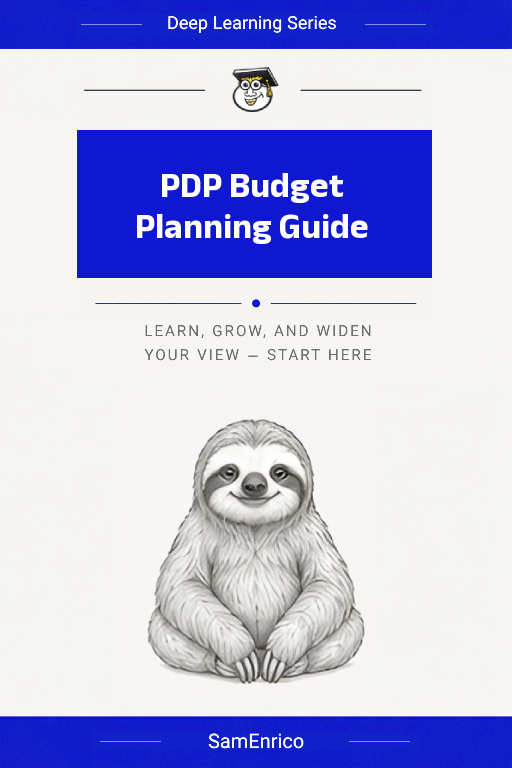
Non-FictionProfessional's Cheat SheetBudgetInvestment
PDP Budget Planning Guide
Allocate budget for your personal development incl
by Corbin Devin
Allocate budget for your personal development including courses coaching and conference attendance costs.
Formats
About this book
Free sample
Chapter 1: The Investment Identity--–- Most people say "I can't afford a course" while simultaneously spending three hundred dollars a month on streaming services, dining out, and unused gym memberships. They say "I'll invest in myself next year" while paying interest on credit card debt from last year's vacation. They say "Learning is too expensive" while scrolling past a forty-nine-dollar certification that would qualify them for a twenty-thousand-dollar raise. The lie isn't about a lack of money. It is about a lack of prioritization.
This chapter attacks the most common barrier to personal development planning: the scarcity mindset that convinces you that you are a consumer first and an investor second.Before we go any further, we need a definition that will guide everything else in this book. Professional Development Planning, or PDP, is learning that directly increases your earning potential in your current or next role. That definition is deliberately narrow. A creative writing workshop may be valuable, but if it does not help you earn more as an accountant, it belongs in your Guilt-Free Spending column, not your PDP allocation. A masterclass in photography may be fulfilling, but if you are a nurse, it is a hobby.
This book is not anti-hobby. It is pro-clarity. When you know exactly what counts as professional development, you stop justifying random expenses as "investments" and start funding only what pays you back.The problem is not that you lack money. The problem is that you have not yet decided that your future self is worth funding. This chapter introduces the concept of Human Capital Depreciation, provides the 10-Year Backcast exercise that reveals the true cost of saying no, and forces a fundamental identity shift from consumer to investor.
By the end of this chapter, you will never say "I can't afford it" again. You will say "I choose not to prioritize it," and that honesty will set you free.The Scarcity Mindset vs. The Investment Mindset Let us start with a simple question. If your car needed a new timing belt to avoid a five-thousand-dollar engine failure, would you say "I can't…
This is the end of the free sample. Get the eBook to keep going. Buy now
Contents
- Chapter 1
- Chapter 2
- Chapter 3
- Chapter 4
- Chapter 5
- Chapter 6
- Chapter 7
- Chapter 8
- Chapter 9
- Chapter 10
- Chapter 11
- Chapter 12
Details
- Author
- Corbin Devin
- Publisher
- SamEnrico
- Language
- English
- Genre
- Non-Fiction, Professional's Cheat Sheet, Budget, Investment
- Released
- 2026-05-29
- Pages (approx.)
- 137
- Available as
- eBook, Audiobook

Read better in the ZLOADR app
Your eBooks on your phone or tablet. Sign in with your SamEnrico account and start reading.
More by Corbin Devin
 Nigerian Green Tax Credits GuideCorbin Devin$11.99
 Calisthenics Handstand RoadmapCorbin Devin$11.99
 Chinese Talent Flows ForecastCorbin Devin$11.99
 The Foster Child Sleep GuideCorbin Devin$11.99
 Innocence Project West Virginia CasesCorbin Devin$11.99
 Beneath the Veil: The Forbidden Love of Cleopatra and Mark Antony in the Shadows of RomeCorbin Devin$11.99
 Understanding Chromosome 20, TrisomyCorbin Devin$17.99
 Operating Agreement Template GuideCorbin Devin$12.99
 How to Start a Hobby in Owning An Antique CarCorbin Devin$11.99
 Food Dudes Driver PartnerCorbin Devin$11.99
You may also like
 Hong Kong Handover 1997Dunn Johnnie$11.99
 Zumba For Postnatal Recovery CourseNeal Christian$11.99
 Zumba for BeginnersLadner Nikia$11.99
 YouTube Comment Mining GuideHumes Pandora$12.99
 Worry Box MeditationCarlin Rudy$11.99
 Workplace Stress MeditationNguyen Lynn$11.99
 Workplace Stress and Sleep RepairHawley Ivory$11.99
 Workplace Perfectionism CureDelaney Jeffry$11.99
 Workplace Injustice Anger GuideWallen Isabelle$11.99
 Work Addiction and Burnout LinkGreenwood Ester$11.99
 Women in Yoga and WellnessBeattie Galina$11.99
 Women in Stand Up ComedyChun Evangeline$11.99