
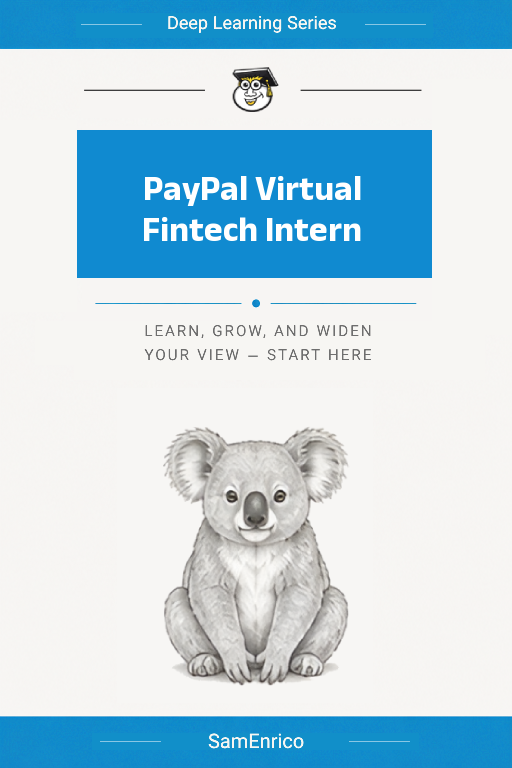
Non-FictionStudent's ShortcutFintech InternshipPayPal Careers
PayPal Virtual Fintech Intern eBook
Join PayPal's remote internship for payment securi
by Barrett Otis
Join PayPal's remote internship for payment security fraud detection or digital wallet development with global teams.
Formats
Free sample
Chapter 1: The $47,000 Mistake--–- The email arrived at 11:47 PM on a Tuesday. Maya had been staring at her laptop screen for four hours, cycling through the same three job boards, watching the same two rejection letters glow from her inbox like tiny digital verdicts. She was nine months out of college with a degree in Philosophy from a state school no one had heard of, $42,000 in student debt, and a growing conviction that she had made a terrible, irreversible mistake by majoring in something that did not teach her how to do anything.Her roommate, Priya, was a computer science major who had already accepted a six-figure offer from a cloud computing company. Priya meant well, but her advice usually landed somewhere between useless and insulting. "Just learn to code," she would say, as if learning to code were equivalent to learning to boil water.
"There are free bootcamps." Maya had tried three of them. She had made it through HTML and CSS – which felt like learning a foreign language where the only vocabulary was "center this div" – and then crashed hard against Java Script, a language that seemed designed to punish anyone who asked "why" instead of just memorizing syntax.The job market had been brutal. Maya had applied to 147 positions since graduation. She had received 146 rejections and one interview invitation that she had accidentally deleted while trying to archive a spam email about extended car warranties. The rejections came in many forms: the impersonal form letter ("After careful consideration..."), the ghosting (no response at all, which somehow hurt more), and the occasional cruelty of a personalized rejection that included the phrase "we were impressed by your background" followed by a "but" that negated everything before it.She was qualified, on paper, for nothing.
Her transcript showed As in Symbolic Logic, Philosophy of Mind, and Ethics. Her resume listed summer jobs at a bookstore and a food co-op. Her only "technical" experience was a single statistics course where she had learned to run t-tests in SPSS, a piece of software that looked like it had been designed in 1998 and never updated. She could not build an app. She could not write a query.
She could not explain what an API was, though she had heard the term enough times to fake a vague understanding.At 11:47 PM, a new email appeared. The sender was "Pay Pal University Recruiting." The subject line was "Virtual Internship Opportunity – Global Fintech Intern (Fraud & Risk)."Maya almost deleted it.She had learned to recognize the signs of mass recruitment emails: the generic greeting ("Dear Candidate"), the lack of personalization, the breathless enthusiasm that seemed to promise the moon and deliver nothing. But something made her click. Maybe it was the word "virtual" – she could do this from her bedroom, no relocation required, no need to explain why she lived in a two-bedroom apartment with three other people in a midsize Midwestern city. Maybe it was the word "fraud" – which sounded thrilling in a way that "data entry" and "administrative assistant" did not.
Or maybe it was just desperation, the simple math of 146 rejections leaving her with nothing to lose.The email read:We are seeking current students and recent graduates for a paid virtual internship in our Global Risk & Fraud Detection division. No prior fintech experience required. Candidates from all majors encouraged to apply. This is a hands-on simulation-based internship where you will learn to identify fraud patterns, analyze transaction data, and work with global teams. Basic analytical thinking required.
Proficiency in SQL is a plus but not mandatory – we will teach you.Maya read it three times. "No prior fintech experience required." "Candidates from all majors encouraged to apply." "We will teach you." These were words she had never seen in a job description before. Every other posting had demanded two years of experience for entry-level roles, a bachelor's degree for jobs that paid barely above minimum wage, or a list of technical requirements that read like a ransom note from a programmer who had given up on humanity.She forwarded the email to Priya with a single question mark.Priya responded thirty seconds later: "APPLY RIGHT NOW. THIS IS REAL."Maya typed back: "I don't know SQL. It says proficiency is a plus."Priya's response was immediate and emphatic: "It says 'a plus, not mandatory.' That's recruiter code for 'we will teach you if you're smart.' Do you know how many people won't apply because they see 'SQL' and panic?
Probably most of them. That's your advantage – you panic but you apply anyway."The application deadline was in thirteen minutes.The Philosophy of Risk Maya had never thought of her philosophy degree as relevant to anything outside of academia. She had chosen the major because she was curious about big questions – What does it mean to know something? How do we make ethical decisions under uncertainty? Can a machine be held responsible for its actions?
– and because she had been terrible at chemistry and only moderately competent at economics. Her parents had been supportive in the way that parents who love you despite your questionable life choices can be: they paid for the degree, attended her graduation, and then gently asked what her "plan" was.She did not have a plan. She had a collection of half-formed ideas about law school (too expensive), graduate school (more of the same), and non-profit work (too many applications, too few responses). The philosophy degree had taught her how to read dense texts, how to construct logical arguments, how to identify hidden assumptions in other people's reasoning, and how to sit with uncertainty without immediately grasping for an answer. It had not taught her how to make a living.But as she stared at the Pay Pal internship application, she realized that those skills were not nothing.
Fraud detection, she guessed, was fundamentally about reasoning under uncertainty. It was about looking at incomplete information – a transaction here, a login there, a device ID that did not quite match – and making a judgment call about whether something was wrong. It was about identifying hidden assumptions in the way systems were designed. It was about asking "why" when everyone else was satisfied with "that's how it's always been done."She opened the application. It asked for her resume, her transcript, and answers to three short essay questions:Describe a time you identified a pattern that others missed.
What did you see, and how did you confirm it was real?*Imagine you notice a sudden spike in small-dollar transactions from new accounts. These transactions are all under $10 and all sent to the same recipient. What questions would you ask, and what would you do next?*Why are you interested in fraud detection, and what unique perspective do you bring?Maya answered the first question by writing about her summer job at the bookstore. She had noticed that certain customers always seemed to buy books from the "staff picks" table, regardless of what was on it, and that those customers almost never bought anything else. She had tracked the purchases over two months and realized that the staff picks table was located directly in the path from the entrance to the…
This is the end of the free sample. Get the eBook to keep going. Buy now
About this book
Details
- Author
- Barrett Otis
- Publisher
- SamEnrico
- Language
- English
- Genre
- Non-Fiction, Student's Shortcut, Fintech Internship, PayPal Careers
- Released
- 2026-05-30
- Pages (approx.)
- 140
- Available as
- eBook, Audiobook

Read better in the ZLOADR app
Your eBooks on your phone or tablet. Sign in with your SamEnrico account and start reading.
More by Barrett Otis
 Legal Argument Anxiety ProtocolBarrett Otis$11.99
 Embassy Siege SurvivorBarrett Otis$11.99
 Meth Employment Recovery GuideBarrett Otis$11.99
 Panic Attack Recognition HandbookBarrett Otis$11.99
 Cultural Expectations and Parental RageBarrett Otis$11.99
 The Frozen Code: Antarctica's Forgotten AI PioneersBarrett Otis$11.99
 The Last Broadcast: Orbiting the Challenger DisasterBarrett Otis$11.99
 Understanding Bowing Congenital Short BonesBarrett Otis$17.99
 Ultimate Handbook Guide to Qingzhou : (China) Travel GuideBarrett Otis$11.99
 CobblerBarrett Otis$11.99
You may also like
 Hong Kong Handover 1997Dunn Johnnie$11.99
 Zumba For Postnatal Recovery CourseNeal Christian$11.99
 Zumba for BeginnersLadner Nikia$11.99
 YouTube Comment Mining GuideHumes Pandora$12.99
 Worry Box MeditationCarlin Rudy$11.99
 Workplace Stress MeditationNguyen Lynn$11.99
 Workplace Stress and Sleep RepairHawley Ivory$11.99
 Workplace Perfectionism CureDelaney Jeffry$11.99
 Workplace Injustice Anger GuideWallen Isabelle$11.99
 Work Addiction and Burnout LinkGreenwood Ester$11.99
 Women in Yoga and WellnessBeattie Galina$11.99
 Women in Stand Up ComedyChun Evangeline$11.99