
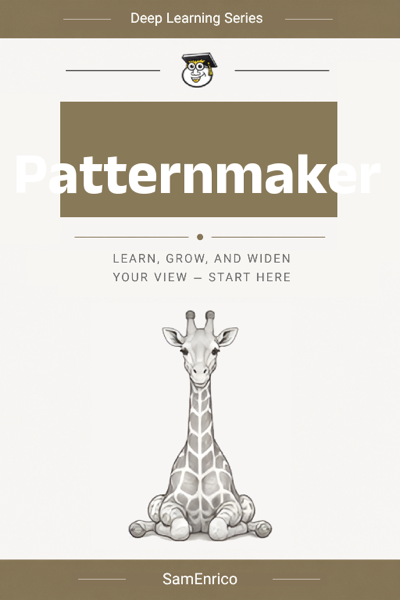
Non-FictionInformativeEducational
Patternmaker eBook
A Coursebook on Patternmaker
by Rudd Malinda
A Coursebook on Patternmaker
Formats
Free sample
Chapter 1: The Cartographer’s Awakening...--Every garment you have ever loved began as a flat piece of paper covered in lines that looked nothing like a dress. That paper was a map, and the person who drew it was a cartographer of cloth – someone who understood that the human body is not a flat surface, and that the journey from two dimensions to three requires a special kind of literacy.Welcome to that literacy. Welcome to patternmaking.Before you cut into a single yard of expensive fabric, before you sew a seam that cannot be undone, you will draw. You will measure, calculate, and problem-solve on paper, where mistakes cost pennies instead of hours. This chapter is not about drafting a garment – not yet.
It is about building the workshop, both physical and mental, that will support every pattern you ever create. It is about understanding that patternmaking is not magic, nor is it pure mathematics. It is a craft with its own tools, its own language, and its own rituals.If you have ever opened a commercial sewing pattern and felt overwhelmed by the cryptic symbols – the triangles, the arrows, the mysterious dots – this chapter will demystify them. If you have ever wondered how a flat piece of paper becomes a three-dimensional sleeve that bends with your elbow, the answer lies in the grainline. And if you have ever despaired at the fit of a garment and wished you could simply "start from scratch," the concept of the block – or sloper, as it is interchangeably called throughout this book – will become your most powerful ally.By the end of this chapter, you will have named your tools, decoded the universal language of pattern symbols, understood the map of fabric grain, and embraced the philosophy of the master pattern.
You will be ready, truly ready, to draft.The Philosophy of the Flat Map Patternmaking is an act of translation. You are translating the curves, angles, and projections of a three-dimensional human body onto a two-dimensional sheet of paper. Then, when that paper is laid onto fabric and cut, sewn, and pressed, it returns to three dimensions – but this time, it holds a shape that mirrors the body.This is why patternmaking is often compared to cartography. A map of a mountain range does not look like the mountains. It uses contour lines, symbols, and a legend.
But someone who knows how to read that map can navigate the terrain without ever getting lost. Similarly, a pattern for a bodice does not look like a bodice. It looks like a collection of oddly shaped panels with darts and notches. But someone who knows how to read that pattern can build a garment that fits.The French call the patternmaker a coupeur – one who cuts. The Italians use modellista – one who models.
Both words capture something essential: you are not merely drawing; you are carving out a shape that will become clothing. You are the architect, the engineer, and the artist, all at once.But before you can design, you must learn the language. And every language begins with its alphabet.Essential Tools: Your Patternmaking Kit You do not need a room full of expensive equipment to begin patternmaking. You need perhaps a dozen tools, most of which cost less than a cup of coffee. What matters is not the price tag but the precision.
Patternmaking is unforgiving of sloppiness. A sixteenth of an inch mismeasured at the paper stage becomes a quarter-inch misfit at the body. So invest in quality where it matters, and improvise where it does not.The Non-Negotiables Mechanical pencils (0.5mm lead). Throw away your wooden pencils. They dull, they vary in width, and they lie.
A mechanical pencil with 0.5mm HB lead produces a line of consistent thickness every time. Buy three: keep one sharp, one reserved for cutting lines, and one as backup. The lead should be dark enough to see but light enough to erase. HB is the goldilocks hardness – not too soft (smudges) and not too hard (scratches the paper).Erasers. Not the pink things on the ends of pencils.
You need a white plastic eraser (for clean, residue-free removal) and a kneaded eraser (for lifting graphite without damaging the paper's surface). Patternmaking is iterative; you will erase. Erase well.Transparent rulers. An 18-inch ruler is your workhorse; a 24-inch ruler is for long lines like skirt hems and pant outseams. They must be transparent so you can see the lines beneath.
The grid should be marked in sixteenths of an inch, not eighths. Metric users: 50cm and 100cm rulers with millimeter markings. Never use a wooden or metal ruler – they obscure what lies beneath.French curve. This comma-shaped template is not a luxury; it is the difference between a neckline that gapes and one that lies flat. A French curve contains dozens of continuous radii, allowing you to draw smooth, biologically plausible curves for armholes (or armscyes, the preferred term throughout this book; armhole appears occasionally in parentheses for clarity), necklines, and hip curves.
Buy a clear plastic one so you can see the lines underneath.Hip curve. Also called a flexible curve or tailor's curve. This long, sweeping template (usually 24 inches) is for drawing the gradual curves of the hip, the crotch seam on pants, and the side seam of a coat. It is the French curve's longer, more patient sibling.Pattern notcher. This small handheld tool (shaped like a pair of pliers with a triangular blade) cuts tiny wedges out of the seam allowance.
These wedges are notches – registration marks that tell you where to match two pattern pieces. A notcher is faster and more accurate than scissors. If you cannot find one, use the tip of your scissors to cut a small V, but be precise: the notch should be 1/4 inch deep, no more.Tracing wheel. You need two: a smooth wheel (for transferring lines onto paper without tearing) and a needle wheel (for perforating paper along a line when using dressmaker's carbon). The needle wheel is for the tracing method described in Chapter 10; the smooth wheel is for general pattern transfer.Paper.
This is where beginners waste money. Do not buy plotter paper or expensive marker paper. You need two types: dot paper (paper printed with a grid of dots at 1-inch intervals, used for drafting because the dots help you maintain straight lines and right angles) and oak tag (a heavy, manila-colored cardstock used for master blocks). Oak tag is expensive; buy it only after you have verified your block fits perfectly in a muslin. For practice, use unwaxed freezer paper or medical exam table paper – cheap, translucent, and erasable.Tape.
1/4-inch wide artist's tape (also called drafting tape). It is matte, removable, and does not react to heat or moisture. Never use standard office tape; it yellows, becomes brittle, and cannot be written on.The Nice-to-Haves (Acquire as You Grow)Clear gridded cutting mat. At least 24 x 36 inches. The grid helps you align grainlines and square corners.
It is not strictly necessary, but it will save you from measuring the same line twice.Rotary cutter and self-healing mat. For cutting paper patterns cleanly. Scissors distort paper slightly; a…
This is the end of the free sample. Get the eBook to keep going. Buy now
About this book
Details
- Author
- Rudd Malinda
- Publisher
- SamEnrico
- Language
- English
- Genre
- Non-Fiction, Informative, Educational
- Released
- 2026-05-04
- Pages (approx.)
- 147
- Available as
- eBook, Audiobook

Read better in the ZLOADR app
Your eBooks on your phone or tablet. Sign in with your SamEnrico account and start reading.
More by Rudd Malinda
 Second Wind Energy GuideRudd Malinda$11.99
 The Remote Panel DiscussionRudd Malinda$11.99
 App Deletion LiberationRudd Malinda$11.99
 Warrant Coverage 2025Rudd Malinda$11.99
 Whispers in the Empty Quarter: The Djinn of the DunesRudd Malinda$11.99
 How to Produce CeleryRudd Malinda$11.99
 Solar Farm Climate Risk InsuranceRudd Malinda$12.99
 How to Start a Projection Screen Business (Beginners Guide)Rudd Malinda$11.99
You may also like
 Hong Kong Handover 1997Dunn Johnnie$11.99
 Zumba For Postnatal Recovery CourseNeal Christian$11.99
 Zumba for BeginnersLadner Nikia$11.99
 YouTube Comment Mining GuideHumes Pandora$12.99
 Worry Box MeditationCarlin Rudy$11.99
 Workplace Stress MeditationNguyen Lynn$11.99
 Workplace Stress and Sleep RepairHawley Ivory$11.99
 Workplace Perfectionism CureDelaney Jeffry$11.99
 Workplace Injustice Anger GuideWallen Isabelle$11.99
 Work Addiction and Burnout LinkGreenwood Ester$11.99
 Women in Yoga and WellnessBeattie Galina$11.99
 Women in Stand Up ComedyChun Evangeline$11.99