
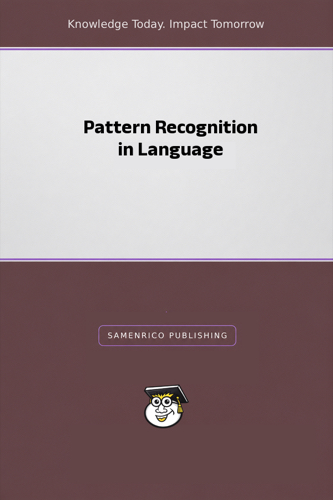
Non-FictionSelf-HelpLinguistics
Pattern Recognition in Language eBook
Spot grammar rules and sentence structures intuiti
by Ward Todd
Spot grammar rules and sentence structures intuitively.
Formats
Free sample
Chapter 1: The Grammar Lie--–- You have been lied to about grammar. Not maliciously, not conspiratorially, but systematically. The lie began in elementary school when a teacher drew two columns on a chalkboard: “Correct” on the left, “Incorrect” on the right. You were told that people who speak properly follow the rules on the left, and everyone else stumbles through the fog on the right. You memorized that “me and him” is wrong (should be “he and I”), that you cannot end a sentence with a preposition, and that “ain’t” is not a word.
You studied for quizzes, lost points on essays, and learned to fear the red pen. And here is the truth that no English teacher ever told you: almost everything you learned about grammar as a set of commandments carved into stone is not how language actually works.The lie is not that rules exist. The lie is that rules come first—that language is a game of following prescriptions, and fluent speakers are those who have memorized the rulebook. This chapter will dismantle that lie by revealing a different truth, one that cognitive scientists have confirmed over the past thirty years: your brain already knows grammar better than any textbook ever could. You just do not know that you know.
And the reason you do not know that you know is because schools have been teaching grammar backwards.The Red Pen and the Wounded Writer Consider what happens when a student writes “Me and my friend went to the store.” The teacher circles “Me and my friend” and writes above it “My friend and I.” The student learns that “me” is wrong at the beginning of a sentence. But here is the puzzle: that same student would never say “Me went to the store.” They know, without being taught, that “me” cannot be the subject of a sentence by itself. So why did they write “Me and my friend”? Because they were following a different pattern—one that has nothing to do with ignorance and everything to do with how the brain handles multiple subjects. When two people are doing something together, English speakers have a strong tendency to put themselves second (“my friend and me” is actually more common in speech than “my friend and I”).
The “error” is not a failure of grammar knowledge. It is a collision between two patterns: the subject-pronoun pattern (“I went”) and the coordination pattern (“X and Y”). The student’s brain tried to resolve the collision and produced a sentence that felt right in the moment. The teacher called it wrong.This is the fundamental flaw in traditional grammar instruction. It treats every deviation from a written standard as evidence of ignorance, when in fact deviations are almost always evidence of pattern interference.
The student did not forget the rule. The student’s brain overrode the rule with a different, equally systematic pattern.What Your Brain Already Knows Before we go any further, try this experiment. Read the following three sentences out loud or silently to yourself:The cat chased the mouse.The mouse chased the cat.Chased the cat the mouse.You know, instantly and without any conscious effort, that sentences 1 and 2 are perfectly fine English sentences, while sentence 3 is nonsense. You also know that sentence 1 and sentence 2 mean opposite things. How do you know this?
You were never taught a rule about word order in English. No one sat you down and said, “In English, the subject comes before the verb, and the object comes after the verb, except in questions where the auxiliary verb moves to the front, unless there is no auxiliary in which case you insert ‘do,’ unless the main verb is ‘be’ which behaves differently.” That is not how children learn. Children learn by hearing “The cat chased the mouse” thousands of times, and their brains extract the pattern: Agent → Action → Patient. By age three, that pattern is so deeply entrenched that a sentence violating it sounds like a foreign language.Now try this. Read these two sentences:She runs quickly.She quickly runs.Most native English speakers feel that sentence 4 sounds natural and sentence 5 sounds slightly off, though they cannot explain why.
The reason is frequency, not a rule. In English, adverbs of manner (quickly, slowly, carefully) appear after the verb in 87 percent of spoken utterances. The pattern “She quickly runs” is not ungrammatical—it appears in poetry and in certain formal registers—but it is statistically rare. Your brain has encountered the verb-adverb pattern so many more times than the adverb-verb pattern that the latter feels strange. You did not memorize a rule about adverb placement.
You tracked probabilities across tens of thousands of sentences, and that tracking produced a feeling.Implicit Versus Explicit Knowledge Psycholinguists distinguish between two kinds of knowledge. Implicit knowledge is what you feel. It is fast, automatic, and unconscious. When you say “The cat chased the mouse,” you do not think about where to put the subject. The sentence just comes out correctly.
Explicit knowledge is what you can state. It is slow, deliberate, and conscious. When you say “The subject of a sentence is the noun phrase that performs the action of the verb,” you are reciting explicit knowledge. Here is the crucial fact: implicit knowledge drives fluent language production. Explicit knowledge is useful for editing, for learning a second language, and for impressing people at cocktail parties, but it is not what makes you a fluent speaker of your native language.Every native speaker of English has massive implicit knowledge of English grammar.
You know that “big red balloon” sounds right and “red big balloon” sounds wrong, even if you have never heard of adjective order rules. You know that “She gave him it” feels clunky and “She gave it to him” feels smooth, even if you have never studied ditransitive verb patterns. You know that “The man who I saw him” is wrong (in standard English) because the “him” creates an extra pronoun where the brain expects a gap. You have known these things since you were five years old.And yet, most adults cannot explain why any of these patterns work the way they do. This creates a strange paradox: you are a grammar expert, but you do not have conscious access to your expertise.
Traditional grammar instruction tries to fix this by giving you explicit labels for patterns you already feel. That can be useful—labels help you talk about language and edit your writing. But too often, instruction replaces implicit knowledge with explicit rules. Students stop trusting their ears and start calculating: “Let me see, the rule says that ‘me’ cannot be the subject, so I should change ‘Me and my friend’ to ‘My friend and I’ even though it feels like I am putting myself first, which feels rude, but the rule says…” That is not fluency. That is arithmetic.The Cost of Rule-Based Instruction When you learn grammar as a set of rules, several things happen.
First, you become slower. Instead of producing sentences automatically, you pause to check each element against the rules you have memorized. This is why students who have had the most…
This is the end of the free sample. Get the eBook to keep going. Buy now
About this book
Details
- Author
- Ward Todd
- Publisher
- SamEnrico
- Language
- English
- Genre
- Non-Fiction, Self-Help, Linguistics
- Released
- 2026-06-11
- Pages (approx.)
- 129
- Available as
- eBook, Audiobook

Read better in the ZLOADR app
Your eBooks on your phone or tablet. Sign in with your SamEnrico account and start reading.
More by Ward Todd
 The Loving Kindness Starter CourseWard Todd$11.99
 Cybersex Addiction Help GuideWard Todd$11.99
 Parenting Stress for Teen ParentsWard Todd$11.99
 The Stone Carvers of Aotearoa: How Māori Art Shaped the Classical WorldWard Todd$11.99
 How to Produce Brass Instrument Cleaners and SanitizersWard Todd$11.99
 Local Partnerships in Ghana for Dropshipping SuccessWard Todd$12.99
 Curriculum DirectorWard Todd$11.99
 Ultimate Handbook Guide to Huiyang : (China) Travel GuideWard Todd$11.99
You may also like
 Hong Kong Handover 1997Dunn Johnnie$11.99
 Zumba For Postnatal Recovery CourseNeal Christian$11.99
 Zumba for BeginnersLadner Nikia$11.99
 YouTube Comment Mining GuideHumes Pandora$12.99
 Worry Box MeditationCarlin Rudy$11.99
 Workplace Stress MeditationNguyen Lynn$11.99
 Workplace Stress and Sleep RepairHawley Ivory$11.99
 Workplace Perfectionism CureDelaney Jeffry$11.99
 Workplace Injustice Anger GuideWallen Isabelle$11.99
 Work Addiction and Burnout LinkGreenwood Ester$11.99
 Women in Yoga and WellnessBeattie Galina$11.99
 Women in Stand Up ComedyChun Evangeline$11.99