
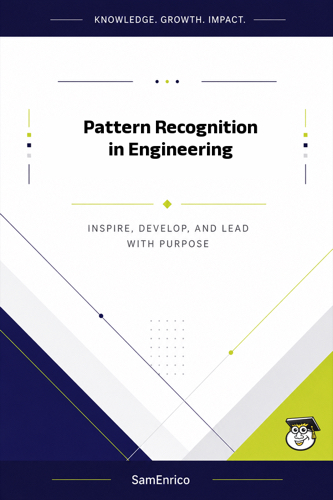
Pattern Recognition in Engineering Audiobook
undefined
undefined
Formats
Free sample
Chapter 1: The Sensor’s Lie...--–- Every pattern recognition system ever built begins with a lie. Not a malicious lie, but a deception baked into the very physics of measurement. The sensor on your machine, your medical device, your autonomous vehicle—it does not output the truth. It outputs a voltage, a current, a digital number that has been filtered, averaged, scaled, and corrupted by noise before you ever see it. Most engineers spend their careers trying to ignore this lie.
The ones who build systems that actually work learn to embrace it.Welcome to pattern recognition in engineering. This is not a book about abstract mathematics or theoretical proofs. Those books already exist, and they fill the shelves of university libraries where they gather dust while real engineers struggle with real problems. This book is about the messy, beautiful, practical art of turning noisy sensor data into reliable decisions—decisions that control robots, diagnose diseases, find faults in rotating machinery, and keep factories running.If you are reading this, you have likely already tried to build a pattern recognition system. Perhaps you collected thousands of samples, trained a classifier, achieved 95% accuracy on your test set, and then watched it fail catastrophically when you deployed it in the field.
Perhaps you spent weeks tuning hyperparameters, only to discover that your carefully crafted model could not distinguish a failing bearing from a passing truck. Perhaps you are starting fresh, determined to avoid the mistakes that cost your last project six months and a promotion.This chapter will save you from all of that. Not by giving you a magic algorithm—the No Free Lunch theorem we will explore shortly guarantees that no such algorithm exists—but by giving you a framework. A way of thinking about pattern recognition that starts not with equations but with the physical world. A design cycle that forces you to ask the right questions before you write a single line of code.Let us begin with a story.The $10 Million Threshold Several years ago, a team of brilliant engineers at a large manufacturing plant was tasked with building an automated quality control system.
Their production line stamped out metal parts at a rate of one per second. The problem was simple: some parts had microscopic cracks that would cause field failures after a few thousand cycles. The cost of a field failure was enormous—recalls, lawsuits…
This is the end of the free sample. Get the Audiobook to keep going. Buy now
About this book
Details
- Author
- Williford Tilda
- Publisher
- SamEnrico
- Language
- English
- Genre
- Non-Fiction, Self-Help / Engineering
- Released
- 2026-06-07
- Pages (approx.)
- 149
- Available as
- eBook, Audiobook

Listen in the VoxFlicks app
Audiobooks and audio dramas wherever you go. Sign in with your SamEnrico account and press play.
More by Williford Tilda
 Imposter Syndrome for Social WorkersWilliford Tilda$11.99Imposter Syndrome for Social WorkersWilliford Tilda$11.99
 The Gacy Victim MemorialWilliford Tilda$11.99
 Occupational Therapy Poverty AdaptationWilliford Tilda$11.99
 Belgian Diamond Heist AftermathWilliford Tilda$11.99
 Nicotine Patch To FreedomWilliford Tilda$11.99
 Chronotype and Study TimingWilliford Tilda$11.99
 Mobutu Sese SekoWilliford Tilda$11.99
 RLS Trigger Avoidance GuideWilliford Tilda$11.99RLS Trigger Avoidance GuideWilliford Tilda$11.99
 The Secret Affair of the Royal Society: Love, Rivalry, and the Birth of Modern ScienceWilliford Tilda$11.99
 The Quantum Leap That Changed EverythingWilliford Tilda$11.99